MacPaw’s Moonlock offers a full suite of Mac security tools in a slick, simple package
In an era where digital threats are becoming increasingly prevalent, MacPaw’s new software, Moonlock, aims to simplify computer security for Mac users. Designed as a standalone application that branches off from the company’s renowned CleanMyMac suite, Moonlock combines essential security features such as real-time malware protection and a built-in VPN with a user-friendly interface. This balance seeks to alleviate the often cumbersome task of maintaining computer security while instilling confidence in users about their online safety. The software is designed to be intuitive, allowing users to navigate through security processes without feeling overwhelmed, making it an appealing option for those who may not be tech-savvy.
Moonlock’s key features include a guided setup process that quickly scans the system for threats and provides recommendations for enhancing built-in security settings. Users can opt for automatic protection that runs continuously in the background or schedule regular scans, with options for quick, balanced, or deep scans. The built-in VPN is particularly beneficial for those who frequently connect to public Wi-Fi networks, offering a layer of security that protects against potential threats. Although some users may experience a slight slowdown in internet speed while using the VPN, the trade-off is often worth it for the added security. With a free seven-day trial available, users can explore Moonlock’s capabilities before committing to a subscription, which costs $54 per year.
Despite the relatively low prevalence of malware on Macs compared to PCs, the threat landscape is evolving, making tools like Moonlock increasingly relevant. As malware incidents rise, having a reliable security solution can provide peace of mind, ensuring that users are protected against potential risks such as adware, ransomware, and cryptominers. Moonlock’s transparent data policies and regular updates further enhance its appeal, making it a solid choice for those looking for an effective yet straightforward security application. Whether you are a seasoned Mac user or new to the platform, Moonlock offers a comprehensive suite of security tools that can help safeguard your digital life without the hassle typically associated with security software.
Thinking about computer security isn’t fun. You spend time and money on software just to keep your computer running as it was meant to in the first place. This inconvenient fact makes app design a crucial consideration: you want something easy enough to use that it doesn’t feel like a chore, but comprehensive and serious enough to instill the confidence and sense of safety you were seeking in the first place. That’s the balance MacPaw’s new
Moonlock
software aims to achieve. It combines the company’s proven security features (including a built-in VPN and real-time malware protection) with a polished graphical interface that guides users through the security process.
Try it:
Get a 7-day free trial of Moonlock
Moonlock by MacPaw
For security changes it can’t make on its own, Moonlock offers a comprehensive guide on how to manually adjust.
MacPaw
See It
What is it?
MacPaw is best known for its all-in-one Apple maintenance suite,
CleanMyMac
. Moonlock spins off CleanMyMac’s dedicated security features into a standalone app that’s cheaper and lighter than the full suite. For readers new to private connections, our PopSci explainers on
how a VPN works
and
how to use a VPN
are a good primer before diving in.
Moonlock’s headliners are its VPN and real-time malware protection. Beyond that, it can restrict data from flowing to specific countries, walk you through a guided audit of your Mac’s built-in defenses, and encourage better security habits overall. If you’ve ever used mainstream antivirus on a PC, Moonlock provides a similar safety net for Mac users.
Pros
Extremely easy to use
Fast scans, even on large drives
Doesn’t slow down the computer when running
VPN is easy to configure and effective
Complies with major agencies and standards
Regularly updates threat databases with help from other trustworthy organizations
Transparent data policies
Guided setup process is quick and addresses built-in security settings
Cons
Mac malware is growing, but still isn’t that widespread
VPN may slow internet speeds on some connections
VPN may take longer to connect than others on some networks
Interface may seem a little too casual for some users
Setup and installation
The setup screens are very slick and polished. MacPaw
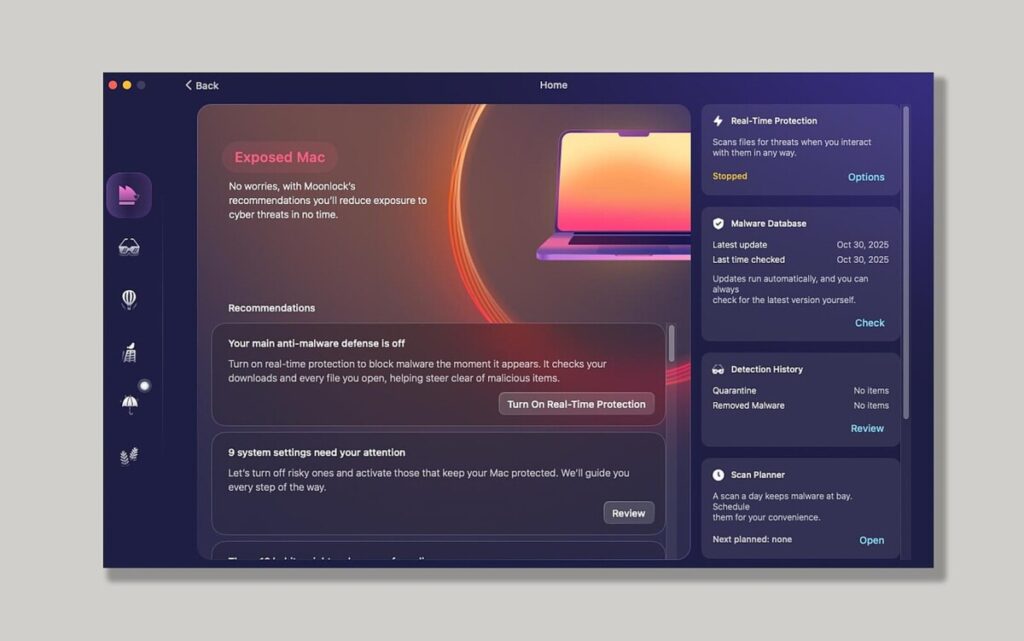
MacPaw aims for simplicity and largely nails it from the start. A quick download and install lead into a guided setup: an initial scan and enabling automatic protections, both of which took me under ten minutes. It scanned my built-in 2TB drive and found no threats, which is always reassuring.
After the scan, Moonlock walks you through macOS’s built-in security features—useful if you haven’t recently reviewed Apple’s own guidance on
protecting your Mac from malware
or the newer
Rapid Security Responses
. In my case, it recommended nine changes; I applied six immediately, and left three minor ones because they conflicted with software I knowingly use.
Using Moonlock on a regular basis
The graphic styling is friendly, but feels a bit dated sometimes. MacPaw
Once installed, automatic protection can run continuously in the background, scanning each file as you interact with it. If you’d rather not keep it always-on, you can schedule periodic scans instead. There are three depths—quick, balanced, and deep—and even the deep scan only took a few minutes to churn through my 2TB of files. If you ever do get into cleanup mode, our guides to
removing malware from your computer
and giving your system a digital spring-clean pair nicely with Moonlock’s tools.
The Moonlock VPN
Moonlock’s VPN shines on unfamiliar networks. I used it at a coffee shop, a train station, and even a sketchy laundromat Wi-Fi, and it connected quickly when I let it pick the optimal location. Manually choosing a location added some variability; a few times I needed multiple attempts to connect, but the hiccups resolved quickly. For benchmarking, I use the straightforward Fast.com test: my home connection averages ~500 Mbps, which dropped to ~200 Mbps with the VPN enabled—about what I see with other services. On slower public networks, the hit wasn’t as noticeable, and the convenience outweighed the speed trade-off.
Do you really need malware protection if you’re using a Mac?
This is the alert you want to see when the scan is over. MacPaw
In roughly 15 years since moving from Windows, I’ve cycled through several Mac antivirus tools. Mac malware remains less common than on PCs, but it does exist and appears to be trending upward. Moonlock cites growing threats over the last half-decade; outside research (e.g., ThreatDown’s annual
State of Malware report
) points in the same direction. If you avoid risky browsing and sketchy downloads, your baseline risk is relatively low—but the penalties for a mistake can be severe, ranging from adware and ransomware to clandestine cryptominers. For broader account safety, we also recommend tightening settings using our guide to
securing your Apple and iCloud accounts
.
Cost and availability
You can find some more advanced settings if you dig into the menus. MacPaw
There’s a
free seven-day trial
to see if Moonlock fits your workflow; after that,
it runs $54 per year
. I’m not generally a fan of subscriptions, but security software is one category where ongoing updates—to both the app and its threat databases—justify the model. You can learn more or download it directly from
Moonlock by MacPaw
.
Verdict
While malware may not top most Mac users’ to-do lists, peace of mind is valuable. Even if Moonlock never flags a threat, you get the reassurance of active protection plus thoughtful touches like the guided macOS audit and built-in VPN. For anyone who wants a simple, set-and-forget solution without spelunking through endless menus, Moonlock is an appealing choice.
The post
MacPaw’s Moonlock offers a full suite of Mac security tools in a slick, simple package
appeared first on
Popular Science
.


