The world’s largest plane will transport wind turbines blades and fighter jets
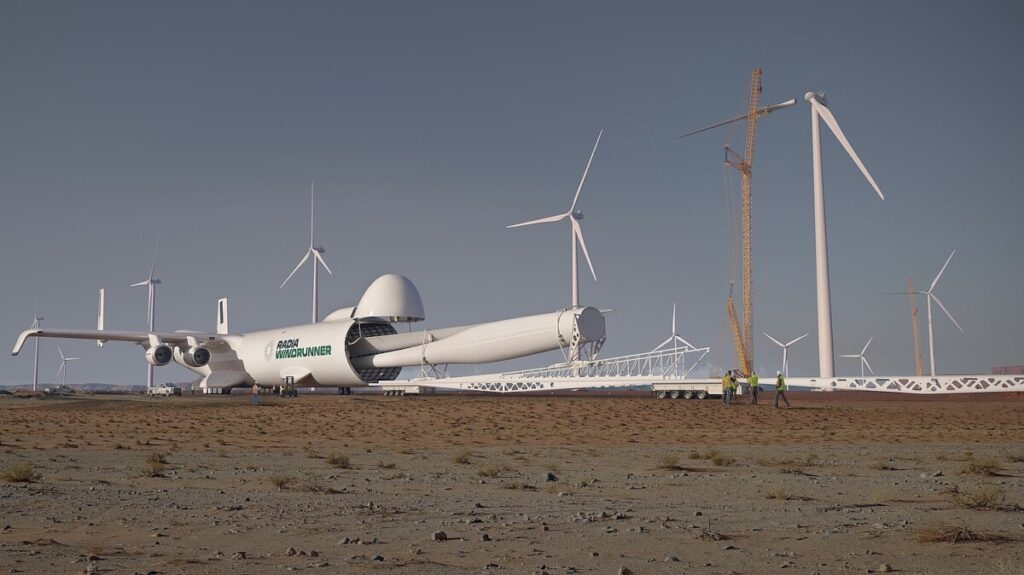
A Boulder, Colorado-based company named Radia is ambitiously working on creating the world’s largest airplane, aptly named the WindRunner. This colossal aircraft will measure 108 meters in length—about the size of an NFL football field—and boast a wingspan of over 260 feet, providing an impressive 12 times the cargo space of the Boeing C-17 Globemaster III. Designed primarily for transporting long and cumbersome wind turbine blades, the WindRunner aims to facilitate the growth of wind energy projects, particularly in rural and developing regions where infrastructure for transporting such large components is severely lacking. Radia’s CEO, Mark Lundstrom, envisions the aircraft as a solution for efficiently moving oversized cargo to hard-to-reach locations, aligning with the company’s mission to reduce global CO2 emissions.
The WindRunner’s design emphasizes maximizing internal volume over weight, allowing it to transport single turbine blades exceeding 300 feet in length. With a payload capacity of about 160,000 pounds and a range of approximately 1,200 miles, the aircraft is intended to revolutionize the logistics of wind energy. However, the project faces challenges, including fluctuating political support for renewable energy initiatives and potential tariffs that could impact the cost of materials. As the Biden administration has promoted wind energy through tax incentives, the changing political landscape under the Trump administration may hinder the economic viability of such projects. Furthermore, Radia is exploring alternative applications for the WindRunner, including potential contracts with the U.S. Department of Defense for transporting military equipment, indicating a pivot in focus as the company navigates these uncertainties.
Despite its promise, the WindRunner has sparked skepticism regarding its environmental impact, given that large aircraft inherently consume significant amounts of fuel. Critics argue that the emissions generated during transportation could offset the benefits of increased wind energy production. However, Radia counters this concern by stating that transportation contributes only a small fraction of a wind farm’s overall carbon footprint. They assert that the WindRunner could ultimately lead to a net positive impact on emissions by enabling the construction of larger, more efficient turbines. As Radia continues to develop the WindRunner, it remains to be seen whether this ambitious project will reshape the logistics of renewable energy and military transportation in the years to come.
A little-known company based in Boulder, Colorado, is pursuing an ambitious, borderline outlandish goal: creating the world’s largest airplane. When completed, the incredibly long 108-meter plane (roughly the length of an NFL football field) is expected to have a wingspan of over 260 feet and could offer
12 times the cargo space
of
Boeing C-17 Globemaster III
. It would also be roughly 1.5 times the size of the
largest commercial airplane
currently in operation.
But you won’t find any
cramped airplane seats
or
flight attendants carts
within that space. In fact, you probably won’t see any humans in the “cabin” at all. Instead, all of that open space was initially designed for a single primary purpose: transporting lengthy, cumbersome wind turbine blades. Radia, the company building this “WindRunner,” is betting that its gas‑guzzling behemoth will drive an uptick in large wind-power projects, both in the U.S. and abroad, especially in rural, developing countries where the infrastructure needed to move turbine blades is limited or nonexistent.
Radia CEO Mark Lundstrom told
Popular Science
that he views his company’s behemoth as “a platform to move the world’s biggest things to the hardest-to-reach locations.”
“Our main goal when we started Radia was to take 10% of the CO2 out of the world,” Radia writes on its website. This remains our intent. The product we have been designing happens to also be spot-on to fill the under-investment in strategic airlift.”
Radia, which has received funding from a number of investors
including Caruso Ventures
and
ConocoPhillips
, started work on the project in 2017 and is projecting its first flight in 2029. While that date is fast approaching, external forces may create new turbulent obstacles for the world’s largest airplane. Shifting political priorities in the U.S. and elsewhere could make the once enticing economic allure of supplying wind energy less appealing. Steep tariffs on everything from the steel used to build turbine blades to the
critical minerals powering them
add yet another layer of complication for wind turbine manufacturers. And if recent announcements are any guide, the plane’s more immediate money maker may come from a different albeit more controversial source: transporting tanks and planes.
What a WindRunner parked in a hangar could look like.
Image: Courtesy of Radia
Why making massive onshore wind turbines is so tricky
Wind, like other renewable energy sources, has
seen massive growth in recent years
. An
analysis
by the nonprofit group Climate Central estimates that overall wind energy capacity in the U.S. alone doubled between 2014 and 2023. By the end of 2023, wind accounted for roughly 10 percent of all energy produced in the U.S. Globally, the International Energy Agency
estimates
that wind will make up 14 percent of all generated energy, with roughly two-thirds of that coming from China.
But transporting the materials needed to build those turbines isn’t straightforward. Ideally, when constructing a wind turbine, the optimal strategy would be to design it with tremendously long blades. Longer blades can catch more wind, which means
more energy generated from a single turbine
. This is largely the current approach for offshore wind farms, where single blades can
span upwards of 230 feet
.
That approach becomes much trickier when building onshore turbines, which accounts for the
overwhelming majority
(around 93 percent) of wind energy generated. The massive blades required for larger installations, which Radia refers to as “GigaWind” projects, are simply too big to transport over typical roads and bridges. Interstate highway clearances, which are around 16 feet, aren’t tall enough to allow a large turbine blade to pass through.
Can the world’s largest airplane actually make wind energy greener?
Image: Courtesy of Radia
Add in various physical obstacles, like overhead power lines and street signs, and the process becomes even more dicey—and expensive. All that constant back-and-forth transporting of blade components on commercial trucks and cargo ships also consumes considerable amounts of gasoline, which is potentially counterproductive if the ultimate goal is to reduce fossil fuel emissions.
“If you could put an offshore size turbine on shore, you can triple the capacity,” Lundstrom said. “You can reduce the cost of the electron by a third.”
That’s where the WindRunner comes in. The plane’s 344-foot payload length and 261-foot wingspan contribute to a total payload volume of about 270,000 cubic feet. That means it can safely transport a single blade over 300 feet long, or possibly several smaller ones. (For a sense of scale, it could
reportedly
hold the equivalent of three Olympic-sized swimming pools.) Despite its absurd size, the WindRunner is actually relatively light. That’s due to the company’s decision to optimize internal space over weight. Once fully loaded, it would carry a payload of about 160,000 pounds, which is slightly less than the much smaller Boeing C-17. Radia claims the aircraft will have a range of roughly 1,200 miles (about the
distance from New York City to Miami
) and can cruise at Mach 0.6, or about 396–400 mph, depending on environmental conditions.
“I think this is the first time that an aircraft has ever been designed to optimize volume versus mass,” Lundstrom added.
But besides maximizing volume, Radia didn’t necessarily want to reinvent the wheel when it came to airplane design. In fact, Lundstrom says they approached the design with a philosophy of “do nothing new.” That means no new engines, or avionic flight controls. Though it might look quite different from other planes visually, the CEO says WindRunner was intentionally designed around parts and technologies in aircraft already flying today. In addition to making things simpler, that tactic cuts down on production costs and lengthy timelines.
“The novelty here is probably not necessarily designing something new, but the novelty perhaps is designing an airplane around the supply chain of stuff that already exists,” Lundstrom said.
Despite all that size (the cockpit alone is
about the size of a Gulfstream private jet
) the WindRunner is being built to have some flexibility in terms of where it can land. It can land at local airports when available, but more often the more sensible option will be to arrive in “semi-prepared” fields near turbine factories. To do that, the WindRunner will have massive rugged tires. It’s also being designed in a way that keeps the engine high off the ground to prevent it from sucking up any dirt or debris that might pop up during landing. That ability to land away from airports could be particularly useful when serving newer power plants constructed in remote areas with limited infrastructure.
Related:
[Why bigger planes mean cramped quarters
]
Still, relatively light or not, actually flying a football-field-sized aircraft requires jet fuel– and lots of it. Though Radia hasn’t specified exactly how much fuel the WindRunner will use, the world’s next largest plane, the
recently destroyed
Ukrainian Antonov An-225 Myrida,
reportedly burned through
more than 50 liters of jet fuel per hour. The fact that something intended to cut back on emissions is itself creating them, of course, can seem like a contradiction. That’s a point not lost amongst a handful of skeptics
online
and on
social media
.
“All that jet fuel wasted for something that may never generate more energy than it takes to create,” one critical Reddit user wrote.
Defending its approach, Radia
argues
that transportation—which the EPA
estimates
accounts for about 29 percent of total U.S. greenhouse gas emissions—is a “negligible contributor to the carbon footprint” once large onshore GigaWind turbines are factored in. The company says that transporting components to and from wind farms currently represents only about 7 percent of a wind farm’s total carbon footprint, with the vast majority of emissions coming from manufacturing.
Radia hopes that future GigaWind turbines, made possible in part by the WindRunner, will generate enough additional clean energy to “mitigate” the emissions impacts from both transportation and manufacturing. The ends, in other words, justify the means. Eventually, Radia says it plans to operate the aircraft on 100%
sustainable aviation fuel
(SAF), which would theoretically further reduce its carbon footprint.
“Larger turbines equate to a substantial reduction in the wind farm’s CO2e emissions footprint,” Radia writes on its website. “And over time, the initial negative impact is balanced and will indeed become net positive.”
Related: [
All your burning questions about sustainable aviation fuel, answered
]
How shifting policy preferences could chart WindRunner’s course
Years into development, Radia now faces another challenge: the Trump administration. A substantial portion of the recent growth in the renewable energy sector was
catalyzed by tax incentives and infrastructure legislation
enacted during Joe Biden’s presidency. President Trump is now
making good on his promise to reverse course
. Earlier this year, he signed
multiple
executive orders
aimed at curbing “
preferential treatment
” for wind power expansion. At the same time, his administration has declared a national energy emergency and called for increased domestic energy production—
particularly from fossil fuel sources
.
When asked about the challenges presented by shifting presidential policies, Lundstrom told
Popular Science
he believes their vision for larger, efficient turbines may align with where the administration wants to go in terms of simply creating large base loads of energy. He also expects the current unpredictability to “stabilize” by the time the WindRunner is up and flying. Lundstrom also said he sees an opportunity for additional wind power to help meet the
soaring energy needs associated with new, power-hungry AI data centers
.
Trump, who regularly refers to turbines as “windmills,” has called them “
the worst form of energy
.”
Uncertainty surrounding on-again, off-again tariff policies may also play a significant role in the WindRunner’s development costs and timeline. Though difficult to quantify given their volatility, a report from the research and consulting firm Wood Mackenzie
estimates
various tariffs proposed earlier this year against Canada, Mexico, and China could increase U.S. onshore wind turbine costs by about 7 percent. While that might sound like a relatively modest impact, it could lead to major shifts in decision-making among wind turbine operators, Radia’s target clients, when considering expanded development. When asked about the tariff issue, Lundstrom said it’s less of an issue for them compared to turbine manufacturers.
A shift toward defense
It might not be entirely surprising, given all that uncertainty, that Radia is more heavily exploring a range of other, non-wind-related use cases for the WindRunner. In May, the company
announced a research agreement
with the U.S. Department of Defense to “assess the utility” of the WindRunner in supporting the Pentagon’s logistics and transportation needs. As part of that agreement, the agency will evaluate whether the world’s largest plane could be a good fit for transporting space launch materials and oversized vehicles.
Rendering of a WindRunner loading F-16s.
Image: Courtesy of Radia
Radia doubled down on the defense angle last month by announcing
WindRunner for Defense
. The company argues that its massive aircraft could be especially valuable for military units seeking to transport entire helicopters, fighter jets, and other vehicles in one piece, without the need for disassembly and reassembly between locations.
It’s worth noting that this same general use case–transporting heavy military equipment–was also the primary mission of the previous aircraft to hold the title of world’s largest plane. That was, at least before it was destroyed by Russian military forces invading Ukraine. Radia, and its prospective wind plants hoping to use its plane for transport, will likely want to try and avoid a similar fate.
The post
The world’s largest plane will transport wind turbines blades and fighter jets
appeared first on
Popular Science
.


