The military’s diversity rises out of recruitment targets, not any ‘woke’ goals
In a recent address at Marine Corps Base Quantico, Secretary of Defense Pete Hegseth and former President Donald Trump rallied hundreds of military leaders around a controversial theme: the alleged dangers of diversity within the U.S. military. This high-profile gathering, held in late September 2025, sparked widespread speculation among journalists about its purpose, with many expecting discussions on pressing national security issues. Instead, Hegseth and Trump launched into vehement critiques of what they termed the military’s “woke” culture, claiming that the Department of Defense had been infiltrated by “toxic political garbage” and a misguided belief that “our diversity is our strength.” Hegseth went so far as to call for an end to diversity initiatives, stating, “No more identity months, DEI offices, dudes in dresses,” while Trump echoed similar sentiments, advocating for a military that prioritizes traditional values over political correctness.
However, this perspective fails to recognize the historical context and necessity of diversity in the military. Since the establishment of the all-volunteer force in 1973, the demographic makeup of the military has evolved significantly, with increasing representation of Black Americans, Latinos, and women. Studies have shown that Black Americans have been overrepresented in the military since the inception of the all-volunteer force, and by 2022, Latino service members made up 25% of new enlistees. Women’s participation has also grown, from just 3% in 1973 to 17% in 2022. This shift is not a product of “woke” politics but rather a response to the military’s need to attract a diverse pool of recruits to meet its personnel goals, especially during challenging recruitment periods.
Critics argue that Hegseth and Trump’s framing of military diversity as a symptom of a broader societal issue is fundamentally flawed. The military’s embrace of diversity is rooted in practical necessity rather than ideological shifts. As the military sought to fill its ranks, it recognized that young Americans from diverse backgrounds were more likely to enlist due to limited opportunities in the civilian workforce. This reality underscores the importance of diversity in maintaining an effective and capable military force. Furthermore, the focus on outward appearances, as emphasized by Hegseth’s comments about the “bad look” of the military, detracts from the essential contributions of individuals who serve, regardless of their background. By perpetuating the narrative that military diversity is a byproduct of liberal policies rather than a strategic necessity, Hegseth and Trump overlook the vital role that diversity plays in the military’s success and survival.
https://www.youtube.com/watch?v=EvOCY9hMMCc
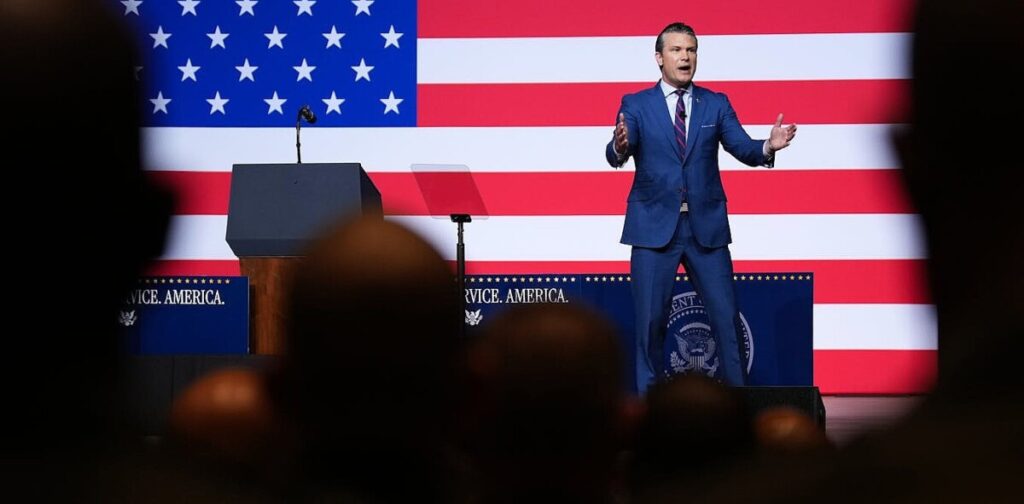
Secretary of Defense Pete Hegseth speaks to senior military leaders in Quantico, Va., on Sept. 30, 2025.
Andrew Harnik/Pool via AP
Secretary of Defense Pete Hegseth and President Donald Trump
addressed hundreds of military leaders
at Marine Corps Base Quantico in Virginia in late September 2025.
Before the meeting, journalists speculated about which urgent issues might require such a
costly and unusual gathering
, to which the assembled military leaders had been summoned from across the globe.
Rather than a major shift in national security strategy,
a loyalty oath or mass firing
, Hegseth and Trump railed against what they see as the military’s primary enemy: diversity.
Hegseth claimed the Department of Defense became “
the woke department
” infected by “toxic political garbage” and the “
insane fallacy that ‘our diversity is our strength
.’”
Trump argued that the military “went, in a way, woke” and called for armed forces that would “
not be politically correct
.” Hegseth similarly called for
a shift in military thinking about diversity
saying, “No more identity months, DEI offices, dudes in dresses. … As I’ve said before and will say again, we are done with that shit.”
Having spent
years studying the U.S. military
and writing a
book on diversity and military recruiting
, the speeches made clear to me that Hegseth and Trump fundamentally misunderstand military diversity. Both men see it as a symptom of “woke” culture rather than as a long-standing practice driven by the very nature and
history of the all-volunteer force
.
Embracing diversity
During times of war and between 1948 and 1973, the U.S. military drafted enlistees to fill the ranks. After years of debate, the draft was ended and the U.S.
established an all-volunteer force in 1973
.
The
demographic makeup of the military quickly changed
as more Black Americans and women chose to join the military. In a
2007 study of representation in the military
, scholars found that Black Americans had been overrepresented in the military for much of the span of the all-volunteer force. And the percentage of Latino service members more than doubled from the late 1980s to the 2000s.
Additionally, Latino service members made up
25% of new enlistees in 2022
.
While women remain underrepresented in the military compared with the U.S. population, the shift to the all-volunteer force led to a steady increase in
women’s military participation
. Women made up 3% of military personnel in 1973 and
17% in 2022
.
The military
would not have been able to meet personnel needs
and
recruitment goals
without the disproportionate representation of women, Black Americans, and Latino service members during this post-draft period.
The U.S. military embraced this diversity long before the influence of “woke” politics and diversity, equity and inclusion initiatives that
Hegseth and Trump claim have undermined the institution
.
That embracement has helped the military
enlist between 128,000 and 190,000 new service members
annually since the 1990s, even though some armed forces, especially the Army, have struggled to meet their
recruiting goals in the past few years
.
Men who have signed up to join the U.S. Marines wait to do qualifying pull-ups in New York City on Nov. 16, 2025.
Robert Nickelsberg/Getty Images
Expanding the scope
To fully understand how the military became one of the most diverse American institutions, you need to go back to the foundations of the all-volunteer force.
The primary challenge the military faced in the implementation of the all-volunteer force was how to persuade young Americans to enlist. Large
budgets were set aside for advertising
, and military branches worked with advertisers to reach potential recruits.
One of the first steps advertisers took in the mid-1970s was to identify “
vulnerable target groups
.” These groups were targeted based on propensity – the likelihood that an individual would serve regardless of their desire to do so.
The
likelihood of service increased
when people felt they had little opportunity outside of the military – whether that meant financial struggles or an inability to afford higher education.
Based on ideas of recruit quality and the traits the military sees as best suited to success in the ranks, the
military has mostly desired to recruit straight and white young men
. But these people were more likely to have opportunities outside of the military. So, military leaders had to
expand the scope of potential recruits
to reach out to groups previously excluded – namely, Black Americans, other people of color and women.
When Hegseth talks about “
fixing decades of decay
” in a department gone “
woke
,” and when Trump argues that the military will now be “
all based on merit
,” they both fail to understand military diversity.
The military didn’t become diverse because it went “woke” or abandoned a merit-based system of promotions.
Military diversity resulted from the exploitative nature of military recruiting. In the all-volunteer force, the most easily persuaded recruits are those in most need of opportunities they can’t find in the civilian world. The very logic behind an all-volunteer force means that the military can’t fill their ranks with white men alone.
A U.S. Army recruiter walks between outdoor posters at a mobile interactive recruiting exhibit on May 21, 2005, in Charlotte, N.C. The U.S. military has had to reach out to the public to communicate a more effective message and compete with other professions to attract potential soldiers.
Robert Nickelsberg/Getty Images
Central casting
Hegseth and Trump, additionally, have framed their criticism of the military with an obsessive focus on looks.
Hegseth criticized the “
bad look
” of the current military,
saying
“it’s tiring to look out at combat formations, or really any formations, and see fat troops.”
He also railed against
“an era of unprofessional appearance” indicated by “beards, long hair and superficial individual expression.”
Trump has consistently talked about wanting military leaders to look like they are out of “central casting”, a
phrase he uses
almost exclusively to talk about white men.
The firings of Admiral Lisa Franchetti, the
first woman to serve on the Joint Chiefs of Staff
, and General CQ Brown Jr., the
second Black Chair of the Joint Chiefs
, appear to reflect this vision of the military in practice.
When Trump and Hegseth attack military diversity, they harm individuals who made the choice to serve. They also perpetuate the myth that military diversity was enforced from outside the military by liberal “woke” politics rather than born of necessity for the military’s very survival.
Jeremiah Favara does not work for, consult, own shares in or receive funding from any company or organization that would benefit from this article, and has disclosed no relevant affiliations beyond their academic appointment.


