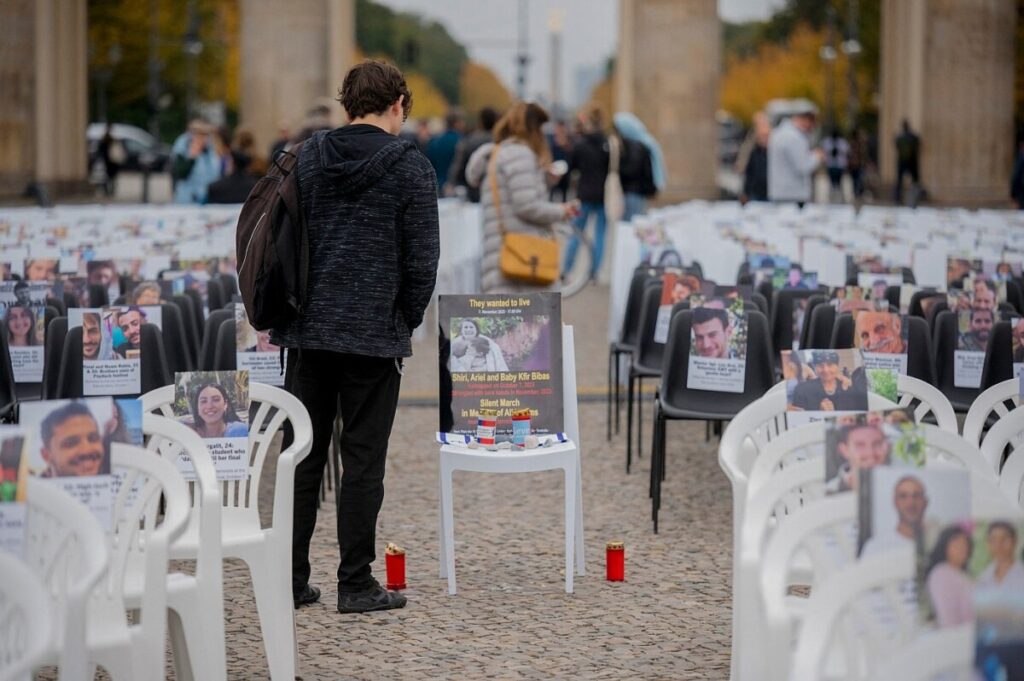
Gaskin: Where should memorials go for Oct. 7 & beyond
In the wake of the traumatic events that unfolded on October 7, 2023, a profound need for memorialization has emerged for Israel and the broader global community. Just as memorials like Hiroshima’s Peace Memorial and the Apartheid Museum serve as vital reflections on loss and resilience, the question of how to honor the victims of this recent tragedy looms large. The discussions surrounding potential memorials are complex and multifaceted, grappling with whether to focus solely on the events of that day, recognize the hostages taken, or reflect on the broader societal responses, including marches for peace and the increase in antisemitism. A critical aspect of these memorials will be how they embody shared values across faiths—Judaism, Christianity, and Islam—emphasizing the dignity of life and the importance of compassion.
The design and narrative choices for these memorials will shape the collective memory of this event. Rather than merely recording history, they will interpret it, influencing how future generations understand the conflict and its implications. For instance, a memorial honoring the hostages could serve as a testament to Israel’s commitment to its citizens and a space for collective mourning. Conversely, acknowledging the significant loss of Palestinian civilians in Gaza, many of whom were innocent victims of violence, raises the need for a memorial that recognizes their suffering as well. A potential solution could be the creation of “twin memorials,” distinct yet interconnected, allowing visitors to engage with both narratives side by side. This approach could foster understanding and coexistence, emphasizing that while the experiences of each group are unique, they are not mutually exclusive.
The selection of artists and the placement of these memorials will also play a crucial role in their reception and impact. Should they be entrusted to renowned figures with global recognition, or should local artists collaborate to model a message of unity? The choice of location—whether in Tel Aviv, Jerusalem, or even neutral grounds like Geneva—will carry symbolic weight, influencing how these memorials are perceived both locally and internationally. Ultimately, the creation of these memorials will not only honor the past but will also invite ongoing dialogue about grief, resilience, and the shared humanity that transcends borders and divides. As the world watches, the narrative shaped by these memorials will reflect not just the trauma of loss but the enduring hope for compassion and understanding in the face of adversity.
Every nation has moments of trauma so profound they demand stone, steel, or glass to remember them. Hiroshima’s Peace Memorial, the Oklahoma City bombing memorial, and South Africa’s Apartheid Museum stand as witnesses to loss and as frameworks for national reflection.
What happened on and after Oct. 7, 2023, will demand the same for Israel and the world: inevitably, there will be a memorial or exhibit. The questions are urgent and unresolved. Will it honor the hostages, or commemorate just Oct. 7? Will it be a solemn memorial or a dynamic exhibit? And will it tell of Israel and the world’s response: the marches in the streets, the democracy and peace movements, the rise in antisemitism, the protests on college campuses, the response from political and religious leaders?
A powerful question is how these memorials might reflect not just evil, but humanity at its best. They should draw upon the shared values of Judaism, Christianity, and Islam — faiths that each insist on the dignity of life and the command to pursue justice and compassion. They could honor the victims of violence and those who risked everything to help — the aid workers, medical professionals, humanitarian agencies, and journalists who bore witness.
By incorporating faith traditions and heroic service into the design, the memorials would elevate stories of courage alongside grief, reminding future generations that even in the darkest hours, people chose compassion over hatred.
Memorials are not neutral. They do not simply record history; they interpret it. The Vietnam Veterans Memorial in Washington, D.C., for example, emphasizes names and individual loss rather than victory or defeat, shaping how Americans remember that war. Similarly, Holocaust memorials across Europe are not only about remembering the murdered but also about acknowledging the responsibility of societies that allowed it to happen.
A memorial is more than design — it is about the narrative a nation chooses to tell, and the values it intends to pass on to future generations.
For the hostages taken on Oct. 7, the case for a central memorial in Israel is clear. It would affirm the state’s commitment to its citizens, serve as a place for families and survivors to grieve, and embody a collective refusal to forget. Because the hostage crisis captured international attention —through rallies, vigils, and yellow-ribbon campaigns — it may also warrant memorials beyond Israel. Cities like New York, Paris, or Berlin could house memorials that speak to the global conscience that was stirred.
Such memorials must tread carefully. They should focus on human suffering rather than political messaging, ensuring they do not become symbols of division but of solidarity.
The case for memorials to Palestinian civilians who died in Gaza is equally strong, though politically more fraught. Tens of thousands of people, many of them women and children, were killed in bombardments and blockades. Their lives deserve recognition.
Moreover, not only Palestinians died in Gaza. Humanitarians and journalists — American, European, and Asian — lost their lives trying to save others or bear witness to the conflict. Like the 9/11 Memorial, which lists American and non-American victims alike, a Gaza memorial should include the names of all those who perished, acknowledging the war’s global reach.
Should these memorials stand apart, or can they coexist? To build entirely separate memorials risks hardening division, each side remembering only its pain. Yet to combine them too hastily risks false equivalence, erasing the very real asymmetry of power and loss.
One possibility is a “twin memorial” concept: two distinct monuments, placed in sight of each other, connected by a shared walkway or garden. Visitors would have to encounter both griefs, moving from one story to the other. This juxtaposition could serve as a metaphor for coexistence: acknowledging that one person’s mourning cannot be used to deny another’s. It also provides the opportunity for dual narrative and understanding.
The choice of artist is not incidental. Should the work be entrusted to an internationally recognized figure — someone like Anish Kapoor, Maya Lin, or Ai Weiwei — whose name guarantees visibility? Or should it be given to Israeli and Palestinian artists working collaboratively, risking controversy but modeling coexistence? Or an open competition, as with the 9/11 Memorial, where design selection became a public process, allowing communities to have a say.
The question of voice is central: whose hands shape the design and whose imagination translates grief into form?
Placement itself carries symbolism. A memorial for hostages in Tel Aviv might affirm resilience, while one in Jerusalem could tie their story to national and religious identity. A space shared by many faiths over the last 2,000 years. A memorial for Gazans in Gaza itself would assert dignity on Palestinian soil; placing it in Ramallah or a diaspora capital could safeguard memory when the homeland is at risk.
Neutral ground — say, Geneva, home of the Red Cross, or at the United Nations headquarters in New York — might offer another model: international recognition that transcends the politics of the region.
Ed Gaskin is Executive Director of Greater Grove Hall Main Streets and founder of Sunday Celebrations


