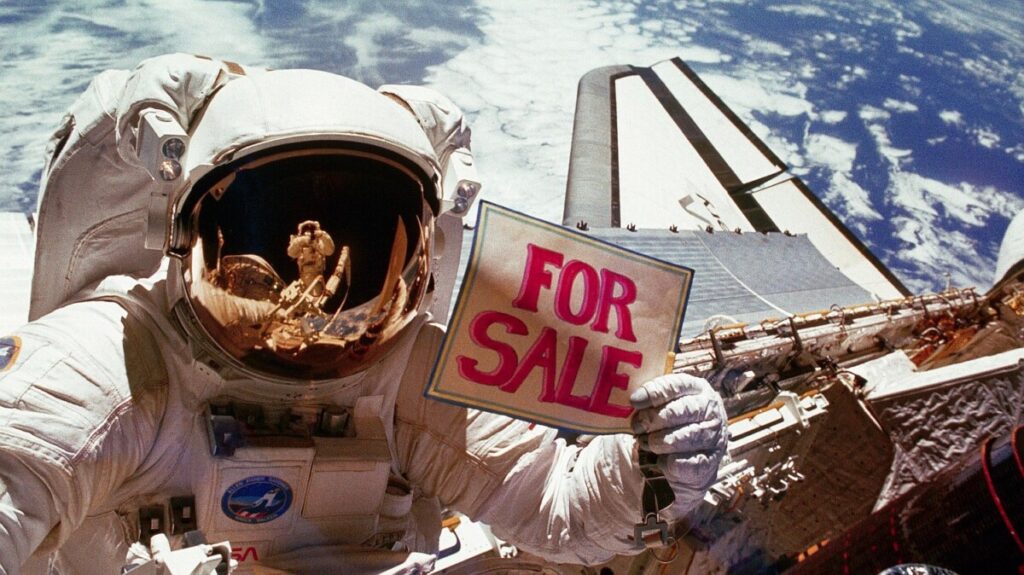
The space billboard that nearly happened
In 1993, aerospace entrepreneur Mike Lawson from Roswell, Georgia, introduced a groundbreaking yet controversial concept: space billboards. Lawson’s ambitious plan involved launching a massive mylar sheet into low Earth orbit, which would unfurl to create a reflective banner up to a mile long and a quarter mile tall. This “mega-banner” would catch sunlight and project a giant image—likely a company logo—visible from various points on Earth for about ten minutes each day. While NASA deemed the technical aspects of Lawson’s proposal feasible, the idea of commercializing the night sky sparked significant backlash. Critics, including renowned astronomer Carl Sagan, condemned the project as a threat to the purity of space and a source of light pollution that could hinder astronomical research.
Despite the initial excitement, public opposition grew, leading to a coalition of activists advocating against the commercialization of space. Lawson’s team attempted to pivot the narrative, suggesting that the billboard would serve environmental purposes, such as monitoring atmospheric ozone levels, while the advertising would help offset costs. However, the project faltered due to a combination of technical challenges and a lack of financial support, as potential advertisers reevaluated the reputational risks associated with such a venture. By 1994, Lawson’s dream of a space billboard had effectively collapsed, prompting lawmakers to take action. In 2000, a law was enacted banning “obtrusive space advertising,” ensuring that the night sky would remain free from commercial interference.
While Lawson’s project never materialized, the concept of space advertising has persisted, with new ventures like StartRocket aiming to revive the idea using modern technology. StartRocket proposed a constellation of small satellites that could create visual displays in the sky, although their plans faced skepticism and delays due to geopolitical tensions. As the debate over space commercialization continues, experts warn of the environmental and observational impacts of increasing space traffic and urge for responsible stewardship of this precious resource. The allure of profit from space advertising remains strong, suggesting that Lawson’s vision may one day resurface, albeit under stricter scrutiny and regulation.
https://www.youtube.com/watch?v=LrEJryI-3vQ
In 1993, Mike Lawson, an aerospace entrepreneur based in Roswell, Georgia, unveiled his vision for a brave new future of advertising: space billboards.
This wasn’t a half-baked scheme: Lawson had meticulous plans for a proposed 1996 launch: His team of engineers would shoot a package of tightly-wound mylar into orbit about 180 miles above the Earth. Once there, the material would unfurl into a thin, reflective sheet up to a mile long and a quarter mile tall, bordered by a series of mylar tubes which would inflate to create a rigid frame holding the mega-banner taut. The sheet would catch the sun’s rays, amplified by a series of small mirrors attached to the platform, and reflect them into the atmosphere. This would create a roughly moon-sized image in the sky of whatever single design the team printed on the banner. It would probably just be a big company logo, Lawson admitted, as the visual would be a little too low-res to read any ad copy without the aid of a telescope. But as it orbited the Earth, the image would reach every corner of the globe, about 10 minutes a day per location.
When the Associated Press, the first outlet
to report on the proposal
, ran Lawson’s plan past NASA, the agency said it didn’t see any technical flaws. “It’s very feasible,” Lawson
told
San Francisco Examiner
science reporter Keay Davidson
a couple days later. “We could fly [McDonald’s] Golden Arches in
space
.”
The history of space advertising
The general
concept of advertising in space
was already well established by 1993. Sci-fi authors like Isaac Asimov and Arthur C. Clarke sketched out visions of extraterrestrial ad campaigns in the 1950s. The entrepreneur
Robert Lorsch pitched Congress
on using corporate sponsorships on rockets and crew uniforms to facilitate NASA’s work in 1980. And in 1990, the Tokyo Broadcasting System
launched a reporter into space
on a Soviet rocket, festooned with ads from nine corporations, to promote the Japanese station’s service through nightly transmissions from the Soviet Mir Space Station.
Even before Lawson’s space billboard idea came about, his company,
Space Marketing Inc. (SMI), founded in 1989
, was already working on advertising campaigns with NASA and the Russian Federal Space Agency—including one
for Arnold Schwarzenegger’s
The Last Action Hero
, slated to launch (literally) in 1993.
Arnie’s flick
outbid
Jurassic Park
, paying SMI and NASA an estimated $500,000 (about $1.12 million in 2025 dollars) for the right to plaster ads on
a Conestoga
, the first privately-funded launch rocket model, and its boosters, and do a press event at the launch.
The Conestoga, shown here in a photo taken in Matagorda Island in Texas, was the first-ever privately-funded launch rocket model.
Image:
Eric Grabow – Space Vector Corporation
/ CC BY-SA 3.0
Some folks weren’t wild about the idea of commercializing the noble endeavor of space exploration. But in the twilight of the “greed is good” era of Reaganite privatization, the world seemed to accept a degree of space-based PR.
The public’s reaction to a space billboard
Still, Lawson’s idea of putting a moon-sized advert into the sky
seemingly crossed a line
, as the proposal sparked a substantial wave of backlash against him
and the eleven firms
he claimed had expressed interest in advertising on his rig. Much of the pushback flowed from a gut-level distaste for the idea of spoiling the night sky with something so commercially crass—and in the process creating a world where ads are so large and pervasive they become unavoidable.
“A lot of people want to look at the night sky and
not
see an ad for soda,”
explains Joanne Irene Gabrynowicz
, an expert on space law who’s written about issues with space advertising.
Astronomers like Carl Sagan, who
called the billboard “an abomination,”
took particular issue with the light pollution it would create. Sagan and other researchers and environmentalists argued the billboard would render ground-based optical research functionally impossible.
As a coalition of activists formed, proposing boycotts and picketing Lawson’s Space Marketing Inc., company reps tried to push back on this outrage,
stressing that their plan
was actually, above all else, an
environmental
venture. The rigid mylar tube platform, conceptualized alongside a team of academics, would contain instruments designed to monitor atmospheric ozone levels; the ads were just a means of defraying costs. (As the platform would cost $15 to $30 million, they reportedly planned to charge $1 million per day for an ad—a bargain for a brand to rival the moon.) The billboard would only stay in orbit for 30 days, they added, before detaching from the frame. It would burn away as it fell back to Earth, while the ozone-monitoring component would circle the planet, unobtrusively gathering data, for another 11 months.
Reps also seemed to walk back Lawson’s earlier ballyhoo, floating the idea of projecting only conservation messages rather than symbols of corporate greed and ambition. “We will not allow it to be giant beer cans or golden arches,”
one spokesperson promised
. “Our hope is it will be some sort of environmental symbol,” like a pale green dot reflecting a tree-hugging message to Earth.
Related Stories from ‘That Time When’ Series
When the U.S. almost nuked Alaska—on purpose
The radioactive ‘miracle water’ that killed its believers
During WWII, the U.S. government censored the weather
The U.S. tried permanent daylight saving time—and hated it
The 21 grams experiment that tried to weigh a human soul
The end of Lawson’s space billboard
But despite SMI’s best efforts at spin, the project fell apart within a year. Technical issues likely contributed to this failure. “We didn’t have access to the low-cost launch platforms that exist now,” explains
John C. Barentine
, an astronomer and
prominent anti-light pollution activist
. Barentine stresses that he’s not an engineer and never saw any concrete plans for the billboard. But he’s also pretty sure that “even at the time, the amount of space debris in orbit around the planet would have shredded the reflective material [it used] in short order.”
However,
retrospective assessments suggest
that public backlash forced potential advertisers to rethink the balance of brand exposure versus reputational risk inherent in the project. The loss of potential funding made it functionally impossible for Lawson to take even a wild stab at the project.
How lawmakers protected space from ads
Determined to make sure no one would ever try to deface the stars with ads again, America’s legislators slowly crafted
a law banning
“obtrusive space advertising.”
“What should we say to the parents of this nation when they have to explain to their children why the hemorrhoid ointment advertisement is next to the moon or the sun?” Susan Molinari, a member of the House of Representatives and a proponent of a space advertising ban,
quipped during a 1993 hearing
. “There will be no more romantic moonlit strolls or breath-taking sunrises…And no longer could we look to the heavens for unadulterated inspiration and comfort.”
Lawmakers settled on a rule banning launch licenses to anyone who planned to send an ad platform into space. Bill Clinton signed the proposal into law in 2000, and a
United Nations resolution echoing
similar sentiments, albeit with fewer enforcement mechanisms, passed in 2001.
However, the furor around Lawson’s space billboard didn’t stop his extraterrestrial advertising career. He later
worked with companies like Pizza Hut
on a series of stunts and commercials, most created in collaboration with Russian space missions. Most (in)famously,
he helped the Hut
film the first-ever pizza delivery (
of “a six-inch salami pie”
) to the International Space Station in 2001. He also worked on space education exhibits and outreach programs well into the late 1990s,
before pivoting into blimp tech
.
In 2001, Mike Lawson helped Pizza Hut deliver a six-inch salami pie to astronauts at the International Space Station.
Video: Pizza delivered to International Space Station/
AP Archive
Dreams of a space billboard live on
But Lawson’s failure didn’t kill the wider dream of a space billboard.
Notably, in 2019
, StartRocket, a small Russian space firm, claimed it was working on a new version of the concept, with plans to project an ad for a gamer-targeted Pepsi energy drink into the sky. Rather than use a giant mylar sheet, the firm explained, they’d
deploy a constellation
of tiny “
CubeSats
”— hopefully by 2021. Each would act like a 30-foot sunlight-reflecting pixel, and maneuver into formations as they orbited Earth to create a series of simple visual displays, similar to those you might see at a drone light show.
Pepsi quickly claimed
this was all a big misunderstanding, and they never had any such plans—and then the Ukraine war
disrupted StartRocket’s operations
for a time. But in 2022, the startup touted a
feasibility study
suggesting they could offer ad space for less than the cost of a Super Bowl spot. Their ads will only be visible at dawn and dusk in areas that already have high levels of light pollution, the firm swears, and will only stay in orbit for a few months for minimal impact.
As of 2025
, StartRocket is still looking for investors—but claims it’s actively assembling its satellite array at a site in Malaysia, and hopes to launch in the near future.
“Given the comparatively low cost of launches and the amount of venture capital circulating in the space economy, I think something like a billboard project akin to the Space Marketing design is certainly more feasible now than it was 30 years ago,” acknowledges Barentine.
And Gabrynowicz, the space law expert, points out that America’s anti-space advertising law left space for new attempts—by failing to fully define the term “obtrusive.” International law’s restrictions on space ventures, she adds, leave it to each individual nation to actually implement those rules.
Over the last year,
astronomers have again mobilized
to try to quash StartRocket’s new space billboard project—and put even more stringent space ad restrictions in place. They argue the risks of generating space debris and interfering with astronomical observations and instruments have only grown more dire with time.
“Because of the consequences of the increase in space traffic,” argues
Piero Benvenuti
, an astronomer and steadfast critic of space advertising proposals, “the only rational decision should be to use space only for applications that offer a unique benefit to humanity.”
“We—or at least those of us who still have a sense of responsibility—know that space is a precious resource for the benefit of society,” he adds. “And as such, it must be protected.”
Unfortunately, Barentine admits, “some believe there is a high return-on-investment to be realized” in a space billboard, potentially beyond Lawson’s wildest dreams circa 1993.
“The lure of that money is so great that, certainly, someone will eventually try it.”
In
That Time When
, Popular Science tells the weirdest, surprising, and little-known stories that shaped science, engineering, and innovation.
The post
The space billboard that nearly happened
appeared first on
Popular Science
.


