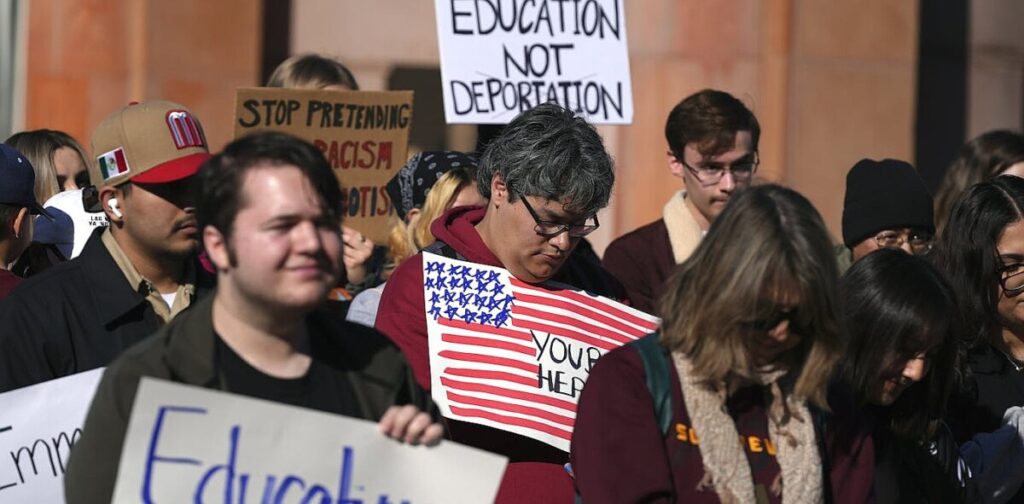
Young, undocumented immigrants are finding it increasingly hard to attend college as South Carolina and other states restrict in-state tuition or ban them altogether
In January 2025, students at Arizona State University organized protests against a Republican student group advocating for the reporting of undocumented immigrants, reflecting the heightened tensions surrounding immigration policies in the U.S. The backdrop of these protests is the Trump administration’s stringent deportation tactics, which have significantly increased the stress levels of approximately 14 million undocumented immigrants living in the country. While the media spotlight often focuses on dramatic arrests and deportations, a less visible yet equally pressing issue is the growing difficulty undocumented students face in accessing and remaining in higher education. Research indicates that restrictive educational policies not only hinder individual aspirations but also have broader implications for the economy and society as a whole.
Historically, the path to higher education for undocumented students has been fraught with challenges. A landmark 1982 Supreme Court ruling allowed undocumented children to attend public K-12 schools, but this protection did not extend to higher education. The Illegal Immigration Reform and Responsibility Act of 1996 further complicated matters by prohibiting states from offering in-state tuition to undocumented students unless they extended the same benefits to out-of-state citizens. Despite initial progress in the early 2000s, when several states, including Texas and California, enacted laws to provide in-state tuition to undocumented students, the tide shifted dramatically in subsequent years. By 2008, South Carolina became the first state to ban undocumented students from public colleges altogether, a decision that was soon mirrored by Georgia and Alabama. The landscape continued to evolve under the Trump administration, with states like Florida revoking in-state tuition for undocumented students in 2025, further exacerbating the barriers to higher education.
The implications of these restrictive policies are profound. Undocumented students typically do not qualify for federal financial aid and face exorbitant out-of-state tuition rates, which can exceed $30,000 annually compared to the average in-state tuition of about $11,600. Research shows that access to in-state tuition can significantly reduce dropout rates by 8% and increase college enrollment among noncitizen Latino students by 54%. However, the restrictive policies have led many talented individuals to abandon their educational aspirations or relocate to states with more favorable conditions. This not only affects the students and their families but also has wider economic repercussions, with studies suggesting that states could lose millions in potential revenue when talented undocumented individuals are unable to pursue their desired careers. As the protests at Arizona State University illustrate, the fight for equitable access to education continues to resonate deeply within communities, highlighting the urgent need for policy reform that supports all students, regardless of their immigration status.
Students at Arizona State University protest against a Republican student group encouraging people to report undocumented immigrants in January 2025 .
Ross D. Franklin/Associated Press
The Trump administration’s
aggressive deportation
policies have
heightened stress
among the country’s approximately
14 million immigrants
who are living in the U.S. without legal authorization.
The
sharp rise in
dramatic arrests
and deportations
of immigrants over the past year has received
widespread media
attention.
A less publicized issue is that many young,
undocumented immigrants are also finding
it harder to apply to and stay in college.
As
someone who researches teacher training
and was a high school teacher in South Carolina, I have researched how
restrictive education policies
make it harder for immigrant students, particularly undocumented students, to receive a college degree.
The University of South Carolina is the largest public university in the state.
Wikimedia
,
CC BY
Bumpy path to higher education for undocumented students
In 1982, the
Supreme Court ruled
that students could not be discriminated against based on their immigration status.
This ruling ensured that immigrant students could not be denied entrance to public K-12 schools.
The caveat is that the ruling did not extend to higher education.
In 1996, Congress approved the
Illegal Immigration Reform and Responsibility Act
, which made it harder for undocumented immigrants who are deported to reenter the U.S., among other changes to increase border security.
This law also said that states could not provide
in-state tuition
to undocumented students at public universities, unless they gave the same benefits to out-of-state American citizens.
Then, in the early 2000s, a
bipartisan group of Texas representatives
helped
pass a bill
that opened up in-state tuition to undocumented students. The bill based tuition and scholarships on
specific residency requirements
, such as graduating from high school in the state, allowing the bill to circumvent the 1996 federal law.
Also in the early 2000s,
California
,
Illinois
,
Washington
and
New York
also passed similar legislation that allows undocumented immigrants to receive in-state tuition – and in some cases, state scholarships – at state universities.
Even some conservative states,
such as Utah
,
Oklahoma and
Kansas
, passed such legislation during the early 2000s that let undocumented immigrants pay in-state tuition at public universities and colleges.
The tide turns
But just a few years later, things began to shift.
In 2008,
South Carolina became the first state
to ban undocumented students from studying at public colleges and universities altogether.
Georgia
and
Alabama
quickly followed suit with similar bans.
In 2012, after Congress created the
Deferred Action for Childhood Arrivals
program to allow immigrants who came to the U.S. as children to temporarily work, study and stay in the U.S., some schools in South Carolina
briefly banned DACA students
from attending public universities – despite the new federal law.
The schools
reversed course
the next year
following a lawsuit
by the American Civil Liberties Union of South Carolina, but still required DACA students to pay out-of-state tuition.
Until 2015, South Carolina even denied in-state tuition for some
American citizens with undocumented parents
. The state reversed the policy following a lawsuit.
The trend toward more restrictive policies toward undocumented students has continued during the Trump administration.
In February 2025, Florida passed a law that
revoked in-state tuition
for undocumented students. Florida
still allows
undocumented immigrants to enroll at public colleges and universities, as long as they pay full tuition.
And over the summer, the Department of Justice
challenged Oklahoma’s
and Texas’
in-state tuition policies, which had allowed all undocumented students to pay in-state tuition.
Both
states quickly
ended their
policies.
Texas and
Oklahoma still
allow DACA recipients to attend public universities and pay in-state tuition rates.
As of 2025,
22 states and Washington D.C.
allow undocumented students to pay
in-state tuition
. The remaining states, meanwhile, either do not have a state policy, require undocumented immigrants to pay out-of-state tuition, or bar them entirely from attending public universities.
A challenging environment
Overall, these shifts make it harder for many undocumented students to go to and stay in college.
The price of in-state tuition at public universities varies, but it typically offers
in-state residents a much lower tuition
rate than students coming from out of state. While the average in-state tuition at public colleges
costs about US$11,610
for the 2024-25 school year, out-of-state students paid $30,780, on average, during this same time frame.
Undocumented students
do not qualify
for federal financial aid, so paying out-of-state tuition at a public university usually prevents immigrants from pursuing a college degree.
Some research shows that in-state tuition policies help reduce
undocumented college students’ dropout rates
by about 8%.
In-state tuition policies also
increase college enrollment
of noncitizen Latino students by 54%.
A blockade for students
I began teaching social studies at a high school in South Carolina in 2012, soon after many of these restrictions on immigrant students were enacted. I found that many educators and students were not aware of these restrictions until students applied to colleges or sought state licenses.
My students included DACA recipients who completed a two-year program in areas like cosmetology, only then to be told they would not be allowed to practice in the state.
My later research focused on
DACA students who aspired to become
educators but had to either stop pursuing that goal or go out of state to teach. Other immigrant students I surveyed in my research said they lost motivation in the high school classroom due to the restrictions to pursue higher education.
Students stage a walkout at a high school in Charlotte, N.C., on Nov. 18, 2025, protesting Border Patrol operations targeting undocumented immigrants.
John Moore/Getty Images
Carryover effects
Policies that make it easier for undocumented immigrants to attend college don’t just affect individual students and their families – they also have a positive effect on local economies.
Research from 2025
shows that when undocumented students can pay in-state tuition, they become more likely to have a job after graduation.
Another study from Clemson University and the nonprofit group Hispanic Alliance found that South Carolina could be losing
up to $68 million
a year in revenue due to the license policy for DACA recipients.
I have known undocumented people who are aspiring doctors and teachers and moved to other states since they could not study or receive professional licenses in South Carolina.
Restrictive education policies could mean that some of the most talented immigrant students
will leave
their respective states. However, the average undocumented immigrant student will not
usually pursue or delay
higher education if the tuition is not affordable.
I believe these policies will ultimately mean a less educated and productive society.
William McCorkle does not work for, consult, own shares in or receive funding from any company or organization that would benefit from this article, and has disclosed no relevant affiliations beyond their academic appointment.


