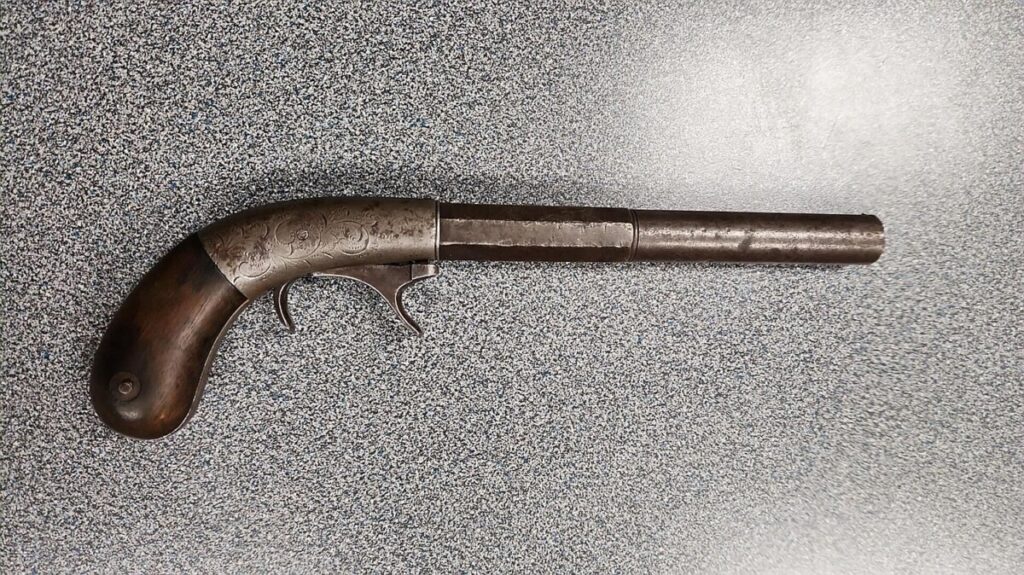
Rare 19th century pistol used to rob Tulsa liquor store
In a bizarre twist to a recent robbery in Tulsa, Oklahoma, a 24-year-old man was arrested for allegedly using an antique firearm to hold up a liquor store. According to reports from multiple Oklahoma news outlets, including WKTUL, the suspect brandished what employees described as an “old-timey musket” during the incident on December 6. Upon his arrest, authorities provided further insights into the weapon, classifying it as a single-shot percussion pistol, which they initially identified as a Derringer. However, experts quickly clarified that the firearm was likely an underhammer pistol, a rare type of gun with a hammer positioned beneath the barrel, a design that dates back to the mid-19th century.
Firearms historian Michael Helms explained that while the Tulsa police were correct in identifying the weapon as a percussion pistol, their classification as a Derringer was inaccurate. Helms elaborated that the term “Derringer” specifically refers to firearms made by Henry Deringer, a Philadelphia gunmaker known for his compact pistols, particularly after one was used in the assassination of President Abraham Lincoln. Instead, the weapon in question is believed to be an underhammer pistol, a design popularized by Nicanor Kendall in the 1840s. This type of firearm was loaded from the muzzle and utilized a unique mechanism where the hammer is cocked by pulling the trigger. The rarity of such weapons, combined with their historical significance, contributes to their status as collector’s items today.
Further analysis by historian Ashley Hlebinsky suggests that the firearm could be a Bacon & Co. Underhammer Pistol, produced between 1850 and 1857. These pistols were known for their decorative engravings and limited production, with only around 500 ever made. If Hlebinsky’s identification holds true, the pistol used in the robbery could be worth as much as $850. As technology advanced in the late 19th century, designs like the underhammer became obsolete, making the incident not only a criminal act but also a fascinating intersection of history and modern crime. The unusual choice of weapon has sparked interest and curiosity, highlighting the intriguing story behind this antique firearm and its unexpected role in a contemporary crime.
https://www.youtube.com/watch?v=lZSpHgn9fag
This article has been updated to include additional source commentary.
It’s difficult to resist raising an eyebrow at an Oklahoma robbery suspect’s alleged recent
weapon-of-choice
. According to several Oklahoma
news outlets
including
WKTUL
, a 24-year-old man was arrested on December 6 by Tulsa police after allegedly robbing a liquor store using what employees described as an “old-timey musket.”
Authorities soon apprehended and charged the suspect before providing some additional details about the weapon.
“For those who are curious, the firearm is likely from the mid-1800s and is a single-shot percussion Derringer. It was also called the ‘Muff Pistol’ or ‘Pocket Pistol,’” Tulsa police
posted to social media
on December 8.
Definitely not a derringer
According to firearms historian
Michael Helms
, law enforcement’s initial assessment is slightly off target—regardless of whether you spell “Derringer” with one “r” or two.
“‘Derringer’ properly refers to a gun made by Henry Deringer, who was a Philadelphia gunmaker that developed a reputation for his compact percussion pistols,” Helms tells
Popular Science
. “Deringer’s name came into widespread use when one of his pistols was used to assassinate Abraham Lincoln. Over time the ‘Derringer’ name became a genericized term for small percussion pistols.”
While cautioning that it’s difficult to assess a historical firearm from a single photo, Helms didn’t see any immediate evidence to suggest the weapon is a replica. Tulsa police were correct in designating it a
percussion pistol
. These types of guns are loaded from the muzzle with a ball and powder and primed using a percussion cap. At the same time, there is also something striking about the crime scene evidence.
“This pistol is something a bit different and somewhat rarer; this is an ‘underhammer’ pistol,” said Helms. Conventional mid-19th century weapons usually featured hammers located on either the top or side of the gun. As the name suggests, underhammers have the hammer positioned underneath the gun barrel.
“In this case, the hammer is attached to the forward trigger, which was used to ‘cock’ the gun. The trigger behind it would have released the hammer and fired the gun,” he added.
Underhammer guns aren’t traceable to a single person or era, but firearm historians do credit its
popularization to Nicanor Kendall
. The gunmaker lived in Vermont during the 1840s and 1850s, and
developed his own underhammer safety
lock after his own pistol misfired while attempting to shoot a squirrel.
While he said the weapon’s overall design is “pretty generic,” Helms theorizes it could have been produced by
Ethan Allen
. Not to be confused with the furniture company or the
leader of the Green Mountain Boys
during the American Revolution, this Ethan Allen was a prominent 18th century arms maker who patented numerous single- and multi-shot pistols.
A likely suspect
However, after examining the available photo, firearms historian
Ashley Hlebinsky
believes that the answer is pretty clear.
“It looks like a Bacon & Co. Underhammer Pistol,” she tells
Popular Science
. Although Hlebinsky admits it’s hard to conclusively determine the maker without examining the markings in person, the gun “looks identical” to
firearms produced between 1850 and 1857
by the Connecticut-based company.
Hlebinsky’s theory is further strengthened by the fact that Thomas Bacon himself previously worked with Ethan Allen. The Bacon & Co. underhammer pistols were .34 caliber weapons featuring either a 4- or 5-inch barrel and broad, floral decorative engravings. If corroborated, then the Tulsa robbery weapon is one of only 500 ever manufactured, and has recently sold for as much as $850.
In the end, there are a few reasons why only a handful of the guns were produced, with technological innovation being the primary explanation.
“With the development of the metallic cartridge revolver in the late 1850s, the architecture of guns changed considerably, and by the 1860s and 1870s the underhammer design (and the percussion lock in general) was largely obsolete,” said Helms.
Today, underhammer firearms are often considered collector’s items. Helms noted while many American and like some European gunmakers “dabbled with these designs,” they arrived late in the percussion pistol’s development and didn’t affect wider arms production.
“All the same, this is an interesting antique pistol,” Helms conceded.
The post
Rare 19th century pistol used to rob Tulsa liquor store
appeared first on
Popular Science
.


