Zagotta: Trump may ultimately cure cancer
The groundbreaking mRNA technology that played a pivotal role in combating the COVID-19 pandemic is now being hailed as a potential game-changer in the fight against cancer, thanks in large part to the initiatives launched during President Trump’s Operation Warp Speed. Recent studies from the MD Anderson Cancer Center and the University of Florida have shown promising results: lung and skin cancer patients who received COVID-19 mRNA vaccines alongside standard immunotherapy lived nearly twice as long as those who received immunotherapy alone. This innovative approach appears to retrain the immune system to recognize and attack cancer cells, leading some scientists to speculate that we may be on the cusp of developing a universal cancer vaccine. The rapid development and deployment of mRNA vaccines during the pandemic not only saved millions of lives but also demonstrated the power of government and private sector collaboration in accelerating medical breakthroughs.
Historically, the use of messenger RNA in cancer treatment had been met with skepticism and limited funding, but Operation Warp Speed catalyzed a significant shift. With millions of dollars in private investment flooding into mRNA research, over 120 clinical trials are currently underway exploring its application across various cancer types. Early results are encouraging, with mRNA vaccines showing the potential to reduce relapse rates in melanoma patients and shrink pancreatic tumors. However, the future of this promising technology is now at risk due to policy decisions made by the current administration. President Biden’s Cancer Moonshot initiative aimed to revolutionize cancer treatment, yet his administration’s Inflation Reduction Act imposed stringent price controls on drugs, which could deter investment in long-term cancer research. This has already led to a troubling decline in post-approval clinical trials, as companies hesitate to pursue projects that may not recoup their costs.
Compounding these challenges, Health and Human Services Secretary Robert F. Kennedy Jr. recently cut nearly $500 million in contracts for mRNA vaccine research, undermining the momentum generated by Operation Warp Speed just as its potential for cancer treatment is becoming clearer. The call to action is clear: a second Trump administration could leverage the successes of the first by prioritizing funding for mRNA research and streamlining the drug approval process. By fostering an environment conducive to innovation, American companies could be empowered to develop the next generation of cancer treatments and cures more swiftly, potentially transforming the landscape of cancer care for future generations.
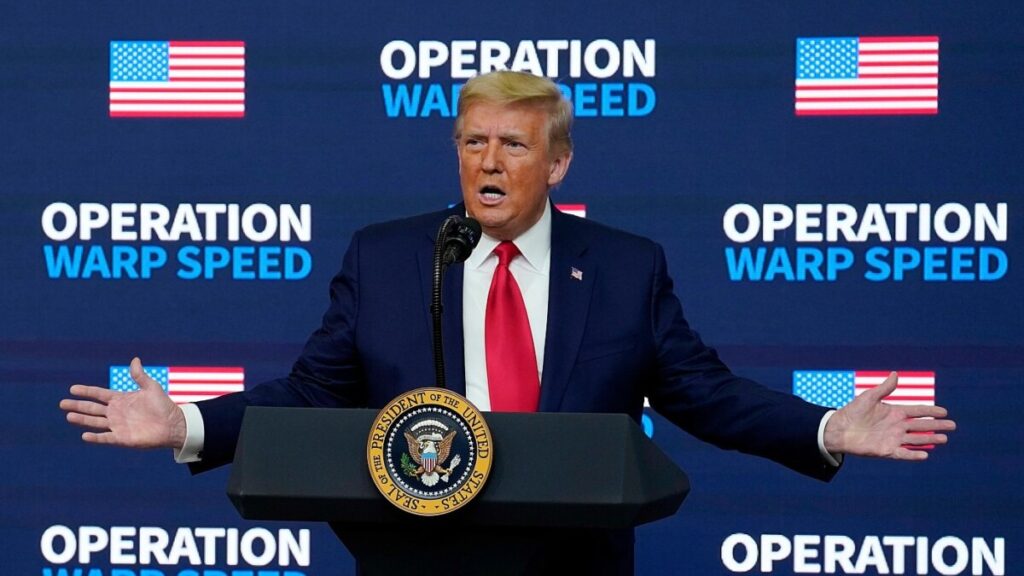
The mRNA technology that helped end the COVID-19 pandemic may now hold the key to defeating cancer, and it exists because of President Trump’s Operation Warp Speed.
Researchers at MD Anderson Cancer Center and the University of Florida recently reported that lung and skin cancer patients who received COVID-19 mRNA vaccines alongside standard immunotherapy lived nearly twice as long as those who received immunotherapy alone. The vaccines appeared to “retrain” patients’ immune systems to recognize and attack tumors, a finding some scientists are calling the first step toward a universal cancer vaccine.
If a cancer vaccine ultimately succeeds, we’ll have Trump to thank. During his term, scientists, manufacturers and regulators worked to deliver mRNA vaccines in seven months, saving millions of lives and $1 trillion in healthcare costs.
Operation Warp Speed proved that when the government clears red tape and partners with industry, breakthroughs arrive at a record pace.
For decades, researchers had explored messenger RNA as a possible tool against cancer, but few investors were willing to bet on it. After Operation Warp Speed, that changed, and millions in private capital poured into mRNA research.
Today, more than 120 mRNA clinical trials are underway for multiple types of cancer. Early studies show mRNA vaccines can reduce relapse rates in melanoma patients and shrink pancreatic tumors.
What started as a race to stop COVID-19 has become a revolution in medicine. Yet, mRNA’s potential is under threat, not from Trump but from previous policies and recent actions by Health and Human Services Secretary Robert F. Kennedy Jr.
President Biden promised to “end cancer as we know it” through his Cancer Moonshot, an initiative to speed up progress in cancer prevention, detection and treatment. In practice, the administration pursued policies that undermined this goal. The Inflation Reduction Act, Biden’s signature domestic achievement, imposed government price controls on drugs for the first time, discouraging the long-term investment and risk-taking required to develop new cures.
That’s especially damaging in cancer research, where drug development timelines can stretch well over a decade and depend on multiple rounds of follow-on research. Industry data already shows a sharp decline in post-approval clinical trials to explore new uses for cancer medicines since the IRA took effect, as companies shelve projects unlikely to recover their costs under government-imposed pricing.
Now, inexplicably, HHS is making decisions that would compound the harm. HHS secretary Kennedy recently cut nearly $500 million in contracts for mRNA vaccine research, just as the technology’s extraordinary potential for cancer treatment is coming into view.
The second Trump administration would be wise to build on the successes of the first by funding mRNA research and streamlining the drug approval process so that American companies can develop the next generation of treatments and cures as quickly as possible.
Anthony J. Zagotta is the president of the Center for American Principles/InsideSources


