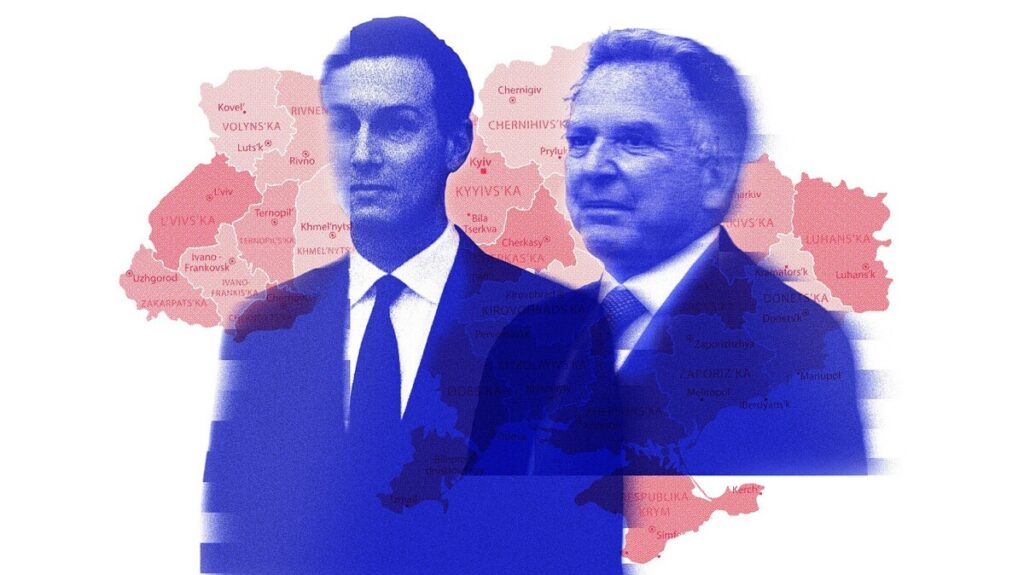
Trumpian Corruption Is Worse Than Ukrainian Corruption
In a recent conversation with Oleksandr Abakumov, a senior detective at Ukraine’s National Anti-Corruption Bureau (NABU), the stark contrast between the dedicated civil servants in Ukraine and the opportunistic negotiators from the U.S. and Russia became evident. Abakumov, who has been at the forefront of anti-corruption efforts in Ukraine, is driven by a deep sense of patriotism and accountability, striving to eliminate the pervasive corruption that has plagued the country for decades. His commitment stems from Ukraine’s tumultuous history, particularly following the 2014 Euromaidan protests that ousted the pro-Russia president Viktor Yanukovych. This political upheaval led to the establishment of NABU, an institution designed to combat high-level corruption and promote transparency, which Abakumov regards as essential for Ukraine’s sovereignty and democratic future.
Abakumov’s current investigation, dubbed “Operation Midas,” targets alleged kickback schemes involving the state nuclear-power company at a time when many Ukrainians are enduring power shortages due to ongoing Russian attacks. The investigation has already led to significant political repercussions, including the dismissal of two ministers and the resignation of a close adviser to President Volodymyr Zelensky. Unlike the passive nature of some media portrayals of the scandal, Abakumov and his colleagues actively pursue accountability, showcasing a healthy political system that seeks to uphold the rule of law. In stark contrast, the recent negotiations between American businessmen, including Jared Kushner and Steve Witkoff, and their Russian counterparts appear to be driven by self-interest rather than a commitment to transparency or democratic values. This dynamic raises concerns about the potential for corruption to undermine Ukraine’s fight for sovereignty, as powerful figures in the U.S. and Russia appear more interested in lucrative business deals than in supporting a democratic Ukraine.
The implications of these contrasting motivations are profound. While Ukrainian officials like Abakumov work diligently to root out corruption within their government, American negotiators seem to prioritize personal gain, potentially jeopardizing Ukraine’s future. The American political landscape is marred by conflicts of interest, as evidenced by Kushner’s financial ties and Witkoff’s business dealings, which could reshape geopolitical alliances to the detriment of Ukraine and its allies. This situation highlights the complexities of corruption, revealing that while Ukraine grapples with internal challenges, external influences from American and Russian interests threaten to further complicate its path to recovery and reform. As Abakumov aptly stated, tolerating corruption is a direct path to losing the war, emphasizing the critical need for integrity and accountability in shaping Ukraine’s destiny amidst ongoing conflict.
A few days ago I called Oleksandr Abakumov, a senior detective at the National Anti-Corruption Bureau of Ukraine. I wanted to ask him about his investigation into a kickback scheme in his country’s energy industry. While we were talking, I got interested in Abakumov himself. As he was explaining his motivations, I was struck by the surprising contrast between people like him—the Ukrainian civil servants and civil-society activists who have been demanding transparency from their leaders for two decades—and the American and Russian negotiators who met this week in Moscow, perhaps to decide Ukraine’s fate.
[
Anne Applebaum: Why does Steve Witkoff keep taking Russia’s side?
]
Ukraine is fighting for its survival. Drones and missiles hit Ukrainian cities most nights. Many Ukrainians nevertheless want, even now, to have a government that’s accountable to the public. Meanwhile, American and Russian kleptocrats are
circling the country
, looking for ways to make deals that benefit themselves.
Abakumov’s career was directly shaped by his country’s history. Until 2014, he was a police detective in the city of Luhansk in eastern Ukraine. At the beginning of that year, a series of mass protests in Kyiv persuaded Ukraine’s corrupt, authoritarian, pro-Russia president, Viktor Yanukovych, to flee the country. Furious at the loss of their puppet, the Russians immediately invaded Crimea and eastern Ukraine, including Luhansk. Ukrainian elections brought a new president to power. Popular demand for reform led to the creation of new institutions, including the National Anti-Corruption Bureau of Ukraine, or NABU, which has from its beginning intended to eliminate high-level state corruption.
Abakumov’s life changed too. He left occupied Luhansk and moved to Kyiv. In 2016, he went to work for NABU, taking a job that he considers to be a great honor. Certainly, NABU is popular: Last summer, after President Volodymyr Zelensky sought to shut the agency down, Ukrainians organized the largest mass protests the country has seen since Russia’s full-scale invasion of Ukraine began in 2022. The president changed his mind, and the agency remained open. The job also appeals to Abakumov’s patriotism. He believes that if he can help eliminate high-level corruption, then he can help Ukraine preserve its sovereignty and its democracy. “Corruption equals Russia, and we are not Russia,” he told me.
In their investigation, dubbed “Operation Midas,” Abakumov and his colleagues have
accused several people
in the government of taking money from contracts involving the state nuclear-power company—a particularly sensitive charge at a moment when many Ukrainians live without electricity, thanks to Russian bombing campaigns.
Foreign coverage of “Operation Midas” often relies on the passive voice, as if the scandal has a will of its own (“Scandal Consumes Top Aide”). But people such as Abakumov, who is a part of the Ukrainian state, worked to make the scandal public. They have interrogated cabinet ministers, published surveillance recordings, searched apartments. The Ukrainian Parliament has dismissed two ministers. Tymur Mindich, a former business partner of Zelensky, has
fled the country
. Late last month, the president’s closest adviser, Andriy Yermak,
resigned
following a search of his apartment. All of this means that the political system is healthy, operating according to the law.
I should note that quite a few Ukrainians, and indeed many Europeans, believe that the investigation has somehow been assisted by the Trump administration, as a way of weakening Zelensky to force him to capitulate. Given that the Trump administration has stopped advocating for anti-corruption policies around the world and, following the closure of USAID, has dramatically decreased cooperation with Ukrainian law enforcement, this seems implausible.
[
Anne Applebaum: The murky plan that ensures a future war
]
Abakumov told me that he believes corruption, not transparency, weakens Ukraine. If Ukraine tolerates corruption, he said, “this is the way we lose, during the war, during negotiations, during rebuilding Ukraine.” Daria Kaleniuk, one of Ukraine’s most prominent anti-corruption activists, told me that with this investigation, “we have the chance to save the country and make it stronger.”
These beliefs are radically different from those held by Ukraine’s opponents. From the beginning of his career, Vladimir Putin, the president of Russia, has sought to enrich himself and his entourage at the expense of ordinary Russians. Putin himself was a pioneer in the use of secret offshore accounts and shell companies to transfer state assets into his own pockets. He has also spent years seeking to prevent those ordinary Russians from finding out about his finances.
In January 2021, the anti-corruption activist Alexei Navalny released a meticulously documented film,
Putin’s Palace
, that revealed a network of kickbacks and payments to the Russian president far larger, more far-reaching, and more baroque than the scandal under investigation in Ukraine. The result: Navalny, who had just been arrested at the Russian border, was sent to a Siberian prison, where he later died. Putin kept his palace, complete with its private hockey rink and hookah bar, and his money. He blocked all further investigations into his wealth, jailed protesters, drove real journalists out of the country, and launched an invasion of Ukraine.
The Americans taking part in the recent Moscow negotiations are not brutal dictators, but neither are they civil servants acting purely in the interests of transparency, accountability, and patriotism. Steve Witkoff, a real-estate developer, and Jared Kushner, the president’s son-in-law and the owner of an investment company that
received $2 billion from Saudi Arabia
, are now conducting the main negotiations. Their Russian counterpart is Kirill Dmitriev, the head of Russia’s sovereign-wealth fund, which
has strong ties with its Saudi counterpart
. He is believed to have met Kushner while doing business in the Gulf.
[
Franklin Foer: Why the Gulf monarchs shower Trump with gifts
]
Last month,
The Wall Street Journal
revealed
that these three businessmen met in Miami Beach in October to discuss not just Ukraine but also future Russian-American business deals. Russian businessmen who are known to be close to Putin have been “dangling multibillion-dollar rare-earth and energy deals” in front of American companies, the
Journal
explained, to “reshape the economic map of Europe—while driving a wedge between America and its traditional allies.” Some of the companies have connections with Donald Trump’s family.
[
Anne Applebaum: The murky plan that ensures a future war
]
Witkoff and Kushner are not taking kickbacks on government contracts, as some Ukrainian officials are now accused of doing. The corruption they represent is more profound: They are using the tools of the American state in a manner that happens to benefit their friends and business partners, even while they do terrible damage to American allies, American alliances, and America’s reputation. This is a conflict of interest on a grand scale, with no real precedent in modern American foreign policy.
In Ukraine, the state itself is investigating the government, the cabinet, even the president’s closest advisers. By contrast, it is impossible to imagine Kash Patel’s FBI investigating anyone in Trump’s White House. Any Russian who investigates Putin goes to jail. The word
corruption
has many nuances, and we aren’t using enough of them when we talk about Ukraine.


