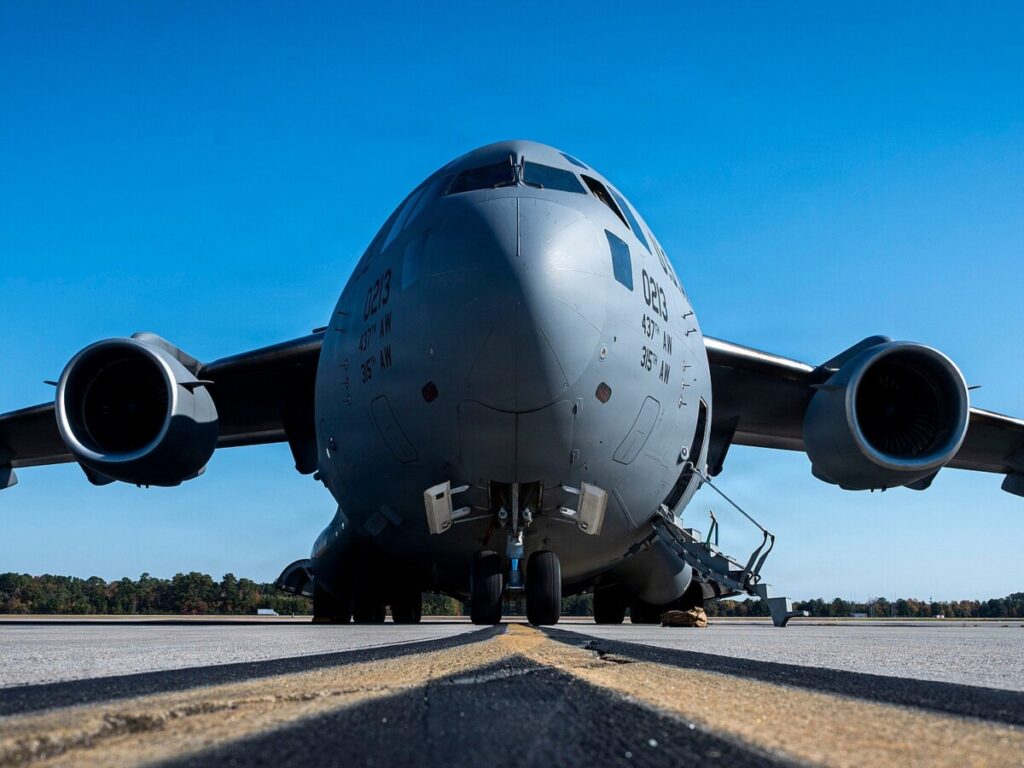
Airlift could be the Achilles’ heel in the US Air Force plan for surviving a fight with China
In a recent analysis published by the Mitchell Institute for Aerospace Studies, retired Air Force Colonel Robert Owen highlights a critical readiness issue facing the U.S. Air Force’s airlift fleet, especially in the context of a potential conflict with China. As the military shifts its focus towards a more dispersed strategy known as Agile Combat Employment (ACE), which aims to enhance survivability by spreading operations across various locations in the Indo-Pacific, the current state of the airlift fleet raises alarms. Owen argues that the aging and diminishing size of the fleet could severely limit the Air Force’s ability to meet the logistical demands of modern warfare. With the average age of aircraft in the fleet soaring from 17 years in 1994 to a projected 32 years in 2024, the urgency for modernization and expansion becomes apparent.
The airlift fleet, which primarily consists of C-17s, converted airliners, and helicopters, is not only shrinking but also lacks the necessary diversity to effectively support high-intensity conflicts. Many of these aircraft, such as the C-5M Super Galaxies, are now decades old and have surpassed their intended service lives, struggling with low mission-capable rates. This aging infrastructure poses a significant challenge as the U.S. military prepares to confront high-end threats like China and Russia, which are rapidly modernizing their forces. Owen emphasizes that the ACE strategy relies heavily on the airlift fleet to transport essential supplies and personnel to forward operating locations, yet the Air Force has not acquired enough suitable aircraft capable of operating from austere airfields, nor does it have plans to do so.
The implications of these findings are profound, as the U.S. military’s airlift capabilities are crucial for maintaining operational readiness and effectiveness in a potential conflict with a major power. While the U.S. still possesses advantages in stealth technology, global logistics, and combat experience, the gap with China’s rapidly advancing air force is narrowing. Senior military leaders and airpower experts are increasingly vocal about the need for the Department of Defense to prioritize the expansion and modernization of the airlift fleet. As the geopolitical landscape evolves, ensuring that the Air Force can effectively execute its ACE strategy will be vital for maintaining U.S. military dominance in the Indo-Pacific region.
In a potential war with China, the Air Force would spread its aircraft and operations across the Indo-Pacific rather than just centralized airbases.
US Air Force photo by Senior Airman Adriana Jordan-Alcañiz
The US airlift fleet has a readiness problem for a modern war, an airpower expert argues in a new paper.
The size, age, and lack of variety in aircraft could hinder the Air Force’s plan to operate in a war with China.
The Agile Combat Employment strategy would have aircraft operate across austere Indo-Pacific locations.
The US airlift fleet for moving troops, weapons, and critical supplies around the world is shrinking and growing older — a dangerous trend that could leave the military in a tight spot if war were to erupt with a major power, a new analysis warns.
In particular, the challenges facing the US Air Force’s airlift force could undercut its plan for keeping units
dispersed and survivable
in a fight with China.
In a new
Mitchell Institute for Aerospace Studies
paper, retired Air Force Col. Robert Owen, who flew C-130 transport aircraft during his 28-year career and also served in a leadership role at Air Mobility Command, argues the current size and state of the airlift fleet may not meet potential wartime demand.
“In a peer conflict,” he warns, “the airlift fleet may not be sufficient to meet the movement, supply, and other logistical demands of the services.”
“The US Air Force, in particular, may not have enough airlift to support its ACE concept,” Owen says, referring to the service’s
Agile Combat Employment
strategy aimed at disaggregating assets to make it harder for an adversary to cripple US airpower in a single
overwhelming strike
.
There are fewer aircraft available for carrying personnel and equipment into the fight, and the ones the US does have aren’t the right, varied mix for a high-end war.
The US military relies heavily on a mix of C-17s, converted airliners, and helicopters to haul cargo, refuel aircraft, and move people between theaters. But many of these airframes are now decades old and sliding toward obsolescence, Owen writes. At the end of the Cold War, the mobility fleet was significantly younger, and the Pentagon had clear plans to replace it.
Some airlift aircraft, like the C-17, are already flying beyond their originally planned service lives. The Air Force’s 52 C-5M Super Galaxies — its largest airlifters — now average 37 years old and suffer from low mission-capable rates, Owen notes. And these planes are not alone. Much of the mobility fleet is aging fast alongside other assets on which the Air Force depends.
Gen. David Allvin, then the Air Force chief of staff, said in March that average aircraft age across the force had jumped from 17 in 1994 to 32 in 2024 as aircraft availability dropped substantially.
Other military leaders have raised concerns about airlift capacity, recognizing significant drops from Desert Storm in the 1990s to now.
“All of these aircraft have been worked hard across three decades of non-stop combat operations around the globe,” Owen said specifically of the airlift fleet. That presents challenges as the US focuses its attention more on higher-end threats like Russia or China.
TK
US Air Force photo by Staff Sgt. Emily Farnsworth
The ACE strategy, Owens writes, envisions “fighter units and support echelons rotating frequently and unpredictably among networks of” permanent bases, semi-permanent installations, and forward arming and refueling points (FARPs).
While the first two basing options can be supported by prepositioned stocks and host-nation support, small fighter teams at dispersed FARPs could be dependent almost entirely on C-17s and other theater mobility aircraft to bring in the fuel, weapons, and people.
The Air Force has been training on its ACE concept for years, having airmen maintain, fly out of, and land across atypical locations like a simple airfield or even a
stretch of highway
.
The concept is that while many air bases are in range and easily targeted, China would be unable to devastate American airpower if it were dispersed across the Indo-Pacific at a mix of traditional and makeshift airfields.
But, Owen writes, the Air Force “has not acquired significant numbers of aircraft capable of operating at the lower end of this requirement — delivering combat equipment and supplies into short and weakly surfaced forward airfields — and has no publicly released plans to do so. The budgets are not sized for this mission growth.”
Thus, efforts to expand and sustain the airlift fleet should be a priority for the Department of Defense, he says.
These issues are just some facing the Air Force, which has shrunk and aged in the decades since the end of the Cold War while also being stressed by counterterrorism and counterinsurgency conflicts.
Senior military leaders, former Air Force personnel, and airpower experts warn that even as the US grapples with shrinking fleets and
declining readiness
, China’s air force is expanding and rapidly modernizing.
The US still retains significant advantages in stealth aircraft, global logistics, combat experience, and allied support, they note, but
China’s sustained investment
in capability is narrowing the gap and changing the balance of risk.
Read the original article on
Business Insider