The Vaccine Guardrails Are Gone
In a significant shift in U.S. vaccine policy, Robert F. Kennedy Jr.’s newly appointed vaccine advisory committee has voted to revise the long-standing recommendation that all newborns receive the hepatitis B vaccine shortly after birth. The committee now recommends that only infants born to mothers who test positive for the virus, or whose status is unknown, receive the vaccine immediately, while others may opt to delay vaccination until two months after birth. Proponents of this change cite the practices of countries like Denmark and Finland, where only infants of infected mothers are vaccinated, and point to a decrease in hepatitis B infection rates in the U.S. However, critics argue that this decision could lead to increased risks, as many pregnant women do not get tested for hepatitis B, and existing tests can sometimes miss infections. Notably, public health organizations such as the World Health Organization and the American Academy of Pediatrics continue to advocate for universal vaccination at birth to prevent chronic infections that can lead to severe health issues later in life.
The committee’s recent meeting highlighted a departure from traditional norms and raised concerns about the qualifications of its members. Kennedy has reshaped the committee, removing outside advisers and appointing individuals who share his skepticism about vaccine safety. This has resulted in a chaotic environment where fringe opinions have taken precedence over established scientific consensus. For instance, presentations were given by individuals with controversial backgrounds, including those who have previously criticized the CDC. Dissenting voices within the committee expressed alarm over the decision’s potential harm, with one pediatrician stating that the new recommendations could undermine the effectiveness of the country’s immunization program. The vote to change the hepatitis B vaccination policy passed with a narrow margin, despite significant pushback from medical professionals and representatives of health organizations. The implications of this decision extend beyond hepatitis B, as the committee is expected to reevaluate other aspects of the childhood immunization schedule, including the safety of aluminum salts used in vaccines, which could further disrupt public health initiatives in the U.S.
As the committee prepares for its next meeting, the future of vaccine policy in the United States appears uncertain, with potential ramifications for childhood immunizations and public health. The decision to delay the hepatitis B vaccine for many infants has sparked controversy and concern among healthcare professionals who fear it may lead to increased infections and complications. Critics, including respected vaccine experts, have voiced their apprehensions about the committee’s direction, indicating that it has strayed from evidence-based practices. With ongoing debates and the possibility of further changes to the immunization schedule, the situation underscores a growing divide in public health policy that could have lasting effects on the safety and efficacy of vaccines in the U.S.
https://www.youtube.com/watch?v=3AVpoAC14rg
Updated at 4:33 p.m. ET on December 5, 2025
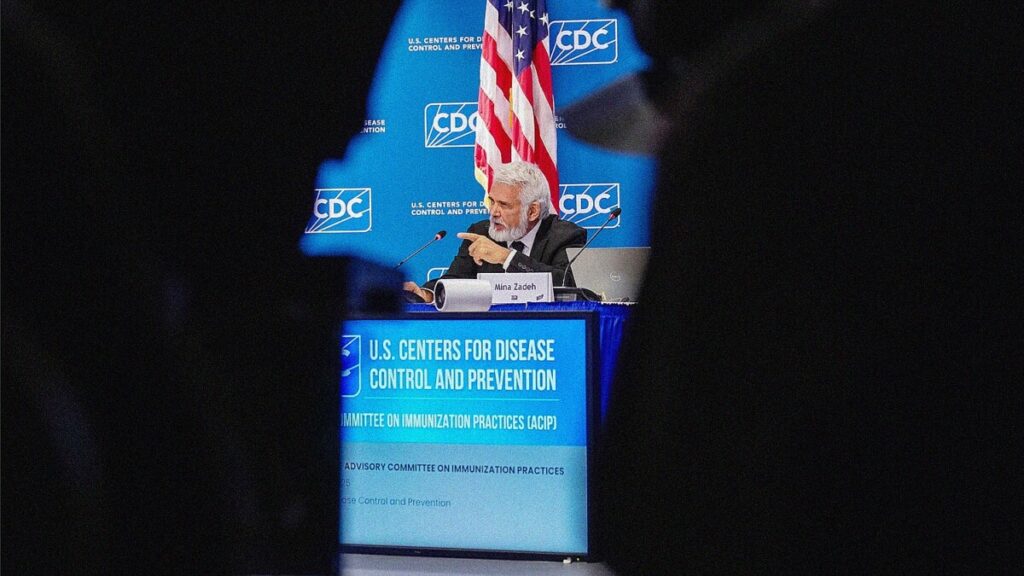
In case there was any doubt before, it’s now undeniable that Robert F. Kennedy Jr.’s allies are in charge of the country’s vaccine policy. The latest evidence: His handpicked vaccine advisory committee voted today to scrap the decades-old guidance that all babies receive the hepatitis-B vaccine shortly after birth. Now the panel recommends that only children born to mothers who test positive for the infection or have unknown status automatically receive a shot at birth. Everyone else has the option of a shot at birth or—as the committee recommends—waiting until at least two months after birth.
Those who favor the change argue that other countries, such as
Denmark
and Finland, vaccinate only newborns of mothers who test positive, and that rates of infection are relatively low in the United States. All of this is true. But in the U.S., many expectant mothers don’t get tested for hepatitis B, and even if they do, those tests sometimes fail to pick up the virus. The rationale for giving the vaccine right away is to wipe out an infection that will afflict the majority of people who contract it as babies for the rest of their life (and, for as many as a quarter of those chronically infected, result in their death from cirrhosis or liver cancer). The World Health Organization and the American Academy of Pediatrics both endorse the universal birth dose. “When you remove that foundation, you essentially cause the whole prevention process to collapse,” Noele Nelson, a former CDC researcher who has published multiple papers on hepatitis B, told me.
The meeting, which began yesterday, was also proof that Kennedy, and those he’s empowered, no longer feel bound by previous norms. In June, Kennedy fired every outside adviser on the committee, alleging unspecified conflicts of interests (even though members are required to disclose those conflicts and recuse themselves when necessary). He has since stacked the board with members who share his doubts about vaccine safety. During the previous meeting, in September, those new members seemed at times unaware of basic facts about vaccines and often unsure about what they were voting on. In the end, their recommendations were fairly modest, advising that children younger than 4 receive two separate shots for MMR and chickenpox.
This week’s meeting was, if anything, more chaotic. Days before it started, Martin Kulldorff, a former Harvard Medical School professor who had been chair of the advisory board, left the committee for a position at the Department of Health and Human Services. The new chair is Kirk Milhoan, a pediatric cardiologist who is a member of the Independent Medical Alliance, a group that has promoted the use of ivermectin to treat COVID-19 despite clinical trials showing that the drug isn’t effective against the virus. But Milhoan didn’t show up in person for the meeting, leaving the moderating duties to Vice Chair Robert Malone, the author of the
conspiracy-theory-driven book
PsyWar
and a hero to people who oppose COVID vaccination; Malone has
called
Anthony Fauci “an accomplice to mass murder.” (HHS did not respond to a request for comment, nor did Malone or Milhoan.) In the days leading up to the decision on the hepatitis-B shot, committee members received four different versions of the question they’d be voting on, and the final language is still difficult to decipher.
[
Read: The most extreme voice on RFK Jr.’s new vaccine committee
]
The meeting was dominated by presentations not from career CDC staff, as it was even in September, but from fringe figures who are closely aligned with Kennedy. Mark Blaxill—a longtime Kennedy ally in the anti-vaccine cause who now works for the CDC—gave a presentation about hepatitis-B-vaccine safety. He noted that he’d been “a critic of the CDC for many years, so it’s been an honor and a privilege to work on the inside and to address some of these issues.” Another presenter, Cynthia Nevison, is a research associate at the University of Colorado at Boulder’s Institute of Arctic and Alpine Research. She is also one of Blaxill’s co-authors on a 2021 paper on rising autism rates that was retracted after the journal’s editors and publisher concluded that they had made a host of errors, including misrepresenting data. (Blaxill told me that the paper was later published with “modest additions” in another journal.)
Just as the meeting was more chaotic than earlier iterations, the pushback was even sharper. Cody Meissner, a pediatrician and committee member who’d also served on the board during the Obama administration, noted, accurately, that rates of hepatitis B have declined in the United States “thanks to the effectiveness of our current immunization program.” Malone interjected—as he did at several points in the meeting—that this was merely Meissner’s opinion. “These are facts, Robert,” Meissner responded. Joseph Hibbeln, a fellow committee member, shouted that there hadn’t been “any information or science presented” about whether delaying the hepatitis-B dose by two months made sense. Amy Middleman, a pediatrician and representative of the Society for Adolescent Health and Medicine, urged the committee “to go back to our true experts” at the CDC. Adam Langer, a longtime CDC expert who is the acting principal deputy director of the center that oversees hepatitis prevention, at one point cautioned the committee not to use countries such as Denmark, which has a much smaller population and more comprehensive prenatal care, as a basis for comparison. Most panelists seem not to have cared.
In the end, the concerns of the committee’s few dissenters—along with the chorus of objections from representatives of medical organizations—were disregarded. The committee voted overwhelmingly (8–3) to change the recommendation. “This has a great potential to cause harm, and I simply hope that the committee will accept its responsibility when this harm is caused,” Hibbeln said afterward. The board also voted that parents should have the option of testing their children’s antibody titers against hepatitis B before they receive subsequent doses of the vaccine—a move for which, several meeting participants pointed out, there is little scientific support. A senior CDC scientist wrote to me that it was the “least science-based, most illogical public health recommendation in U.S. history.” The committee’s decisions are not final yet: The CDC director still needs to sign off on them. Because Kennedy
pushed out Susan Monarez
less than a month after she was confirmed as director, the decision will rest with the acting director, Jim O’Neill, whom Kennedy selected as deputy HHS secretary and who has no background in medicine.
[
Read: ‘It feels like the CDC is over’
]
The new normal for the vaccine advisory committee appears to be the appearance of vigorous scientific debate in which the experts are either not consulted or simply disregarded. That doesn’t bode well, because the committee apparently plans to reconsider the rest of the childhood-immunization schedule—something Kennedy promised Senator Bill Cassidy, who chairs the Senate health committee, that he would not do. Earlier today, the committee heard a presentation from Aaron Siri, a lawyer who worked for Kennedy’s presidential campaign and has represented clients who believe that their children were injured by vaccines. He used his time to spell out his doubts about the childhood-vaccine schedule.
According to Malone, the committee had asked Paul Offit and Peter Hotez, both widely respected vaccine experts, to appear as well. In an email, Hotez told me he declined because the board “appears to have shifted away from science and evidence-based medicine.” Offit told me in an email that he didn’t remember being asked to attend but that he would have declined because the committee “is now an illegitimate process run by anti-vaccine activists.” Even Cassidy, who has mostly stopped short of directly criticizing Kennedy’s actions in office, slammed Siri’s appearance in front of the committee, posting on X earlier this week that the committee was now “totally discredited.” (When I asked Siri for comment, he pointed me to an X post in which he’d challenged Cassidy to a public debate on vaccines. A spokesperson for Cassidy’s office did not respond to a request for comment.)
At the end of today’s meeting, the board gave a preview of its next target: aluminum salts, which are used in a number of childhood inoculations to boost immune response. (A presentation on the topic by Kulldorff was originally scheduled for today, but was removed from the agenda last night.) A recent study of more than 1 million Danish children found no evidence that aluminum salts are associated with neurodevelopmental disorders such as autism. Yet Milhoan, the new chair, said concerns had “reached a threshold where it needs to be considered.” Another member, Retsef Levi, speculated about how new safety trials might be conducted. If the committee decides at its next meeting, in February, that a common ingredient, used in vaccines for decades, is unsafe, it could upend childhood immunization in the United States. Which is, of course, exactly what many of Kennedy’s longtime allies have wanted all along.


