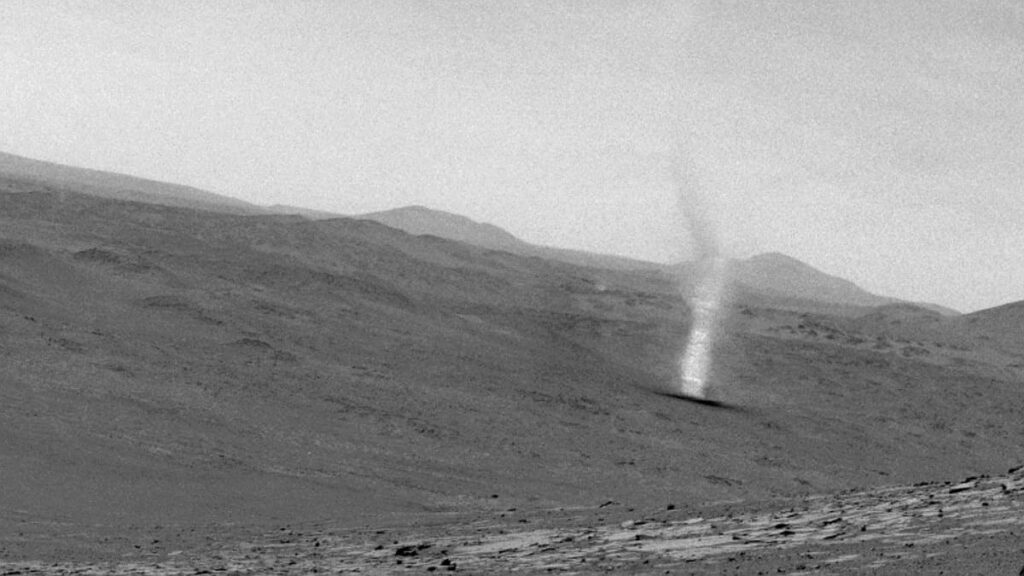
NASA Mars rover captures crackling lightning. Hear the thunder yourself.
In a groundbreaking discovery, scientists have confirmed that Mars experiences mini lightning generated by dust storms, a phenomenon that had been a topic of speculation for decades. This revelation comes from the Perseverance rover, which has been exploring the Jezero Crater region. Equipped with a microphone, the rover captured not only the sounds of Martian winds but also crackles and pops that resemble small electrical discharges. These sounds, akin to static electricity, were identified during the rover’s two-year mission as it monitored dust devils and the leading edges of dust storms. Ralph Lorenz, a scientist involved with the Perseverance mission, expressed excitement over the clarity of these sounds, which NASA has now made available to the public in a recent YouTube release.
The phenomenon of dust devils on Mars, which are whirlwinds that form on hot, dry days, is similar to those on Earth but occurs in a much thinner atmosphere. As dust particles collide, they generate electric charges that can build up strong enough to create sparks. This is particularly likely on Mars, where the atmospheric conditions require less energy to generate electrical discharges compared to Earth. Baptiste Chide, another scientist on the team, noted that even modest charging could lead to these sparks, which have now been observed directly for the first time. While the Perseverance rover has yet to capture these lightning events visually, the audio recordings and electromagnetic data it has collected provide compelling evidence of their existence.
This discovery has significant implications for understanding Mars’ environmental chemistry and the potential challenges for future exploration. The electrical discharges could alter the planet’s surface chemistry, creating compounds that may hinder the preservation of ancient life. Such findings underscore the importance of understanding Martian storms, especially since thousands occur each year, potentially generating more electricity than the isolated dust devils observed. While previous missions have not reported serious electrical damage from these events, the historical context, including the malfunction of the Soviet Mars 3 lander shortly after its landing during a dust storm in 1971, highlights the need for caution. As scientists continue to study these phenomena, they gain valuable insights into Mars’ atmosphere and the challenges that lie ahead for human exploration of the Red Planet.
Scientists now have proof that
Mars
‘ dusty storms can generate mini lightning, putting to rest decades of speculation.
The discovery came from a microphone aboard
NASA
‘s
Perseverance
rover, a lab on six wheels exploring the
Jezero Crater
region. While it was listening to Martian winds spinning and spitting dust, it also picked up something no one had heard there before: crackles and pops that turned out to be small electrical shocks within
dust devils
and storm fronts.
Of course, everything on Mars has to be different from Earth — not even the thunder can sound like thunder. Instead, these tiny bits of lightning give off sounds more like those that people associate with static electricity — the shuffling-of-your-socked-feet-and-touching-a-doorknob variety.
Over two Martian years, researchers identified 55 brief discharges — usually when dust devils passed close by or when the leading edges of dust storms rolled over the rover. Now people can listen to the Martian lightning themselves. NASA released a recording, featured in the YouTube video below, this week.
“We got some good ones where you can clearly hear the ‘snap’ sound of the spark,” said Ralph Lorenz, a Perseverance scientist at the Johns Hopkins Applied Physics Lab, in
a statement
.
SEE ALSO:
NASA’s asteroid sample just revealed new clues to life’s origins
Scientists have long studied dust devils churning up Martian dirt. About 13 years ago, NASA’s Mars Reconnaissance Orbiter caught sight of an extraordinary one with
a column stretching 12 miles
into the sky.
Dust devils on Mars form similarly to those on Earth, despite the fact that Mars’ atmosphere is much thinner. They tend to happen on dry days
when the ground gets hotter
than the surrounding area. Typically smaller than tornadoes, dust devils are whirlwinds that make a funnel-like chimney, channeling hot air up and around. The rotating wind accelerates similar to the way spinning ice skaters move faster as they bring their arms closer to their bodies.
About 13 years ago, NASA’s Mars Reconnaissance Orbiter caught sight of an extraordinary one with a column stretching 12 miles into the sky.
Credit: NASA / JPL-Caltech / UA
As wind-blown grains bang into each other, they swap tiny electric charges. Over time, those charges build strong electric fields that can lead to sparks or even lightning, especially inside volcanic ash clouds. The Red Planet is covered in fine dust and constantly experiences dust devils and massive storms, so scientists have expected similar charging there.
“On Mars, the thin atmosphere makes the phenomenon far more likely,” said Baptiste Chide, a Perseverance scientist at L’Institut de Recherche en Astrophysique et Planétologie in France, in a statement, “as the amount of charge required to generate sparks is much lower than what is required in Earth’s near-surface atmosphere.”
Lab experiments and computer models predicted this. That raised the possibility that even modest charging could produce flashes.
Scientists have documented
lightning on Jupiter
and Saturn, and they suspected for decades that Mars has lightning, too. But no one had ever observed it directly — that is, until now.
Though Perseverance hasn’t caught one of these little lightning events on camera, its hot mic has picked up their pops just as dust clouds have swept past. In addition to the audio, the instrument made electromagnetic recordings.
Scientists noticed that the sparks occurred when dust lifted and collided, not simply when it hung in the air. It is the motion and friction of grains, not just having dusty skies, that drive the electricity, they said. Their
findings
now appear in the journal
Nature
.
Although the rover encountered only two strong dust devils during this period, both produced detectable sparks. That means countless other whirlwinds across the planet are likely doing the same thing. Even more significant are the thousands of dust storms that form each year. Scientists suspect those turbulent, miles-long storm fronts produce far more electricity than isolated dust devils.
Electrical discharges from Martian lightning may change the chemistry of the planet’s surface. They can create compounds like hydrogen peroxide, chlorine gases, and perchlorates that destroy organic matter. These reactions may help explain why scientists struggle to find well-preserved
traces of ancient life
at the surface.
Understanding this phenomenon is important to keep spacecraft and future astronauts safe on the Red Planet, according to NASA. Fortunately, decades of rover missions have not experienced any serious electrical damage. Still, the research team notes that the Soviet Mars 3 lander, which stopped transmitting only seconds after landing during a dust storm in 1971, might have fallen victim to a spark-related malfunction.
Generally speaking, the Red Planet is
a quiet place
, largely due to Mars’ low-atmospheric pressure. In fact, it can fall so silent, there was a time the Perseverance team believed the rovers’ mics might be broken.