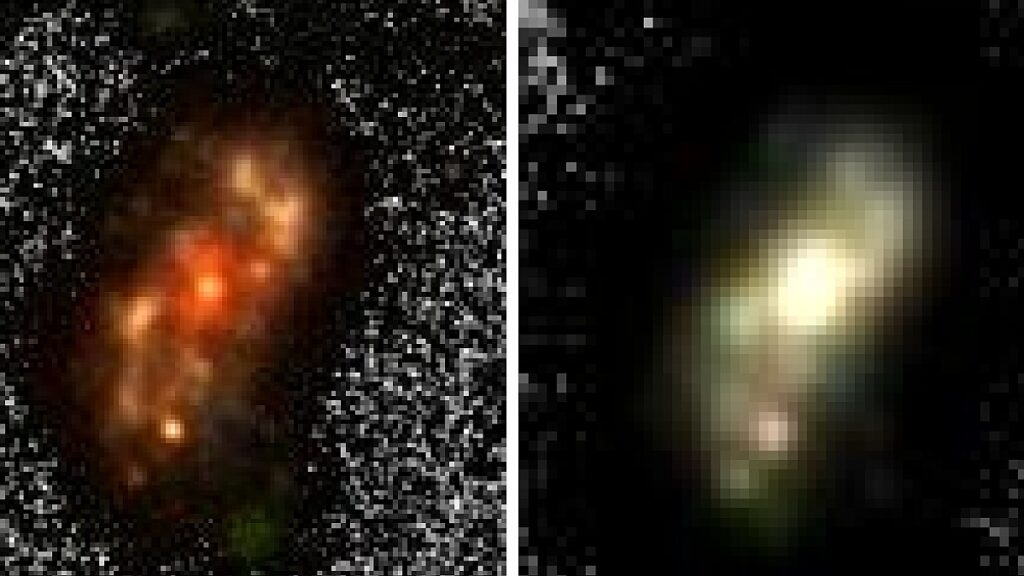
Webb telescope found a Milky Way lookalike 12 billion light-years away
In a groundbreaking discovery, astronomers have identified a large spiral galaxy named Alaknanda that formed just 1.5 billion years after the Big Bang, making it one of the earliest known spiral galaxies in the universe. This remarkable finding was made possible by the advanced capabilities of NASA’s James Webb Space Telescope (JWST), which captured detailed images of Alaknanda, revealing its striking resemblance to the Milky Way. The light from this galaxy has traveled over 12 billion years to reach Earth, showcasing the telescope’s ability to observe celestial bodies from a time when the universe was still in its infancy. Previously, astronomers believed that early galaxies were too chaotic to form the orderly structures seen in mature galaxies, but Alaknanda’s well-defined spiral arms challenge this long-held assumption.
The research team from the National Centre for Radio Astrophysics in India published their findings in the journal *Astronomy & Astrophysics*, highlighting the significance of gravitational lensing, a natural phenomenon where the gravity of a massive galaxy cluster magnifies the light from distant galaxies. This effect allowed scientists to observe Alaknanda’s features with unprecedented clarity. The galaxy spans approximately 32,000 light-years and boasts a flat, rotating disk with two prominent spiral arms, marking it as a “grand-design” spiral galaxy. The arms are adorned with bright clumps of newly formed stars, indicating active star formation at an astonishing rate of about 63 solar masses per year—significantly higher than the Milky Way’s current star production.
The discovery of Alaknanda raises intriguing questions about the processes that govern galaxy formation in the early universe. The lead author, Rashi Jain, emphasized that the physical mechanisms driving galaxy assembly may operate far more efficiently than current models suggest. With its stars averaging only 200 million years old, Alaknanda’s rapid formation challenges existing theories and suggests that the early universe was capable of producing large, organized galaxies much sooner than previously thought. As researchers continue to study Alaknanda, future observations with Webb’s instruments and radio telescopes will aim to uncover the dynamics of its star and gas movements, potentially revealing whether its spiral arms represent a stable structure or a transient phase in the galaxy’s evolution. This discovery not only enhances our understanding of galaxy formation but also opens up new avenues of exploration in the field of cosmology.
Researchers have discovered a large, orderly
spiral galaxy
that formed soon after the
Big Bang
, when
space
was only about 1.5 billion years old.
The galaxy, named Alaknanda, appears in observations made by
NASA
’s
James Webb Space Telescope
as part of major sky surveys. Because the
Milky Way
lookalike is seen at an extreme distance, its light has traveled for more than 12 billion years to reach Earth. Only recently has telescope technology become powerful enough to spot galaxies with this level of detail from such an early time.
For decades, astronomers believed galaxies in the early universe were too turbulent to settle into neat spiral shapes. Young stars and gas were thought to move chaotically, producing irregular clumps instead of smooth disks and arms.
Hubble Space Telescope
observations supported this view, as
spiral galaxies
seemed more scarce beyond about 11 billion years in look-back time.
The discovery raises new questions about how such structures formed so early.
“Alaknanda reveals that the early universe was capable of far more rapid galaxy assembly than we anticipated,” said Yogesh Wadadekar, the study’s co-author, in
a statement
. “Somehow, this galaxy managed to pull together 10 billion solar masses of stars and organise them into a beautiful spiral disk in just a few hundred million years. That’s extraordinarily fast by cosmic standards, and it compels astronomers to rethink how galaxies form.”
SEE ALSO:
NASA Mars rover captures crackling lightning. Hear the ‘thunder’ yourself.
Webb’s sharper vision has revealed many disk-shaped galaxies from the early universe, and now, a small but growing number of true spiral galaxies — including Alaknanda — far earlier than predicted by older models. The telescope found CEERS-2112 and REBELS-25, two spiral galaxies, in the early universe in 2023 and 2024, respectively.
The discovery of Alaknanda, made by scientists at the National Centre for Radio Astrophysics of the Tata Institute of Fundamental Research in India, has been published in the journal
Astronomy & Astrophysics
.
The research team was able to see immense detail in Alaknanda with the help of a natural phenomenon known as gravitational lensing.
Credit: NASA / ESA / CSA / I. Labbe / R. Bezanson / Alyssa Pagan / Rashi Jain / Yogesh Wadadekar
“The physical processes driving galaxy formation — gas accretion, disk settling, and possibly the development of spiral density waves — can operate far more efficiently than current models predict,” said Rashi Jain, the lead author, in a statement. “It’s forcing us to rethink our theoretical framework.”
Alaknanda — named after the Himalayan river that is a twin headstream of the Ganga — spans roughly 32,000
light-years
across, comparable to large modern spiral galaxies. It also contains a huge number of stars.
Images show that the galaxy already has a flat, rotating disk with two clear spiral arms with the classic pinwheel shape. These arms appear smooth and symmetrical, earning Alaknanda the label of a “grand-design” spiral galaxy, meaning it has defined arms rather than patchy or broken ones.
Along the spiral arms, scientists observed chains of bright clumps of newborn stars. These clumps look like a string of beads, marking areas where gas has collapsed into dense pockets that ignite new stars. In other views, each string appears as part of a larger spiral arm.
The research team was able to see immense detail in the distant galaxy with the help of a natural phenomenon known as
gravitational lensing
. A massive galaxy cluster’s gravity acts like a giant magnifying glass in the sky, bending and enhancing the light of Alaknanda to appear twice as bright.
Observing Alaknanda across different wavelengths of light allowed scientists to estimate the age of the galaxy’s stellar population and found the stars average only about 200 million years old.
Credit: NASA GSFC / CIL / Adriana Manrique Gutierrez illustration
To understand Alaknanda’s history, researchers compared its brightness across 21 different wavelengths of light, spanning ultraviolet to infrared. By matching those measurements to computer models of stellar populations, they estimated that the galaxy’s stars average only about 200 million years old. That means roughly half formed in a rapid burst after the universe was already more than 1 billion years old.
Alaknanda continues to grow quickly. It forms new stars at a rate equal to about 63
suns
per year — dozens of times faster than the Milky Way does today. Certain colors of light shine brighter than expected because glowing gas around new stars gives off strong signals, confirming the galaxy’s intense star-forming activity.
Scientists still do not know how spiral arms formed so quickly in these ancient systems. Some theories suggest they arise from slow-moving density patterns inside disks, while others point to gravitational disturbances from nearby galaxies or large clumps of gas. Alaknanda even appears to have a small neighboring galaxy that could have helped trigger its spiral structure, but more evidence is needed to draw that conclusion.
Future observations using Webb’s instruments for measuring motions inside galaxies, along with radio telescopes, could map how Alaknanda’s stars and gas orbit its center. Those data could help determine whether its disk has settled into its final configuration or whether the spiral arms represent a mere phase in its development.