Were there any venomous dinosaurs?
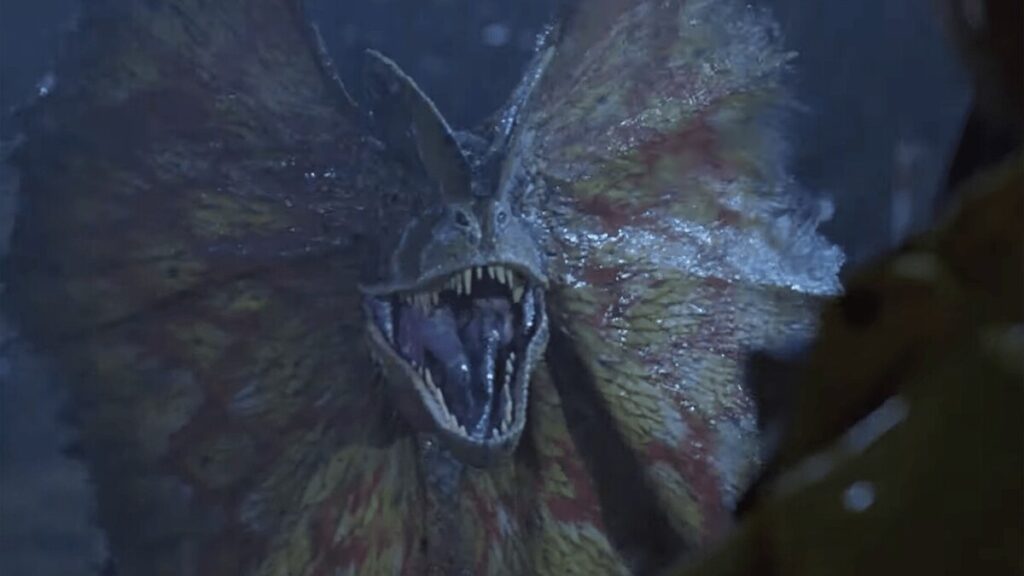
The fascination with dinosaurs has often been fueled by Hollywood’s imaginative portrayals, particularly in films like *Jurassic Park*, where the Dilophosaurus is depicted as a venomous creature capable of spitting toxic venom. However, recent paleontological research has debunked this myth, revealing that the frill and venomous abilities attributed to Dilophosaurus were likely products of creative license rather than scientific fact. Initially, in 1984, paleontologist Sam Welles speculated that the dinosaur possessed a venom gland due to the structure of its jaw, which he believed was too fragile for hunting. Yet, contemporary findings indicate that Dilophosaurus had a much stronger jaw than previously thought, and the supposed venom gland was misidentified. This raises intriguing questions about the potential existence of venomous dinosaurs, leading scientists to explore other candidates such as Sinornithosaurus, a small feathered carnivore from Cretaceous China. Though initially considered venomous due to grooves in its teeth that might have channeled toxins, further studies have cast doubt on this claim, with most paleontologists now agreeing there isn’t enough evidence to support the idea.
The distinction between venom and poison is crucial to understanding these discussions. Venomous creatures, like snakes and spiders, actively deliver toxins through bites or stings, while poisonous organisms, such as poison dart frogs, passively release toxins when touched. In searching for evidence of venom in prehistoric reptiles, paleontologists look for specific anatomical features, such as grooves or tubes in teeth. However, as Helen Burch, a paleobiology PhD candidate, points out, modern venomous reptiles like the Komodo dragon lack clear structures, suggesting that if venomous dinosaurs existed, their anatomical features might not be preserved in the fossil record. Interestingly, Burch highlights the case of Uatchitodon, a Late Triassic reptile with definitive venom structures resembling those of modern snakes. While it exhibited characteristics that link it to dinosaurs, it is not classified as one. This illustrates that although venomous reptiles coexisted with early dinosaurs, the evidence does not support the existence of venomous dinosaurs as depicted in popular culture.
The evolutionary implications of venom are also noteworthy, as Burch explains that venom has evolved multiple times across various animal groups, including reptiles and mammals. While the absence of modern venomous birds, which are the living descendants of dinosaurs, casts doubt on the likelihood of venomous dinosaurs, it remains possible that some prehistoric species may have developed similar defensive adaptations as seen in today’s toxic birds, like the pitohui of New Guinea. Ultimately, while the fossil record provides tantalizing clues, it cannot definitively answer whether dinosaurs were venomous, and it highlights the complexities of evolution and adaptation in the animal kingdom. As science continues to advance, so too does our understanding of these ancient creatures, leaving open the possibility that some of our assumptions about dinosaurs may still be challenged in the future.
https://www.youtube.com/watch?v=U_zjVY6A2ZU
It’s one of the most memorable scenes in the original
Jurassic Park
movie: the dinosaur
Dilophosaurus
spreads the frill around its neck and sprays deadly venom from its jaws. The frill (inspired by
Australia’s frilled lizard
) is pure Hollywood fantasy. But paleontologists did formerly speculate that
Dilophosaurus
spat venom, or at least had a toxic bite. Sam Welles,
who described the Arizonan dinosaur in 1984
, identified a structure in the jaw as a potential venom gland, and suggested that its jaws were too fragile to dispatch prey with brute force alone.
Today, more complete fossil evidence has rewritten these early assumptions. Scientists now believe that
Dilophosaurus
’s jaws were much stronger than previously thought, and what was thought to be a venom gland was just a misidentified part of the jawbone. So
Dilophosaurus
is no longer believed to have been venomous; but what about other
dinosaurs
?
In 2009, a small, feathered carnivore from Cretaceous China called
Sinornithosaurus
was also
speculated to be venomous
. Researchers noted grooves in
Sinornithosaurus
’s teeth that might have been channels for
the flow of toxins
. This claim initially generated media attention, but subsequent studies have
called it into question
. Today, most paleontologists do not believe there is sufficient evidence that
Sinornithosaurus
was venomous either
. While some paleontologists think there could still be venomous dinosaurs out there, we only have evidence for venom in just a handful of prehistoric reptiles that lack the defining anatomical features of dinosaurs.
This small, feathered Cretaceous dinosaur,
Sinornithosaurus
, was once speculated to be venomous.
Image: Nobumichi Tamura/Stocktrek Images / Getty Images
The difference between venom and poison
The terms “venomous” and “poisonous” are often confused with each other, but they actually refer to different ways that
animals
transmit organic poisons (toxins)
. Poisonous animals, such as poison dart frogs, passively deliver toxins when touched or bitten. Venomous animals have to actively sting or bite to deliver toxins, either to defend themselves, like bees, or to kill or immobilize prey, like spiders. While poisonous animals may store toxins throughout their bodies, venomous animals usually have specialized organs for producing and injecting venom.
How modern biology informs paleontology
When looking for evidence of venom production in prehistoric reptiles, paleontologists generally look for telltale venom-producing structures such as grooves or tubes in the teeth. “We have to use what we know in the modern world to inform what we can observe from the fossil record,” says Helen Burch, a PhD candidate in paleobiology at Virginia Tech University.
However, some modern venomous reptiles like the komodo dragon lack the
clearly visible tube structures
seen in snakes. Furthermore, “a lot of the reptiles that we see today have their venom glands positioned subdermally, or just below the skin,” says Burch, rather than in a depression in the bone. This means that “if we were looking for a venomous dinosaur, the structures that we would look for might not even be showing up in the bone,” she adds. So while there is no conclusively known venomous dinosaur, there’s a possibility that evidence simply wouldn’t show up clearly in the fossil record.
Burch explains that a prehistoric reptile called
Uatchitodon
, which lived in North America in the Late Triassic about 220 million years ago, “has a very definitive venom structure that looks pretty much exactly like what we see in modern snakes,” says Burch. “We have an opening at the base of the tooth and an enclosed tube, and then an opening at the tip of the tooth.” Without any remains of
Uatchitodon
beyond these remarkable teeth, we can’t say precisely where it fits on the reptilian family tree, so we can’t call it a venomous dinosaur.
However, it’s notable that “
Uatchitodon
had serrated teeth,” says Burch, and “at the time when we find
Uatchitodon
, the only animals that have serrated teeth are archosauromorphs,” a very large and diverse grouping that includes the dinosaurs, as well as
pterosaurs, crocodilians, and more
. So despite the venom-bearing structures in its teeth,
Uatchitodon
was likely more closely related to dinosaurs than to modern lizards and snakes, even though
Uatchitodon
was
not
a dinosaur.
Venomous prehistoric reptiles aren’t the same as venomous dinosaurs
Despite their incredible variety, all dinosaurs share certain skeletal characteristics. The presence or absence of these can help to diagnose a fossil as being from a dinosaur or not. For example, the legs of dinosaurs were positioned directly under their bodies, giving them
an upright stance
. In most other groups of reptiles, the legs sprawl out to the sides and the body may lie flat against the ground.
Burch was involved in the discovery of
Microzemiotes sonselaensis
, another of the few known reptiles with venom-producing features from the Mesozoic era, when the dinosaurs thrived.
Microzemiotes
‘ relation to other reptiles is unclear from existing remains.
Related Ask Us Anything Stories
What would a dinosaur taste like?
How do snakes move? It’s not all slithering.
Why are there so many birds?
Which animals can and can’t fart?
Without humans, what would happen to Earth?
Why do turtles do the ‘Superman pose’?
However, we know where to place another early venomous reptile,
Sphenovipera
: Rather than being a dinosaur, it belonged to a group whose only living representative is the tuatara, a lizardlike creature that lives on
rocky beaches in New Zealand
. The examples of these two species and
Uatchitodon
show us that venomous reptiles did live at the same time as the earliest dinosaurs, and that some fell within the same clade, or genetic grouping, as the dinosaurs themselves. But this doesn’t mean that there were actually venomous dinosaurs as
Jurassic Park
would have you believe.
Venom has evolved many times, in different ways
Burch points out that, while all modern venom-bearing reptiles are grouped together
in the clade Toxicofera
, “these animals that we’re seeing in the fossil record, that are reptiles that are hypothesized to be venomous, don’t fall inside this clade. So that is where it gets more interesting.”
The presence of venom structures across so many different groups suggests that venom has evolved multiple times in reptiles, just as it also evolved repeatedly in fish, mammals, and many other animals. Toxins are a useful evolutionary tool
with many applications
.
Burch points out that “we see venom used in super different ways” across different species, as well as a large variety of different toxins, including some meant to cause pain to an attacking predator, and others meant to immobilize prey long enough for it to be swallowed whole.
So, what’s the verdict on poisonous dinosaurs?
When it comes to the possibility of a venomous dinosaur, there’s not enough evidence to say for sure. “It is notable that we don’t have any modern birds which are venomous, which are the surviving lineage of dinosaurs,” says Burch. However, we do see dinosaurs—in this case, living birds—that store toxins as defensive poisons if we turn again to the modern world.
The jungles of New Guinea are home to several species of pitohui, the world’s
only known poisonous birds
. Pitohuis store built-up toxins from the insects they eat in every part of their bodies, even their bones and feathers, making them toxic enough to irritate the skin of
humans who handle them
. It’s certainly possible that some prehistoric dinosaurs did the same. In fact, genetic studies of pitohuis have shown that their toxic defense evolved multiple times independently, rather than once
in a common ancestor
. Perhaps it also evolved at least once in prehistoric dinosaurs.
The hooded pitohui (
Pitohui dichrous
) is the only known poisonous bird in the world.
Image:
DepositPhotos
While distinct structures like grooves in the teeth can point to an animal’s being venomous, no skeletal features can tell us if a creature was poisonous without organic material to examine. This means it would be impossible to know if an animal was poisonous “in the deep fossil record, when we lose all organic material,” says Burch. “I mean, we had frogs in the Triassic; we could have had poisonous frogs. But there’s simply no way to know, right?”
In
Ask Us Anything
, Popular Science answers your most outlandish, mind-burning questions, from the everyday things you’ve always wondered to the bizarre things you never thought to ask. Have something you’ve always wanted to know?
Ask us
.
The post
Were there any venomous dinosaurs?
appeared first on
Popular Science
.


