Trump embraces gas guzzlers and air pollution by weakening fuel economy standards
In a significant shift in U.S. automotive policy, President Donald Trump has announced a plan that will roll back fuel economy standards established by the Biden administration for model years 2022-2031. Under the new proposal from the National Highway Traffic Safety Administration (NHTSA), the federal fuel economy standard is set at around 34.5 miles per gallon by 2031, a stark reduction from the Biden-era goal of approximately 50.4 miles per gallon. This decision has drawn sharp criticism from environmental advocates who argue that it undermines efforts to reduce air pollution and combat climate change, potentially leading to higher fuel costs for consumers and adverse health outcomes, especially for vulnerable populations living near busy roadways.
Critics, including Darien Davis from the League of Conservation Voters, emphasize that these changes will not only increase costs for drivers but also threaten the progress made in reducing harmful emissions. The previous standards were projected to save Americans $23 billion in fuel costs over time and significantly cut gasoline consumption, preventing the release of millions of metric tons of carbon dioxide into the atmosphere. In stark contrast, Trump claimed that his rollback would lower car prices by $1,000, a statement that lacks supporting evidence and has been met with skepticism from clean energy advocates who predict that the new policies will lead to higher fuel expenses instead.
The rollback also reflects a broader trend in the Trump administration’s energy policies, which have seen the elimination of incentives for electric vehicle (EV) purchases and a push for increased oil and gas production. Automakers, previously incentivized to transition to cleaner technologies, now find themselves in a landscape where compliance with fuel economy standards is less stringent, as evidenced by the removal of fines for failing to meet Corporate Average Fuel Economy (CAFE) standards. This shift has been welcomed by industry leaders, including Ford CEO Jim Farley, who described the announcement as a “victory of common sense and affordability.” As the U.S. Department of Transportation prepares to finalize these standards after a public comment period, the implications of this policy change will be felt across the automotive landscape, affecting everything from vehicle pricing to environmental health.
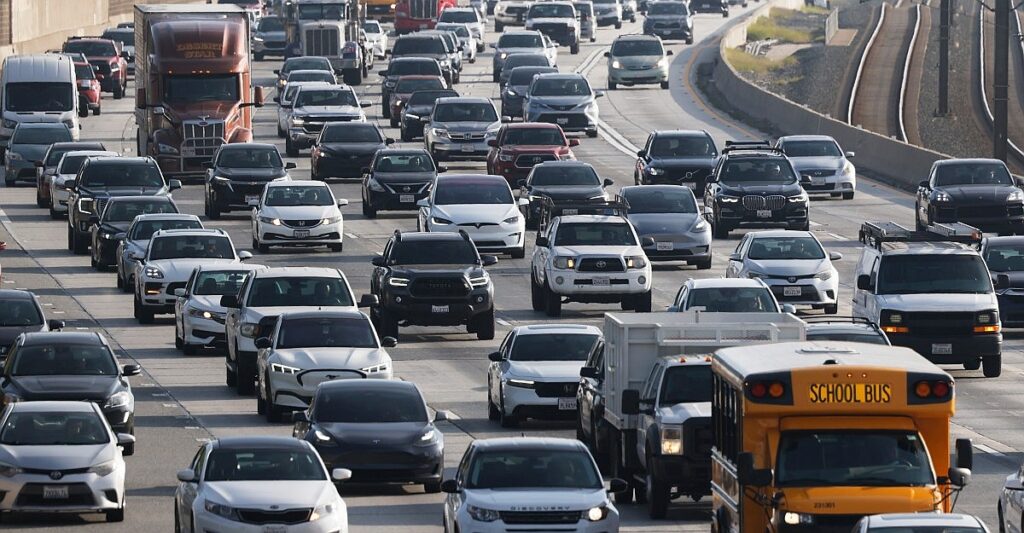
Motorists drive on Interstate 210 during the morning commute on December 03, 2025 in Pasadena, California.
President Donald Trump announced a new plan that lets carmakers pollute more by making less fuel efficient vehicles. The National Highway Traffic Safety Administration (NHTSA)
said today that it’ll roll back
fuel economy
rules finalized last
year by the Biden administration for model year 2022-2031 vehicles.
The Trump administration has
eliminated incentives for EV purchases
,
stymied energy efficiency
policies, and gutted
pollution regulations
in general. The president wants the US to produce more oil and gas, and says that his agenda will boost business for American automakers. Critics contend that Americans will ultimately pay for these measures with higher fuel costs, as well as health risks and climate disasters stemming from tailpipe emissions.
“Slashing fuel economy standards will increase costs for drivers and threaten the progress made in reducing dangerous air pollution and preventing adverse health outcomes for children, older adults, and communities who live near busy roads,” Darien Davis, government affairs advocate on climate change and clean energy at the League of Conservation Voters, said in a statement emailed to
The Verge
.
“Slashing fuel economy standards will increase costs for drivers”
NHTSA proposed a federal fuel economy standard of around 34.5 miles per gallon of gas by 2031. That’s far lower than the bar Biden set last year of reaching an average of roughly 50.4 miles per gallon by 2031.
The agency
previously estimated
that the higher standards set in 2024 would collectively save Americans $23 billion in fuel costs over the years, or about $600 for each passenger car and light truck owner over the lifetime of their vehicle. The rules were expected to cut down gasoline use by 70 billion gallons through 2050. That would avoid 710 million metric tons of planet-heating carbon dioxide pollution,
equivalent
to taking more than 165.6 million gas-guzzling passenger vehicles off the road for a year. Trump claimed without evidence that his latest action would shave $1,000 off the price of a car, while clean energy advocates expect the rollback to lead to higher fuel costs.
Automakers would likely have had to sell more EVs in order to meet the higher Biden-era standards for fleetwide fuel economy. Trump’s Transportation Secretary Sean Duffy
accused the Biden administration
in June of
illegally using Corporate Average Fuel Economy (CAFE)
standards to mandate EV sales. In July, Republicans
eliminated fines for carmakers failing
to meet CAFE standards in the
giant spending bill
they passed in July and
sunsetted tax credits for EVs
. “America Now Effectively Has No Fuel Economy Rules,” reads a July
headline from Kelley Blue Book
.
GM had paid $128.2 million in CAFE penalties for 2016 and 2017,
Reuters
reports
. Stellantis, which owns Chrysler, has paid more than $590 million in penalties since 2016. Leadership for both companies joined the president in the Oval Office today as he announced the new CAFE standards.
“We’ve just freed you up, so you’re going to have a good day, you’re going to have a good number of years,” Trump said to auto industry leaders during the announcement.
“Today is a victory of common sense and affordability,” Ford CEO Jim Farley later responded.
The US Department of Transportation is
expected to post the proposal for public comment
before finalizing standards next year.