Condemning Millions for One Man’s Crime
In the wake of a tragic shooting incident in Washington, D.C., where an Afghan man allegedly killed a member of the West Virginia National Guard and critically injured another, the implications of Donald Trump’s presidency on immigration and asylum policies have come into sharp focus. This event has become a catalyst for Trump to further his agenda against refugees and immigrants, particularly targeting those from Afghanistan. Following the shooting, Trump swiftly canceled all U.S. visas issued to Afghans abroad, halted asylum hearings, and announced a review of green cards for migrants from 19 countries, including Afghanistan. His rhetoric painted a picture of a nation under threat, suggesting that individuals like the alleged shooter were allowed into the U.S. unchecked, despite the fact that he had been granted asylum under the Trump administration itself. This contradiction highlights the broader theme of misinformation that has characterized Trump’s approach to immigration, as he continues to propagate false narratives about the safety of returning Afghan refugees to their homeland and the supposed dangers posed by migrants.
The article also critiques the underlying ideologies driving these policies, particularly those articulated by Stephen Miller, a key architect of Trump’s immigration strategy. Miller’s assertion that migrants inherently import the societal ills of their home countries is not only misleading but dangerous, as it fosters an environment of collective guilt and prejudice. The author reflects on the historical injustices faced by various immigrant groups, emphasizing that the actions of a few should not define an entire population. This narrative of fear and division undermines the core values of Western civilization, which include the sanctity of individual lives and the principle of judging people on their merits rather than their backgrounds. The article poignantly illustrates the human cost of these policies through the story of Saman, an Afghan refugee in Pakistan, who, despite her family’s sacrifices during the war, now finds herself and her loved ones at risk of deportation back to a Taliban-controlled Afghanistan. Her heartfelt condemnation of violence and her plea for understanding serve as a powerful reminder of the resilience and humanity of those seeking refuge.
Ultimately, this tragic incident and the subsequent political fallout reveal the complexities of immigration policy and the profound impact it has on real lives. As the Trump administration’s actions continue to shape the narrative around refugees and migrants, the need for empathy and a reevaluation of these policies has never been more urgent. The article calls for a recognition of the individual stories behind the statistics, urging a shift away from fear-mongering towards a more compassionate and just approach to those seeking safety and a new beginning in America.
https://www.youtube.com/watch?v=5afpFMIdSEQ
Most of us are lucky enough to avoid any direct encounter with the true nature of Donald Trump’s presidency. But over time, abstract nouns such as
authoritarianism
and
xenophobia
lose their hard edges with too much use. It can take some personal experience to bring home what the Trump administration is doing to human lives and values.
The solitary Afghan man who allegedly shot two members of the West Virginia National Guard near the White House last week, killing a 20-year-old woman and critically wounding a 24-year-old man, gave the president exactly the pretext he needed to crush the hopes of desperate people here and around the world. Trump started with Afghans, canceling all U.S. visas issued to Afghans abroad and barring visa holders from entering the country, including men and women who aided the 20-year American war effort in Afghanistan. He halted asylum hearings in the U.S. for all migrants; announced that green cards issued to migrants from 19 countries, including Afghanistan, would be reviewed; and promised to examine every asylum case approved under the previous administration. He wrote that any foreign-born resident of the U.S. found to be “incapable of loving our Country” or “non-compatible with Western Civilization” would be deported.
[
Juliette Kayyem: A terrible and avoidable tragedy in D.C.
]
This broad assault against the right of refuge is being staged on a heap of lies. Trump suggested that he would never have allowed the alleged gunman—who had served in a CIA-trained unit during the war—and others like him into the country; in fact Trump criticized President Joe Biden for leaving Afghan allies behind after the fall of Kabul in 2021, and the alleged gunman was granted U.S. asylum in April, under Trump. He said that Afghans were allowed into the U.S. “unvetted,” when they’ve been put through security screenings at every stage, from the original entry to the request for asylum and green cards. The claim by Kristi Noem, Trump’s secretary of homeland security, that Afghanistan is now safe enough for her department to send Afghan refugees back there is a lie.
The argument that federal troops are needed in U.S. cities to end a nonexistent crime wave created by refugees and other migrants is a lie, as is the administration’s insistence that national security requires mass deportation. Trump himself has undermined that security far more by purging the FBI of agents deemed disloyal, cutting millions of dollars from counter-terrororism, and diverting thousands of federal law-enforcement officers to the dirty business of rounding up men in Home Depot parking lots and arresting married couples who have shown up to a green-card hearing. “If they are correct in characterizing the shooting as a terrorist attack,” Becca Heller, the founder of the International Refugee Assistance Project, told me, “how come no one is talking about the intelligence failure that allowed a terrorist attack against U.S. troops on U.S. soil?”
All of these lies are built on a deeper one. Stephen Miller, the ideologue behind the foreigners-out policy, told it over the weekend in a social-media
post
: “You are not just importing individuals. You are importing societies. No magic transformation occurs when failed states cross borders. At scale, migrants and their descendants recreate the conditions, and terrors, of their broken homelands.”
If it were true that those fleeing horrifying violence are bound to inflict the same oppression on others, Miller might well have added:
Just as Jews imported here from postwar Europe brought the industrial slaughter of Dachau and Bergen-Belsen with them and inflicted it on their innocent American neighbors in Scarsdale. Just as South Vietnamese who managed to flee the victorious North terrorized the peaceful streets of Galveston with civil war and torture. Just as multiple generations of Iranians and Sudanese have imposed the brutal tyrannies of their homelands on the good people of Los Angeles and Fargo.
Miller is justifying collective punishment and guilt by blood. I’ve witnessed those barbarisms elsewhere, in war-ravaged countries and in dictatorships, but never before during my lifetime as a matter of national policy here at home. Trump and his top aides are re-creating in America the conditions and terrors of failed states. They’re erasing the distinction between the perpetrators and victims of violence. They’re abolishing the essential value of the Western civilization they claim to be defending: the sanctity of each individual; the right of all men and women to be judged on their own merits, not as faceless carriers of the pathologies of entire societies and heritages.
[
David A. Graham: Trump seizes back the spotlight
]
Within hours of the shooting, I received a text from an Afghan woman I know,
whom I’m calling Saman
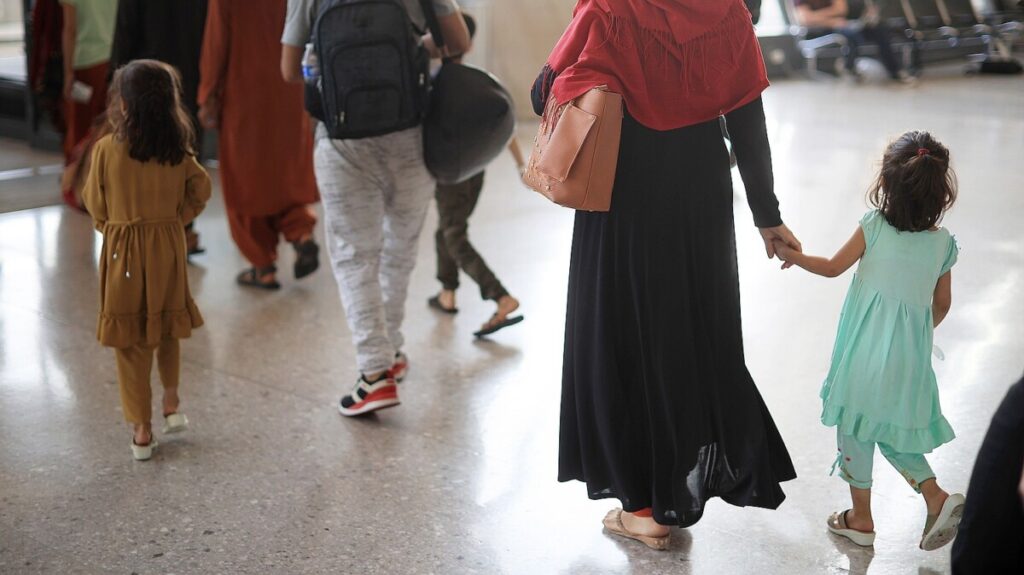
. (She asked that I not use her real name.) She’s a refugee in Pakistan, where she, her husband, and their two small children are barely surviving month to month as they try to escape deportation by the Pakistani authorities back to Afghanistan. There an ominous fate would await them. Both Saman and her husband served in the Afghan special forces during the American war. She is Hazara, a religious minority that has suffered severe repression under the Taliban; her sister in Afghanistan is hiding from Taliban attempts to force her into marriage; her husband’s brother is languishing in a Taliban prison. After years of repeated vetting by the U.S. refugee agency, the couple was about to be resettled here in January, when Trump returned to office and halted the program.
No other country is willing to accept them, and now they’ve been utterly abandoned by the country at whose side they fought. An administration that claims to be standing up for the U.S. military is inflicting moral injury on troops that have vouched for their wartime Afghan comrades, including Saman and her husband. I was still trying to find a way to tell her that their last hope of being allowed to come here had just died—that the president and his advisers have deemed her and her family incapable of loving America, incompatible with Western civilization, and certain to bring Afghanistan’s chaos and terror to the United States—when I heard from her. I can’t come up with any answer to the Trump administration better than what Saman said herself:
This tragedy was shocking, painful, and beyond anything words can truly express. I want to offer my sincere condolences to you and to everyone affected by this terrible event. I want to state clearly and with all my heart that I strongly condemn this attack. Such violence is inhuman, unjustifiable, and against every moral value I believe in. As an Afghan, I feel a heavy weight of sorrow and shame that someone from my country committed such a horrific act, even though I know very well that the actions of one individual do not represent an entire nation.
To be completely honest … sometimes I wish I were not Afghan. I wish I had not been born in Afghanistan so I would not have to carry the burden and the pain caused by the actions of people who do not represent the real, peaceful Afghan people.
I kindly ask you not to let this tragedy change the way you see me, or the many Afghans who believe deeply in peace, humanity, and mutual respect.


