Google plans to power a new data center with fossil fuels, yet release almost no emissions – here’s how its carbon capture tech works
As the demand for energy from AI data centers surges across the United States, concerns about their greenhouse gas emissions are mounting. These data centers, which can require anywhere from a few megawatts to over 100 megawatts of power, are significantly impacting the environment, especially when their energy source is fossil fuels. To mitigate these emissions, innovative solutions like carbon capture and storage (CCS) are gaining traction. CCS technology captures carbon dioxide emissions from power plants and industrial facilities and sequesters them underground in geological formations, effectively preventing them from entering the atmosphere. Google has recently entered into a groundbreaking corporate power purchase agreement to support the development of a natural gas power plant in Illinois that will utilize CCS to capture approximately 90% of its emissions.
The mechanics of CCS involve capturing carbon dioxide produced during the combustion of fossil fuels, transporting it—often through pipelines—and injecting it deep into the earth for permanent storage. Various geological formations can serve as storage sites, including depleted oil and gas reservoirs, volcanic basalt, and deep saline aquifers. The latter, particularly the Mount Simon sandstone formation in Illinois, is seen as a promising option due to its vast capacity, which could potentially store between 27 and 109 gigatons of carbon dioxide. This is significant considering that the total carbon emissions from fossil fuels in the U.S. for 2024 are projected to be about 4.9 gigatons. Google’s collaboration with Broadwing Energy aims to utilize this aquifer, employing existing infrastructure from prior carbon storage projects, such as those initiated by Archer Daniels Midland.
The urgency for implementing CCS is underscored by the rapid expansion of data centers and the projected need for an additional 100 gigawatts of power capacity annually to meet rising energy demands. Experts, including those from the International Energy Agency, assert that CCS technology is essential for combating climate change and preventing global temperatures from escalating to dangerous levels. While challenges remain—such as past incidents of leaks and the need for stringent monitoring—the potential of CCS to significantly reduce emissions from one of the fastest-growing energy sectors is a hopeful development in the fight against climate change. As more companies and initiatives embrace this technology, the path towards a more sustainable energy future becomes increasingly viable.
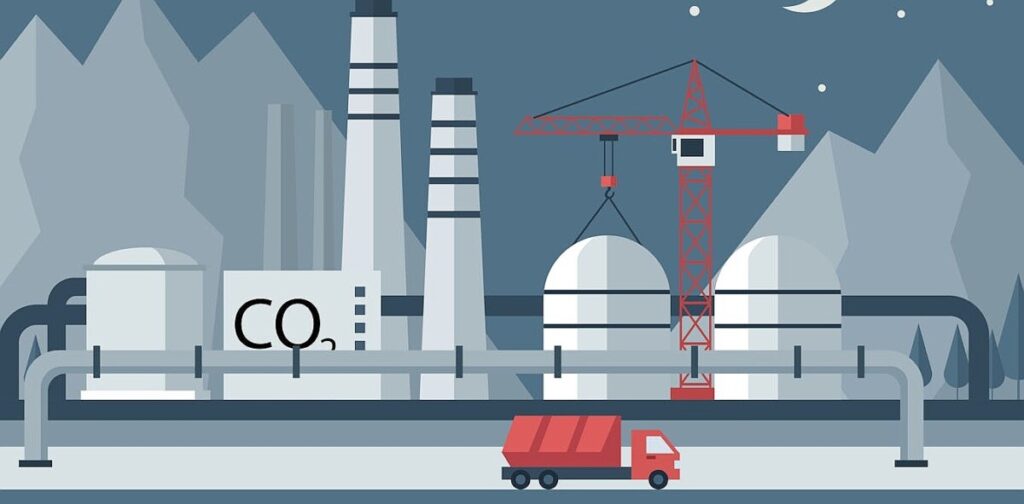
Carbon capture and storage projects capture carbon dioxide emissions from industrial facilities and power plants and pipe them underground to geological formations.
Nopphinan/iStock/Getty Images Plus
As AI data centers spring up across the country, their energy demand and resulting greenhouse gas emissions are raising concerns. With servers and energy-intensive cooling systems constantly running, these buildings can use anywhere from a few megawatts of power for a small data center to
more than 100 megawatts
for a hyperscale data center. To put that in perspective, the average large natural gas power plant built in the U.S. generates
less than 1,000 megawatts
.
When the power for these data centers comes from fossil fuels, they can become major sources of climate-warming emissions in the atmosphere – unless the power plants capture their greenhouse gases first and then lock them away.
Google recently entered into a unique corporate power purchase agreement to support the
construction of a natural gas power plant
in Illinois designed to do exactly that through carbon capture and storage.
So how does carbon capture and storage, or CCS, work for a project like this?
I am an engineer who wrote
a 2024 book about various types of carbon storage
. Here’s the short version of what you need to know.
How CCS works
When fossil fuels are burned to generate electricity, they
release carbon dioxide
, a powerful greenhouse gas that remains in the atmosphere for centuries. As these gases accumulate in the atmosphere, they
act like a blanket
, holding heat close to the Earth’s surface. Too high of a concentration heats up the Earth too much,
setting off climate changes
, including worsening heat waves, rising sea levels and intensifying storms.
Carbon capture and storage involves capturing carbon dioxide from power plants, industrial processes or even directly from the air and then transporting it, often through pipelines, to sites where it can be safely injected underground for permanent storage.
A snapshot of some of the ways carbon capture and storage works. The pipelines into the oil layer, in black, and the oil well illustrate enhanced oil recovery.
Congressional Budget Office, U.S. Federal Government
The carbon dioxide might be transported as a
supercritical gas
– which is right at the phase change from liquid to gas and has the properties of both – or dissolved in a liquid. Once injected deep underground, the carbon dioxide can become permanently trapped in the geologic structure, dissolve in brine or become mineralized, turning it to rock.
The goal of carbon storage is to ensure that carbon dioxide can be kept out of the atmosphere for a long time.
Types of underground carbon storage
There are several options for
storing carbon dioxide underground
.
Depleted oil and natural gas reservoirs
have plentiful storage space and the added benefit that most are already mapped and their limits understood. They already held hydrocarbons in place for millions of years.
Carbon dioxide can also be injected into working oil or gas reservoirs to push out more of those fossil fuels while leaving most of the carbon dioxide behind. This method, known as
enhanced oil and gas recovery
, is the
most common one
used by carbon capture and storage projects in the U.S. today, and
one reason CCS draws complaints
from environmental groups.
Volcanic
basalt rock
and
carbonate formations
are considered good candidates for safe and long-term geological storage because they contain calcium and magnesium ions that interact with carbon dioxide,
turning it into minerals
. Iceland
pioneered this method
using its bedrock of volcanic basalt for carbon storage. Basalt also covers most of the oceanic crust, and scientists have been exploring the potential for
sub-seafloor storage reservoirs
.
How Iceland uses basalt to turn captured carbon dioxide into solid minerals.
In the U.S., a fourth option likely
has the most potential
for industrial carbon dioxide storage – deep saline aquifers, which is what Google plans to use. These widely distributed aquifers are porous and permeable sediment formations consisting of sandstone, limestone or dolostone. They’re filled with highly mineralized groundwater that cannot be used directly for drinking water but is very suitable for storing CO2.
Deep saline aquifers also have large storage capacities, ranging from about 1,000 to 20,000 gigatons. In comparison, the nation’s
total carbon emissions from fossil fuels in 2024
were about 4.9 gigatons.
As of fall 2025,
21 industrial facilities
across the U.S. used carbon capture and storage, including industries producing natural gas, fertilizer and biofuels, according to the Global CCS Institute’s 2025 report. Five of those use deep saline aquifers, and the rest involve enhanced oil or gas recovery. Eight more industrial carbon capture facilities were under construction.
Google’s plan is unique because it involves a power purchase agreement that makes building the power plant with carbon capture and storage possible.
Google’s deep saline aquifer storage plan
Google’s
400-megawatt natural gas power plant
, to be built with
Broadwing Energy
, is designed to capture about 90% of the plant’s carbon dioxide emissions and pipe them underground for permanent storage in a deep saline aquifer in the nearby
Mount Simon sandstone formation
.
The Mount Simon sandstone formation is a huge saline aquifer that lies underneath most of Illinois, southwestern Indiana, southern Ohio and western Kentucky. It has a layer of
highly porous and permeable sandstone
that makes it an ideal candidate for carbon dioxide injection. To keep the carbon dioxide in a supercritical state, that layer needs to be
at least half a mile (800 meters) deep
.
A thick layer of Eau Claire shale sits above the Mount Simon formation,
serving as the caprock
that helps prevent stored carbon dioxide from escaping. Except for some small regions near the Mississippi River, Eau Claire shale is considerably thick – more than 300 feet (90 meters) – throughout most of the Illinois basin.
The
estimated storage capacity
of the Mount Simon formation ranges from 27 gigatons to 109 gigatons of carbon dioxide.
The Google project plans to use an existing injection well site that was part of the first large-scale carbon storage demonstration in the Mount Simon formation. Food producer Archer Daniels Midland
began injecting carbon dioxide
there from nearby corn processing plants in 2012.
Carbon capture and storage has had challenges as the technology developed over the years, including a
pipeline rupture
in 2020 that forced evacuations in Satartia, Mississippi, and caused several people to lose consciousness. After a recent
leak deep underground at the Archer Daniels Midland site
in Illinois, the Environmental Protection Agency in 2025 required the company to improve its monitoring. Stored carbon dioxide had migrated into an unapproved area, but no threat to water supplies was reported.
Why does CCS matter?
Data centers are expanding quickly, and utilities will have to build more power capacity to keep up. The artificial intelligence company OpenAI is urging the U.S. to
build 100 gigawatts
of new capacity every year – doubling its current rate.
Many energy experts, including the International Energy Agency, believe
carbon capture and storage will be necessary
to slow climate change and keep global temperatures from reaching dangerous levels as energy demand rises.
Ramesh Agarwal does not work for, consult, own shares in or receive funding from any company or organization that would benefit from this article, and has disclosed no relevant affiliations beyond their academic appointment.


