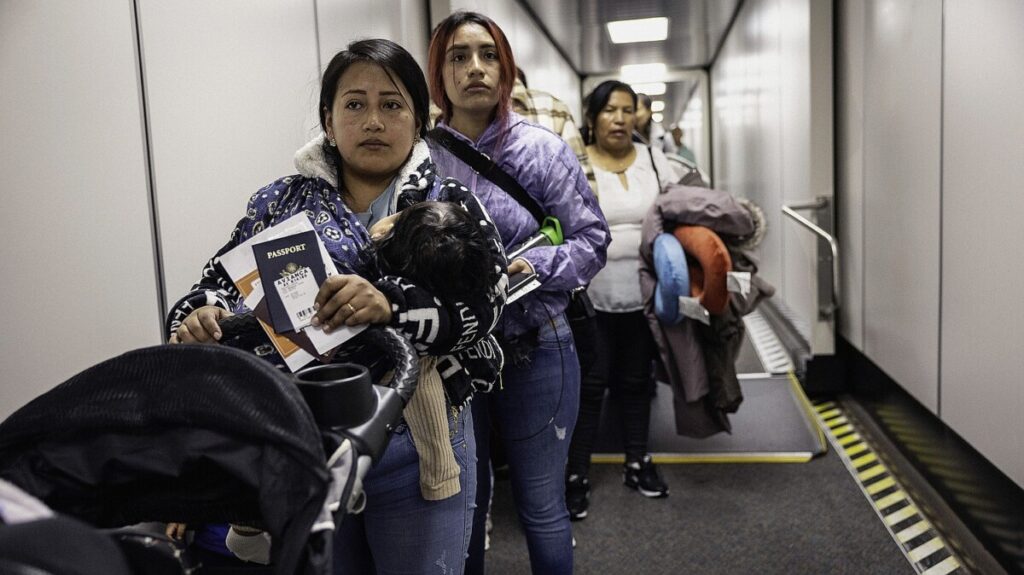
The $7,500 Self-Deportation
In the spring of 2023, the Department of Homeland Security (DHS) initiated an ambitious $200 million advertising campaign aimed at encouraging undocumented migrants to “self-deport” through a government app called CBP Home. This initiative, dubbed Project Homecoming, offered participants a free plane ticket and a $1,000 cash bonus if they formalized their departure from the United States. Nearly nine months into the program, approximately 35,000 individuals have utilized the app to leave the country, translating to an expenditure of around $7,500 for each self-deportation when factoring in the costs of advertisements, airfare, and cash incentives. This approach is framed by DHS officials as a more humane alternative to the traditional enforcement methods employed by Immigration and Customs Enforcement (ICE), which can cost upwards of $17,000 per deportee.
The campaign’s messaging targets not only potential deportees but also aligns with the political agenda of the Trump administration, which has sought to amplify fears surrounding immigration. Following a tragic incident involving National Guard troops near the White House, President Trump called for a “REVERSE MIGRATION,” highlighting a broader goal of removing one million immigrants annually. However, despite these lofty ambitions, ICE is projected to achieve only about 400,000 removals in the current year, falling significantly short of the administration’s targets. The DHS has faced scrutiny over the transparency of its data, as statistics on border arrests and deportations have not been published since January, raising questions about the integrity of the reported figures. Critics, including four Democratic senators, have expressed concerns regarding potential conflicts of interest in the awarding of contracts related to the advertising campaign, particularly noting ties between DHS officials and GOP-linked firms.
Despite the substantial investment in the self-deportation initiative, the effectiveness of the campaign is questionable. Reports indicate that only a small fraction of those who have left the U.S. since Trump’s return to office did so using the CBP Home app, with many opting to depart quietly without financial incentives. The DHS claims that a staggering 1.6 million immigrants have voluntarily left the country since Trump took office, a figure that, if accurate, would represent the largest decline in the foreign-born population in over half a century. However, experts have raised skepticism about this number, pointing to inconsistencies in labor market data and questioning the reliability of the estimates. As the DHS continues to promote the app during the holiday season, the implications of these mass departures remain uncertain, particularly concerning labor markets, housing prices, and overall economic conditions in the U.S.
https://www.youtube.com/watch?v=7DN-QDixLzo
T
he Department of Homeland Security
launched a $200 million advertising campaign this past spring that urged migrants to “self-deport,” dangling an offer that sounded like a darker version of a credit-card promotion. By formalizing their departure through a government app, CBP Home, participants could receive a free plane ticket and a $1,000 cash bonus.
Nearly nine months later, about 35,000 people have used CBP Home to leave the country, according to figures I obtained from two DHS officials who track the program. Given the cost of the advertising blitz, as well as the airfare and cash payments, it works out to about $7,500 per self-deportation.
The DHS spokesperson Tricia McLaughlin wrote to me that the program, called Project Homecoming, has created “a smooth, efficient process for illegal aliens to return home” and that “tens of thousands” of participants have used CBP Home to depart. McLaughlin declined to say what DHS spends per self-deportation, but the department has estimated the cost of having ICE officers arrest, detain, and deport someone to be more than $17,000 per deportee.
The target audience for the pricey ads was not just potential deportees but also the president’s core supporters. After National Guard troops were shot, one of them fatally, near the White House last week, allegedly by an Afghan national, President Donald Trump said on social media that he wanted to “permanently pause migration from all third world countries” and called for “REVERSE MIGRATION,” which he
later defined
as “get ’em out of here; I want to get ’em out.” The White House has set a goal of
1 million removals
a year, but according to the latest government data, ICE is on track to carry out about 400,000 during Trump’s first year back in office. (U.S. border authorities also turned away about 100,000 people, which DHS counts in its overall deportation tally of more than 500,000.) It’s the highest level in a decade, though far short of the president’s promises.
Authoritative data on border arrests, deportations, and other immigration-enforcement metrics used to be
published
monthly by DHS’s Office of Homeland Security Statistics. But the office hasn’t released a report since January, and the deportation statistics cited by the administration typically appear in social-media posts and press releases.
[
Read: The self-deportation psyop
]
DHS Secretary
Kristi Noem
and her aides have tried to boost deportation numbers by setting arrest quotas for ICE officers. They have embraced and promoted imagery of harsh street-level immigration enforcement to sow fear and intimidate people into leaving. They present self-deportation as a more humane alternative to ICE enforcement, one that allows people to exit on their own terms rather than in shackles. Within
weeks
of Trump’s inauguration, Noem’s team began awarding contracts on an emergency basis for the promotional
campaign
, bypassing the standard competitive-bidding process.
Four senators, including Gary Peters, the ranking Democrat on the Senate homeland-security committee, sent a letter on November 20 to the DHS inspector general requesting an investigation into ties between top department officials and the GOP-linked firms that won the awards. Last month, ProPublica
reported
that one subcontractor is the Strategy Group, a company run by the husband of McLaughlin, the DHS spokesperson. The company has worked extensively for Noem and
Corey Lewandowski
, the longtime Trump lieutenant who has no formal role at DHS but functions as Noem’s de facto chief of staff.
“By invoking a national emergency, DHS was able to award this contract while circumventing federal contracting regulations requiring a fair and open competition, raising concerns that the Department misused emergency authorities to steer taxpayer funds toward politically connected entities,” the senators wrote in their
letter
.
DHS officials have denied wrongdoing. When ProPublica asked McLaughlin about her husband’s firm’s contract with DHS, McLaughlin said, “We don’t have visibility into why they were chosen.” She declined to comment to me on the ProPublica findings.
The self-deportation ads continue to appear on social-media platforms and during Spanish-language broadcasts of soccer games and other sporting events. One recent ad, shared by DHS and the White House to Instagram, shows images of ICE officers shackling migrants and loading them onto planes alongside the words “If ICE finds you.” Then it pivots to the words “If you self-deport” and a set of images showing smiling travelers and kids getting stuffed animals as they board a flight home.
Although DHS’s spending on ads has been a boon to contractors, the campaign doesn’t appear to be persuading many people to use CBP Home. By the department’s own estimates, only about one in every 50 immigrants who has self-deported since Trump took office has done so using the app. Most of them are giving up and leaving quietly, without the money or the free flight.
N
oem and other department leaders
insist that they have not missed the White House’s deportation target and are in fact exceeding it. They claim that 1.6 million immigrants have voluntarily left the country since Trump took office—four times the number removed by ICE. If true, it would be the largest drop in the number of foreign-born U.S. residents on record, with potential implications for food prices, rents, wages, and other benchmark indicators.
Trump officials have already declared victory. Micah Bock, a DHS public-affairs official who records weekly social-media videos that
sermonize
on U.S. history and culture (including that “America is not a nation of immigrants” and that “Thanksgiving is not a global potluck”), claimed this month that mass departures will benefit Americans worried about affordability.
“Wages for Americans are rising,” Bock said in one video. “Rents in places like the Midwest, Miami, and Boston are plummeting as foreign nationals leave our country in droves.”
Bock’s Thanksgiving
message
claimed that DHS has “driven the largest decline in the foreign-born population of the United States in over 50 years” and that the drop is “making our neighborhoods safer for children to play outside and our elders to walk without fear.”
The 1.6 million figure appears to be based on an estimate by the Center for Immigration Studies, a small Washington, D.C.–based think tank whose efforts to restrict immigration have had an outsize influence on Trump’s policy advisers, including Stephen Miller. DHS has treated the demographic estimates as an enforcement statistic, reporting the departures as if they were carried out by ICE officers rather than estimated by academic analysts.
[
Read: Hundreds of thousands of anonymous deportees
]
DHS officials declined to explain to me the basis for the claim of 1.6 million self-deportations. The department has previously suggested that the figure is a product of its own data, without saying how it was reached. So I called Steven Camarota, one of the researchers at the Center for Immigration Studies who came up with the estimate.
Camarota and the other analysts I spoke with cautioned that the available data are preliminary and that more estimates will be released by the Census Bureau’s American Community Survey next year.
Camarota and a co-author used data from the monthly Current Population Survey, a Census Bureau query of 60,000 households that is used by the Bureau of Labor Statistics to calculate the unemployment rate and other monthly indicators. The CPS estimated a 2.2 million decline in the country’s foreign-born population from January to July.
Camarota calculated that three-quarters of that change was the result of self-deportations by immigrants Trump compelled to leave. “These declines are unprecedented, and so they should be viewed with some skepticism,” Camarota told me. “But the best data we have shows a big decline. We’re seeing it month after month.” He also pointed to surveys of employers in construction and hospitality—two industries that typically hire immigrants not authorized to work in the United States—that show employees quitting at increasing rates.
Jed Kolko, a former Commerce Department official during the Biden administration who is now at the Peterson Institute for International Economics, cast doubt on the Current Population Survey data in a recent
post
arguing that the self-deportation figures are implausibly large. On an annual basis, he wrote, the figures would suggest a decline of roughly 4 million foreign-born residents, implying “absurd gyrations in the labor market.”
Kolko told me that a drop of such magnitude would mean that the population of the United States is falling at a record rate, leaving millions of vacant jobs and a much tighter labor market. That is not what unemployment and wage data show, he told me, and the Trump administration continues to forecast higher GDP growth incompatible with a major population shift.
“If the workforce is growing much more slowly all of a sudden or even shrinking, then you would be likely to forecast GDP to grow more slowly—unless you are arguing that output per worker is growing at a historically high rate,” Kolko said.
[
Read: Every state is a Border Patrol state
]
The relationship between falling rents and self-deportations is also murky. Susan Wachter, a real-estate economist at the University of Pennsylvania’s Wharton School, told me that the biggest declines are in cities in the South and the West Coast, where the housing supply has expanded faster than demand.
“There is a plausible story that a decline in demand will lead to lower growth in rents,” Wachter told me. “But the rent declines at this point are mostly in the overbuilt cities in the South, where there’s a lag response in increasing demand in those cities.”
The size of the foreign-born population of the United States was about 50 million last year, according to 2024 Census estimates; of that number, 11 million to 14 million were believed to be living in the country without legal status. But Chloe East, an economist at the University of Colorado Boulder who studies immigration and labor markets, told me that calculating out-migration using monthly employment surveys is not reliable because “we don’t really have great alternative estimates of the foreign-born population.”
East said that she is watching the construction and service industries for signs of an inflationary effect. “When we remove a lot of the workers from those industries, firms will often raise the price of the goods and services, because it’s harder for them to find workers,” she told me.
DHS’s claim that wages are rising for U.S.-born workers does not appear to be confirmed by the most recent Bureau of Labor Statistics data, released in July. Those data showed private-industry wage growth
slowing
during the second quarter of 2025. The BLS says that its next figures, covering the third quarter up through September, will be released on December 10.
East said that her research on previous mass-deportation campaigns did not find an across-the-board increase in wages for U.S. workers. “We think that that’s largely because these jobs are hard to attract U.S.-born workers to work in, even if the employers offer higher wages, because they’re more dangerous, they’re more dirty, they’re seasonal jobs, they’re jobs with unpredictable schedules,” she told me. “That makes it hard to attract other people to take these jobs.”
At DHS, senior officials have launched an end-of-year push to boost deportation numbers by urging people to use CBP Home to leave for the holidays—and not come back. “Do you hear that? Home is calling!” Border Patrol Chief Michael Banks wrote on social media over Thanksgiving.
“This holiday season, give yourself the gift of home with the CBP Home app,” DHS trolls in another ad on social media. Set to the Perry Como song “(There’s No Place Like) Home for the Holidays,” the
ad
, which resembles a 1950s black-and-white commercial, shows departing immigrants picking up toys as they board a plane to leave.


