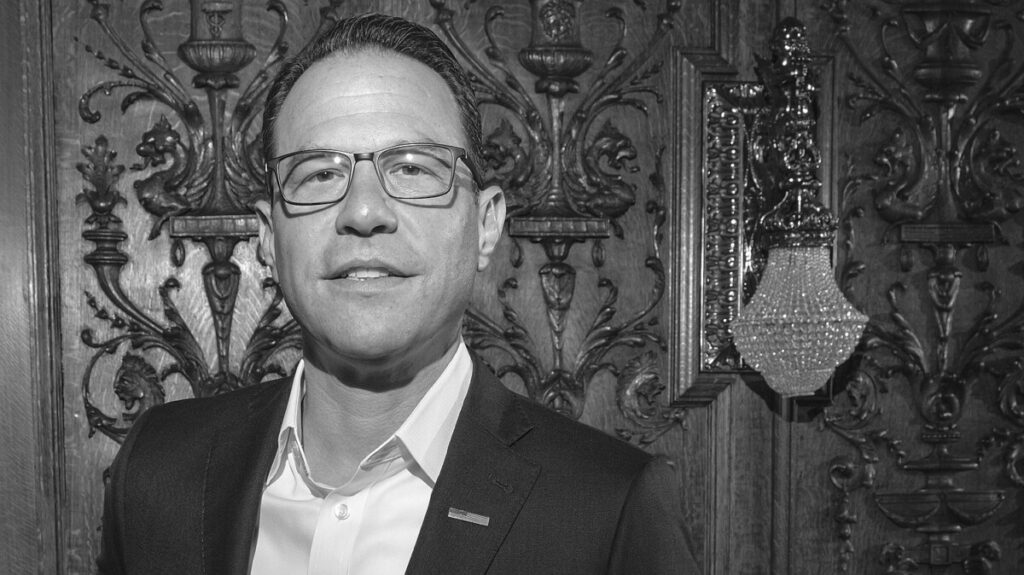
What Josh Shapiro Believes
In a recent in-depth profile from *The Atlantic*, Pennsylvania Governor Josh Shapiro emerges as a complex figure navigating the treacherous waters of contemporary American politics. Known for his calm demeanor and strategic approach, Shapiro is often likened to former President Barack Obama for his composed communication style. However, a recent interview revealed a more volatile side as he reacted to criticisms from Vice President Kamala Harris in her new book, which accused him of ambition and self-interest during their discussions about a potential vice-presidential partnership. Shapiro’s indignation at these claims, particularly the insinuation that he sought to influence decisions about the vice-presidential residence, highlights the vulnerabilities that lie beneath his polished exterior. Despite his typically measured responses, the interview showcased a moment of raw emotion, revealing Shapiro’s deeper frustrations with how he is perceived within his party and the broader political landscape.
Shapiro’s political journey has been marked by a commitment to addressing the needs of Pennsylvania’s working-class citizens, often focusing on issues that resonate with voters across party lines. His administration has prioritized practical solutions, such as eliminating the college-degree requirement for public-sector jobs and enhancing vocational training, which have earned him a 60% approval rating in a state that is a crucial battleground. Shapiro’s approach is informed by a belief that Democrats must reconnect with disillusioned voters, especially those who have turned to figures like Donald Trump. He argues that the Democratic Party has often alienated these constituents through elitist attitudes and failure to address their concerns. Shapiro’s pragmatic style has led him to seek common ground with Republicans, but this has also drawn criticism from progressives who feel he compromises too easily.
As Shapiro eyes a potential presidential run in 2028, he faces the dual challenges of maintaining his moderate appeal while navigating the increasing polarization within his party. His ability to connect with voters, including those who traditionally support Republicans, positions him as a unique candidate who could bridge divides. However, as the political environment shifts, Shapiro’s carefully crafted narrative may be tested. His past decisions, including controversial stances on issues like school choice and his handling of a recent sexual harassment scandal involving a close associate, could haunt him in a future campaign. Ultimately, Shapiro’s journey reflects the broader struggles of the Democratic Party as it seeks to redefine itself in an era marked by populism and division, making his potential candidacy one to watch in the coming years.
https://www.youtube.com/watch?v=PWcEQX98XDc
I
t is a rare thing
to see Josh Shapiro sweat. For all the grief the Pennsylvania governor gets for imitating Barack Obama—the staggered cadence, the side-of-the-mouth delivery for effect—their essential shared trait is self-possession. If Pennsylvania’s governor has a superpower, it is an unflappability that allows him to stay cool and composed and to communicate precisely what he wants to communicate.
Most of the time.
I sat down to talk with Shapiro earlier this fall, shortly after he held a tough-on-crime press conference near Philadelphia. By that point, I had interviewed him several times. His comments were always polished and predictable: More than once, I would return to variations of a question I’d already asked, hoping to penetrate his practiced commentary, only to get the same responses, word for word. This was especially the case when I raised the subject of Kamala Harris.
I knew, from speaking with people close to Shapiro, that he’d lost some respect for the former vice president during the 2024 campaign—and not simply because she chose someone else as her running mate. In Shapiro’s view, given the near-existential stakes for both the Democratic Party and American democracy, Harris’s lapses during the election—in particular, ignoring Joe Biden’s obvious decline—were unforgivable. But he had been careful not to say so publicly.
Shapiro knew that I would take one more run at his thoughts about Harris. What he didn’t know was that early copies of her book were then making the rounds among reporters. Having obtained the relevant sections of
107 Days
that morning, I asked Shapiro if Harris had given him any heads-up about her book. She had not, he said. Then I told him that Harris had taken some shots at him.
Shapiro furrowed his brow and crossed his arms. “K,” he said.
The man I observed over the next several minutes was unrecognizable. Gone was his equilibrium. He moved between outrage and exasperation as I relayed the excerpts. Harris had accused him, in essence, of measuring the drapes, even inquiring about featuring Pennsylvania artists in the vice-presidential residence; of insisting “that he would want to be in the room for every decision” Harris might make; and, more generally, of hijacking the conversation when she interviewed him for the job, to the point where she reminded him that he would not be co-president.
“She wrote that in her book?” he said in response to the claim concerning the residence’s art. “That’s complete and utter
bullshit
.”
“I can tell you that her accounts are just blatant lies,” he added.
After reading Harris’s book and talking with people from both camps, I found descriptions of the meeting to be mostly consistent. Shapiro arrived in an edgy mood, chafing at efforts among fellow Democrats to sabotage his tryout. (Shapiro, who is Jewish, was especially irked by
anti-Semitic innuendo from the left
.) The two skipped past any semblance of small talk and Shapiro proceeded to interview Harris, rather than the other way around. “I did ask a bunch of questions,” Shapiro told me, sounding exasperated. “Wouldn’t you ask questions if someone was talking to you about forming a partnership and working together?”
What seemed to bother Shapiro, more than any one detail, was Harris portraying him in ways consistent with the whispers that had dogged him throughout the vetting process and throughout his career: that he was selfish, petty, and monomaniacally ambitious. Given that they’d known each other a long time—“20 years,” Shapiro said with a groan—I asked whether he felt betrayed.
“I mean, she’s trying to sell books and cover her ass,” Shapiro snapped. The governor stared past me now, shaking his head. As I began to ask a different question, he held up a hand. He looked disgusted. With me? With Harris? No, I began to realize: He was disgusted with himself.
“I shouldn’t say ‘cover her ass.’ I think that’s not appropriate,” Shapiro said. His tone was suddenly collected. “She’s trying to sell books. Period.”
One could understand why Shapiro’s facade had momentarily cracked. In the past year, he has feuded with a president who has unleashed the federal government on personal and political opponents; evacuated his wife and children from a residence set ablaze by a would-be assassin; confronted a surge of anti-Semitism from the far right and far left alike; and agonized over the direction of a Democratic Party that appears impotent in the face of an assault on the nation’s governing institutions.
The 52-year-old Shapiro has kept some distance from the fray. He doesn’t host a podcast or spend much time on cable news. Even as he engages in regular skirmishes with the White House over policy matters, the governor goes out of his way to not antagonize the MAGA base. Shapiro, who is expected to run for president in 2028, believes that his party’s prospects of regaining power depend less on combatting Donald Trump than on courting the president’s supporters. He may be onto something: Shapiro’s approval rating in Pennsylvania—the country’s premier battleground state, where he’s spent roughly half his life on the ballot and never lost a race—hovers around 60 percent.
If he does launch the presidential bid that some friends say, only half-jokingly, he’s been plotting for 30 years, it will rest on two basic theories. The first is that competence will soon be the hottest commodity in politics. The second is that exhaustion, more than anything else, will motivate voters in 2028. To take advantage of that—to chisel away at the MAGA coalition—will require more than generic, Biden-esque pledges to restore civility. Shapiro believes that it will demand humility on the part of Democrats, a sincere accounting of how they contributed to the electorate’s fracturing along lines of class and culture.
He knows this isn’t necessarily a popular thing to say. Shapiro’s methodical career climb has been built, to no small degree, on preparation and risk management. Even those who detest the governor acknowledge that he is a master operator, someone with an uncanny ability to diagnose threats and seize opportunities and say the right thing at the right time. In an era of populist disruption, however, it’s unclear whether Shapiro’s carefully calibrated approach to politics is still an advantage.
For a man with such an established public profile—years as a congressional aide, decades in various elected offices, a network as extensive as that of any Democrat in office today—Shapiro remains something of a mystery, a man whose real views and motives are widely debated but ill-defined. In conversations with dozens of people who know the governor, a certain irony is inescapable. Shapiro seems to believe that he is uniquely equipped to run for president and repair the Democratic Party’s deficit of trust and authenticity. Any such campaign, however, would expose deficits of his own.
Jonno Rattman for The Atlantic
Shapiro visits with day campers at the York State Fair, in York, Pennsylvania, July 2025.
T
he men leaned
over the counters of their vendor booths, craning their necks to follow the sight of a VIP and his security entourage as they marched past and turned a corner. “Who was that?” one of them shouted.
A woman in her 50s, retreating in the direction of her mobile root-beer stand, yelled back: “The governor!”
Ann Phillips appeared irritated, even a bit upset. Most of the people I met at the York State Fair, an annual festival of deep-fried culture in South Central Pennsylvania, were Republicans. Phillips was too—a three-time Trump voter. In fact, Phillips told me, she’s never voted for a Democrat in her life. But she wasn’t upset with Shapiro because of his party identification. She was upset when Shapiro passed by her without stopping. She wanted to shake his hand, take a photograph, and tell the governor that he should run for president in 2028.
“I actually respect him. He’s not full of shit,” Phillips said. “Unlike most Democrats, he seems to actually care about regular people.”
Consider this an early prototype of forthcoming “Elect Shapiro” ads: a hardworking white woman against a backdrop of snow cones and saucer-cup rides, in a county Trump carried by 25 points, praising the Democratic governor for defying the pompous stereotypes of his party.
Since his election in 2022, Shapiro has been hard at work building a policy profile—and a political brand—that revolves around helping the forgotten people of Pennsylvania. One of his first actions was to drop the state’s college-degree requirement for nearly all public-sector jobs. He doubled funding for apprenticeship and vocational-training programs. He expanded grants to help farmers while attempting to streamline regulatory and permitting processes for the agriculture industry. He worked with conservative lawmakers to end Pennsylvania’s centuries-old ban on Sunday hunting.
A native of suburban Philadelphia who listens to hip-hop but also loves NASCAR, Shapiro has identified his party’s blind spots the old-fashioned way. He typically spends three days a week on the road, touring main streets across the commonwealth, listening to what locals have to say. Throughout our conversations, Shapiro spoke repeatedly of the “righteous frustration” he encounters when roaming the state. People in small towns have watched their jobs disappear, their children die of overdoses, their communities fall apart in the space of a single generation. All the while, they saw “the perpetrators,” as Shapiro put it, escape accountability at every turn.
Those people might have expected some empathy from the Democratic Party. What they got instead was a sort of contemptuous neglect—elites lecturing and looking down on them, yes, but mostly just looking the other way. By the time Obama left office, Democrats had accepted as gospel the concept of demography as destiny; party officials saw no worth in catering to non-college-educated white voters, whose share of the electorate was rapidly shrinking.
“Democrats lost ground in some of these communities by failing to show up and failing to treat people with a level of respect that they deserve,” Shapiro told me. The chief beneficiary of this turned out to be Donald Trump.
The governor wanted to make something clear: He dislikes the president. Does not respect him, does not agree with most of his policies. “But I do respect his ability to communicate with these constituencies,” Shapiro said. “Donald Trump has been a once-in-a-generation political figure who’s managed to connect on a deeper cultural level.”
The problem, Shapiro added, is that the connection is built on lies. He noted, for example, how during the 2024 election Trump consistently promised never to touch entitlement programs. “His first bill was to gut Medicaid for 310,000 Pennsylvanians, including 154,000—so half—from communities that Donald Trump won,” Shapiro said. “And that pisses me off—that he showed up in these communities, lied to these good people, and then turned around and completely fucked them over by taking away their health care to pay for a tax cut for people in the highest income brackets who”—he punctuated every word—“Do. Not. Need. Them.”
The governor had grown animated. “
That
,” he said, “is treating people disrespectfully.”
Of course, disrespect comes in many different forms. Shapiro recently visited Potter County to announce a grant that would help a small general store replace its ancient gas-storage tanks; in a remote area with no other refueling options around, this represented a lifeline for a community that caters to snowmobilers, hunters, fishermen, and ATV riders. When he met with the locals—salt-of-the-earth types, he said, who were surprised that a
Democrat
would come around—he was struck by how low the bar had been set.
Given these voluminous odes to the good, God-fearing folk of the commonwealth, I asked Shapiro about what Obama had said in 2008—his musing that people in small-town Pennsylvania, pummeled by deindustrialization, “get bitter; they cling to guns or religion or antipathy toward people who aren’t like them, or anti-immigrant sentiment, or anti-trade sentiment, as a way to explain their frustrations.” The governor winced as I read the words to him.
“I think his understanding of the challenges in those communities was real. But I think instead of offering his prescription for how he’d make it better, he insulted the very folks who were suffering,” Shapiro said.
He pointed out that Obama’s remarks, and Hillary Clinton’s infamous “basket of deplorables” comment, were uttered at high-dollar fundraisers (the former in San Francisco, the latter in New York City). This, he seemed to imply, was the root of the problem: Democrats mock the voters in flyover country for the entertainment of their coastal audiences, then act surprised when those same voters turn on the Democratic Party. In fact, Shapiro seemed to suggest at one point, he was sympathetic to voters who’d done so in 2024.
“We can’t ignore the fact that elections are binary choices. And so you’re asking people, at least in the last case, to choose between Kamala Harris and Donald Trump,” he said. “We can have this kind of theoretical conversation about Trump, but, like, it was always Trump
versus somebody
.”
When I pointed out that many of the people we’d been discussing were not reluctant Trump voters—that, in fact, most were enthusiastic Trump voters—the governor cut me off.
“They’re also a Shapiro voter.”
He reminded me four times during our conversations that polling showed roughly 30 percent of Trump supporters in Pennsylvania also supported him. Shapiro wanted to make a point: Democrats are wrong to dismiss their grievances with blanket caricatures. “It doesn’t mean that there’s not racism and bigotry and anti-Semitism and hate out there,” he said. “But the vast majority of people that I confront every day are really good people and, at least here in Pennsylvania, are willing to split their tickets and are willing to vote for people that they think are gonna get out there and make their lives better.”
I asked him to explain something: Why have all these decent and honest and kind people pledged their allegiance to a president who is indecent and dishonest and cruel?
“I think,” he said, drawing a long breath, “it is a question that’s still not totally answerable.”
This was a rare admission of uncertainty for a man who’s always seemed to have the answers.
[
From the January 2025 issue: George Packer on the Trump reaction and what comes next
]
Jonno Rattman for The Atlantic
Shapiro made two shots at a basketball carnival game at the York State Fair, July 2025.
Despite standing
5 foot 8, Shapiro was a big man on campus at Akiba Hebrew Academy: a captain of the basketball team, bellower of Billy Joel songs, charmer of female classmates. (His 11th-grade yearbook includes a photo of Shapiro in a hula skirt, a bra, and Nikes.) Everyone attached to the Jewish private school in suburban Philadelphia—teachers, parents, fellow students—seemed to love Shapiro, the son of a prominent pediatrician.
Shapiro enrolled at the University of Rochester, in New York, with plans to follow his father into medicine and walk onto the school’s Division III basketball team. But both dreams fell apart on the same day: Early in the fall semester, Shapiro flunked a premed exam and was cut from the basketball team. Dejected, he returned to his dorm and ran into a classmate looking for someone to represent their hall in student government. Shapiro made a face at the memory of this conversation. “Like,
I don’t know why I’d ever want to do that
,” he recalled thinking.
The governor loves to tell this story as a lesson in serendipity—that politics came for him, not the other way around—perhaps to neutralize narratives about his ambition. The reality is more complicated. His mother, a schooolteacher who’d marched for civil rights, had steered him toward activism. Shapiro had applied to live in Tiernan Hall, housing set aside for students interested in service and leadership. As a high schooler, he’d launched a long-shot bid for student-body president that he lost. Now, soon after joining the student government at Rochester, he decided once again to run for president—as a freshman—and wound up winning an upset over multiple upperclassmen.
Shapiro was in a hurry. A search of Rochester’s archives turns up dozens of hits detailing his presence on campus; most notable is an
op-ed arguing that peace would “never come” to the Middle East
, because Palestinians “are too battle-minded to be able to establish a peaceful homeland of their own.” (Shapiro has since renounced those sentiments.) But he wasn’t all bombast. Rochester’s magazine, for instance, described him attending a multicultural gathering with other students; amid profound differences over ideology and upbringing, the young Shapiro comes across as charitable and unassuming. “We live in a world where Democratic elites are seen as looking down on everyone,” Ami Eden, a childhood friend of Shapiro’s who today is a journalist in New York City, told me. “And here’s Josh. He’s the exact opposite. He doesn’t come off as thinking he’s smarter than anyone. He doesn’t come off as thinking he’s better than anyone.”
For this, Shapiro credits his devout and unpretentious parents. Raised in an observant Jewish household—Shabbat dinner every Friday, synagogue on Saturday mornings—Shapiro felt a measure of liberation when he moved away. He still kept kosher and hung around the Hillel on campus. Yet he was beginning to think about religion less in terms of observance and more in terms of purpose. In time, he would come to find inspiration in the character of Joshua, who led God’s people into the promised land, demonstrating the patience and faithfulness Shapiro wished to emulate as a leader.
Patience did not come naturally. In 1994, he landed a semester-long congressional internship. According to his then-roommate, Adam Keats, Shapiro wasn’t especially interested in the free happy hours and late-night parties that drew other college kids to Capitol Hill. “He had come to D.C. for a reason,” Keats recalled, “and that was to get a full-time job in Washington.”
Even with the political climate growing hotter—Newt Gingrich’s revolution was under way—Shapiro hit it off with Democrats and Republicans alike, collecting names and phone numbers and favors to call in. After graduation, Shapiro worked briefly in the Israeli embassy’s public-affairs division in D.C., then returned to the Hill full-time. In the fall of 1998, Joe Hoeffel was sitting in a temporary office in Washington when a young man showed up and announced, “I’m Josh Shapiro, and I’d like to be your legislative director.” Hoeffel, who had just been elected to Congress, was taken aback—“
Who the hell is this kid?
” he recalled thinking—but eventually hired him. Three months later, when Hoeffel decided to replace his chief of staff, he promoted Shapiro to the top job. Nobody he’d consulted had ever heard of a 25-year-old chief of staff, yet nobody questioned the decision.
“He was just a natural,” Hoeffel told me.
The congressman remembered one incident that became office lore: When giving an interview to a small Jewish publication, Shapiro went into such detail about his responsibilities, and about his record delivering for the people of Pennsylvania’s Thirteenth District, that “you would have thought we had a one-person office,” Hoeffel said. The congressman’s other staffers made copies of the article and plastered them all around the office, he said, mostly to tease the young chief of staff but also to deliver a none-too-subtle reminder to Shapiro: Politics is a team sport.
What they didn’t realize was that Shapiro was preparing to go solo.
Michael Bryant /
The Philadelphia Inquirer
/ AP
Shapiro, then Montgomery County commissioner, greets a voter at a diner while running for Pennsylvania attorney general, April 2016.
Mark Peterson / Redux
Shapiro and former President Barack Obama at a campaign rally, November 2022.
Kyle Grantham / The New York Times / Redux
Shapiro addresses reporters outside his official residence on April 13, 2025, after the mansion was lit on fire by an arsonist.
I
n 2003
, Shapiro and his high-school sweetheart turned wife, Lori, who’d worked in the Clinton administration, moved home to the Philadelphia suburbs. They planned to have children, make private-sector money, and catch their breath. Shapiro, who’d earned a law degree from Georgetown via night school, found work at a big firm. But he barely made it through orientation before he started to grow restless.
So Shapiro set a meeting with Democratic power brokers in Harrisburg. “These were still the days of an old machine, where we dealt with veteran politicians who’d climbed the ladder,” Mike Manzo, who served as chief of staff to Pennsylvania’s House Democratic Caucus, told me. “And here comes this young lawyer from Philly, giving us a granular breakdown of every neighborhood in the district and telling us the people he was going to target door-to-door. It was honestly kind of jarring.”
With his wife’s blessing—Lori is known to be the governor’s political consigliere—the longtime staffer became a candidate. He cashed in on D.C. connections to turn his race for the state assembly into a trendy stop for national Democrats, hosting Howard Dean, Steny Hoyer, and others for campaign events. Still, on the stump, Shapiro was his own man. Yard signs listed no party affiliation. Mailers announced, “My plan is neither Democratic nor Republican—it’s common sense.” Tax cuts and tort reform were pillars of his platform.
Newspapers portrayed the 153rd District race as a bellwether, but in the end, it wasn’t close. Shapiro beat his Republican opponent by nearly 10 points—one of just two Democrats in the state to flip a House seat that cycle—and charged into the assembly with designs on upending the place. That didn’t go over well.
“He didn’t have one true friend in the entire fucking assembly,” Bill DeWeese, the legislature’s top-ranking Democrat at the time, told me. “He was a political athlete of the first magnitude—everyone could see that—and Harrisburg was just a way station for him. He was already on his way to running for bigger and better offices, and people resented it.”
DeWeese acknowledged that he is “not a paragon of objectivity” when it comes to Shapiro. After all, the young lawmaker was initially a protégé and later turned on him, calling for his resignation amid a scandal that ultimately sent DeWeese to prison. Still, DeWeese’s assessment wasn’t altogether different from that of others I spoke with about that period. Colleagues recalled how, after refusing a pay raise that had been passed by the legislature, Shapiro raised prodigious amounts of money while bashing members, including his supposed friends, who’d voted for it. They also pointed out how the first-term lawmaker helped orchestrate a power-sharing agreement that elected a Republican speaker—and won himself the newly created post of deputy speaker.
As a legislator, Shapiro was limited by the immutable—being young, short, and Jewish, not quite a recipe for political stardom in a place like Harrisburg. But he compensated with rare political instincts. As the Pennsylvania Democratic establishment was lining up behind Hillary Clinton in the 2008 presidential primary, Shapiro endorsed Obama. A few years later, in 2011, he left the assembly—not for a congressional bid, as many had anticipated, but to run locally, in Montgomery County, for a spot on its three-member board of commissioners.
Joe Hoeffel—Shapiro’s former boss—had become board chair in 2011, and was thrilled when he heard that Shapiro wanted to run. But Shapiro didn’t want to be Hoeffel’s sidekick. The two men sat down several times; Hoeffel hoped they could reach an understanding, but Shapiro wouldn’t budge. He wanted the top of the Democratic ticket and the board chairmanship. He wanted Hoeffel to recognize that, at a certain level, politics is
not
a team sport.
Hoeffel decided to retire. Shapiro was elected commissioner and took over as chairman. But he was gaining an ugly reputation. “You don’t want to turn your back on him,” Hoeffel
told
The
Philadelphia Inquirer
in a 2017 interview
. “Loyalty is not his strong suit.”
Hoeffel told me he stands by those comments. But he added an important bit of context: He thinks Shapiro is a good man, and furthermore, he believes Shapiro could make an outstanding president. This might have struck me as incongruous—that one could admire the governor, both personally and professionally, yet not quite trust him—if I hadn’t heard the same thing again and again from other members of his own party.
Jonno Rattman for
The Atlantic
Shapiro shakes hands with a member of the Air Force, July 2025.
S
hapiro has never been
easily pegged on the ideological spectrum. To the extent that he has an organizing philosophy, it’s that government can and should be a tangible force for good in people’s lives. (Hence the gimmicky slogan that has become ubiquitous within his political orbit: “GSD,”
for
Get Shit Done
.) Montgomery County was a testing ground. Under Shapiro’s leadership, the board implemented austerity measures, erasing its budget shortfall while increasing salaries and bolstering pensions for county employees. Party affiliation became an afterthought as Shapiro built alliances and gave appointments to prominent Republicans. The fights Shapiro did pick—defying state law in 2013, for instance, by giving marriage licenses to same-sex couples—were rare. Bruce Castor, a Republican who served eight years on the board, including four alongside Shapiro—and who later led Trump’s defense during his second impeachment trial—told me that “the job of commissioner is a total pain in the ass, and Josh was by far the best person I’ve ever seen do it.”
After four years running the county, Shapiro was getting antsy again, and saw an opening to run for Pennsylvania attorney general. He had no prosecutorial experience but plenty of relationships that helped him collect the cash and endorsements necessary to win the 2016 primary. After beating his GOP opponent by three points in November—tallying more votes in Pennsylvania than either Donald Trump or Hillary Clinton—Shapiro became the commonwealth’s chief law-enforcement officer.
In two terms, Shapiro fought Trump’s 2017 so-called Muslim travel ban, reached a huge settlement with pharmaceutical companies that had profited from the opioid epidemic, prosecuted a handful of elected officials, and secured guilty pleas for several of the Penn State fraternity members responsible for the hazing death of a pledge.
But the case that brought Shapiro the most recognition was one he inherited. Upon taking office, the new attorney general was told of a secret grand-jury probe already under way. Shapiro decided to press forward. Two and half years later, his office published its findings: More than 1,000 minors had been abused over a period of decades by some 300 priests across Pennsylvania. Shapiro fought to publish a full, unredacted report that named every name, even taking his appeals for transparency to the pope himself, and in the process made enemies of powerful Catholics. But he secured justice for survivors and gained a measure of celebrity along the way. A
New York Times
headline declared: “
Meet Josh Shapiro, the Man Behind the Bombshell Investigation of Clergy Sexual Abuse
.”
Shapiro had always looked more like a banker than a politician: glasses with thin wire rims, dark hair parted neatly on one side, tie in a prominent knot. Before long, a makeover was in the works. Slicked-back hair covered an emerging bald spot. He began wearing glasses with thick black frames and navy suits with an open collar, no tie, along with clean white sneakers. The change could be heard as well as seen: Shapiro began playing with intonations and dropping the
g
from the ends of words—sounding an awful lot like a certain friend of his. (“I just don’t hear it,” Shapiro said of the Obama impersonation that has been the source of much ridicule. “I don’t think I’ve changed my cadence or my rhythm or how I speak.”)
This evolution reflected an apparent reality: Shapiro was on his way. Early in his second term as attorney general, the 2022 Democratic nomination for governor was already his. After running unopposed in the primary—something unheard of in a statewide contest—he got outright lucky in the general election. Republicans chose as their nominee Doug Mastriano, a state senator most famous for his fanatical religious identity (he’d prayed that God would help Republicans “seize the power” ahead of January 6, and launched his campaign for governor to the sound of a shofar blowing) and his association with the anti-Semite Andrew Torba, the founder of the far-right social-media platform Gab. (Mastriano eventually
distanced himself from Torba
and said that he rejected anti-Semitism.)
As an opening salvo, Shapiro recorded a 60-second biographical ad that showed footage of his family observing Shabbat, citing his obligation to make it home every Friday for dinner with his wife and four children. This struck some allies as an unnecessary risk. One prominent Democrat, a liaison to the campaign from Washington, pleaded with Shapiro’s team not to run the ad. But the candidate felt strongly—due in part, perhaps, to the extremist ideology embodied by his opponent—that a proper introduction to voters must include his Jewish identity.
The fall campaign turned into a drubbing. In a state where the past two presidential races had been decided by a combined total of less than two points, Shapiro beat Mastriano by 15 and helped downballot Democrats recapture the state House for the first time in more than a decade.
Sworn into office as Pennsylvania’s 48th governor in January 2023, Shapiro had reason to feel bullish. The midterms had validated his theory that narratives of bigotry and polarization were overstated. Trumpism had just been routed at the ballot box. The former president was isolated and unpopular. The 2016 election was looking more and more aberrant. A return to relative unity seemed possible, and Shapiro embraced a malice-toward-none approach aimed at healing the body politic.
Instead, the wounds only grew deeper.
[
From the February 2025 issue: Stephanie McCrummen on the New Apostolic Reformation’s war on the secular state
]
O
ne Friday
this past spring, Shapiro and Lori took their kids to visit Ellis Island. They stood on a balcony inside the main building, looking down at where their ancestors had taken their first steps on American soil, the parents explaining how the long journey in steerage had been worth it for two poor Jewish families that dreamed of freedom. It was a poignant moment for the Shapiros. And then the next night, after hosting a Passover seder in Harrisburg, Josh, Lori, and three of their children were nearly murdered in their beds when a man named Cody Balmer broke into the governor’s residence and started lighting Molotov cocktails.
As we spoke in the months that followed, Shapiro admitted that he was still struggling with “emotional challenges” stemming from the incident. He’d been informed that Balmer blamed him for the deaths of Palestinians in Gaza. Shapiro also learned that his assailant had wielded a hammer and planned to bludgeon him to death. Nothing—not even the guilty plea that will imprison Balmer for up to 50 years—can eradicate the trauma of that night, or the guilt he’s borne in the aftermath.
“If I don’t run for office, if I don’t get elected governor, they’re not sleeping there that night,” Shapiro said at one point, staring off as he relived the episode. He told me later: “My desire to serve put my kids’ lives at risk. And that’s something that I carry around.”
What he began to realize, as he processed his family’s ordeal, is that it actually makes his outreach to Republicans all the more important. “The fact that people view institutions as incapable or unwilling to solve their problems is leading to hyper-frustration, which then creates anger,” he said. “And that anger forces people oftentimes into dark corners of the internet, where they find others who want to take advantage of their anger and try and convert that anger into acts of violence.” Shapiro believes that politicians have a duty to confront this cycle both by making government responsive to voters’ problems and by pressing for dialogue that can “bring down the temperature.”
The first part really does come naturally to Shapiro. Rather than pursuing splashy, base-pleasing initiatives, he has kept a workmanlike focus on issues such as permitting reform and housing affordability. Infrastructure is an obsession: He’d been on the job five months when, in June 2023, an Interstate 95 overpass in Philadelphia collapsed. The governor issued a disaster declaration, set up a 24/7 livestream of the reconstruction project, and reopened the highway with temporary lanes just 12 days after the collapse.
He had hoped that getting beyond the partisan divide would come just as easily. Unlike Obama, who despised the dirty work of politics—“Why don’t
you
get a drink with Mitch McConnell?” he famously joked—Shapiro loves the game. He has made a career of forging compromise. He genuinely enjoys the strategic challenge of governing a state with a divided legislature. He wants to mix it up with Republicans. It’s just become harder to find willing partners.
The search has led him to unexpected places. In July, after ending the Sunday-hunting ban, Shapiro found himself on the phone with Ted Nugent, the right-wing ’70s rock star. A Republican lawmaker had connected them after Nugent, who discovered his love of hunting in Pennsylvania, expressed a strange new respect for the governor. That phone call led to Shapiro appearing on an episode of Nugent’s podcast
Spirit Campfire
—one of the strangest, most conspiracy-laden corners of the MAGA ecosystem—during which Nugent, whose anti-Semitic outbursts are well documented, called Shapiro “my blood brother.”
All of this was a bit mystifying to some Shapiro allies. And it came at a time when, in our own conversations, the governor was warning his fellow Democrats about the dangers of pandering. When I’d asked about two likely 2028 contenders sharing with right-wing influencers their newfound objections to biological men competing in women’s sports—Gavin Newsom to Charlie Kirk and Rahm Emanuel to Megyn Kelly—Shapiro rolled his eyes. “I think you gotta go meet people where they are. I’ve been very clear with that. I’ll go on anything; I’ll talk to anybody. But you also have to, like, remain true to yourself,” the governor said. “Just ’cause you go on a conservative podcast doesn’t mean that you can cosplay a conservative politician. You gotta remain true to your values.”
What are Shapiro’s values when it comes to, say, transgender kids playing sports?
He shrugged off the question, saying his answer had always been consistent. Pennsylvania has a governing body that oversees debates related to scholastic sports, Shapiro said, and the experts of that body, not politicians, are the ones qualified to make these calls. But when I pressed—asking if his personal view was different from his political view—Shapiro said that it was. “Look, I think it’s a tough deal being born into the wrong body. And I don’t think these kids deserve to be persecuted and bullied by the president of the United States. I also don’t think they deserve an unfair advantage on the playing field.”
That’s Shapiro: the consensus-seeker, a self-described “pragmatic progressive” always in search of positions that won’t antagonize either side. The problem with this approach is that it often ends up antagonizing both sides. A longtime champion of organized labor, Shapiro stunned allies in the teachers’ unions by campaigning on school choice in 2022. They hoped it was mere rhetoric. The following year, however, he worked with Republicans to introduce a $100 million voucher initiative in the state budget. Facing wrath from the left, Shapiro assured Republicans that he wouldn’t fold. But he quickly did, using a line-item veto to kill the voucher program. Both Republicans and Democrats felt betrayed.
Another example is the Israeli response to the Hamas attack on October 7, 2023. Progressives accuse Shapiro of
censoring anti-Israel activists and academics at the University of Pennsylvania
and of
expanding the definition of anti-Semitism
to include certain rhetoric aimed at delegitimizing the state of Israel. Conservatives, meanwhile, recoil at his criticism of the Israeli government, particularly of Prime Minister Benjamin Netanyahu, whom Shapiro has called “one of the worst leaders of all time.”
This presents a conundrum should Shapiro seek the presidency. He has become synonymous with his faith in ways that other Jewish Democrats, such as former Chicago Mayor
Rahm Emanuel
and Illinois Governor J. B. Pritzker, are not. He lived in Israel for a semester in high school; he loves the country and embraces the term
Zionist
. (In her book, Harris helpfully reminded readers that left-wing activists dubbed him “Genocide Josh” last year.) Progressives would use all of this against him in a primary, inviting a response from Shapiro that, if not perfectly calibrated, could damage his prospects in a general election.
Peter Deutsch, a former Democratic congressman who gave Shapiro one of his first jobs in politics, crossed over in 2024 and endorsed Trump. When campaigning for Trump in Pennsylvania, Deutsch told me, he was struck by Shapiro’s popularity among voters there. But he also wondered how much of that owed to a strategic ambiguity—about foreign policy and everything else—that is not sustainable.
“I like Josh very much, and if he runs for president one day, I want to be able to support him,” Deutsch said. “But first, I need to know what he truly believes.”
T
he worst-kept secret
in Pennsylvania politics is that the governor is disliked—in certain cases, loathed—by some of his fellow Democrats. The causes vary: policy disputes, personality clashes, accusations of meddling and sabotaging and ceaseless self-promoting. When Shapiro was being vetted for vice president in the summer of 2024, Erin McClelland, whom Democrats had recently nominated for Pennsylvania treasurer, stunned the state party by suggesting on social media that Shapiro would “undermine” Harris—adding other insults for good measure. In his recent memoir, Senator John Fetterman, whose rise in Pennsylvania has run parallel to the governor’s, recounted their history of feuding while serving together on the state’s Board of Pardons. At one point, when Shapiro
opposed clemency in a particular case
—a decision Fetterman chalked up to “optics” and political calculation—he called Shapiro “a fucking asshole” on a hot microphone. Fetterman said the two men no longer speak.
The private commentary from Democrats is worse. In 30 years spent climbing the party ladder, Shapiro has acquired a long list of enemies. If he wasn’t already aware, the governor found out the hard way in 2024, when a not-small and not-subtle chorus of Democrats made their misgivings about him known to Harris and her team. (A Pennsylvania lawmaker told me that, at one point, a member of Harris’s vetting operation called him to say that in their decades working in party politics, they had never witnessed so many Democrats turning on one of their own.) If Shapiro chooses to run for president in 2028, Democrats in the state told me, the backlash will be far more visible.
“Right now, Shapiro is insulated because he’s an incumbent and Democrats need him to hold the line,” Annie Wu Henry, a Philadelphia-based political strategist who has worked to elect Fetterman and Representative Alexandria Ocasio-Cortez, told me. But come 2028, she warned, “a lot of the decisions he’s made are the kinds of things that people will raise when they don’t feel obligated to stay quiet anymore.”
Shapiro hasn’t had a real race in nearly a decade. That could change next year, when he is expected to face off in his reelection bid against Stacy Garrity, a decorated combat veteran who won statewide election twice as treasurer. The national GOP has already telegraphed its intentions to flood Garrity’s campaign with money and manpower, knowing the downballot implications of toppling Shapiro.
Republicans will have no shortage of attack-ad material. Shapiro at one point opposed Japan’s acquisition of Pittsburgh-based U.S. Steel—infuriating Republicans and industry leaders, who saw it as a lifeline for thousands of workers—but wound up celebrating the sale after Trump announced it. He has also taken tortured stances on energy issues, inviting scorn from all angles. Meanwhile, for a third consecutive year, Shapiro and state lawmakers failed to reach a budget agreement by the statutory deadline—a source of great annoyance for Shapiro insofar as it undercuts his “Get Shit Done” mantra. “Look, I can’t construct the budget, write the budget, vote on the budget,
and
sign the budget,” the governor told me in September. “At some point, lawmakers need to come to work.”
But the biggest liability for Shapiro might be a former associate named Mike Vereb.
The two men became friends when Vereb, a former Montgomery County cop, was elected as a Republican to the statehouse one cycle after Shapiro. Vereb served as chair of the Montgomery County GOP when Shapiro was head commissioner, and they continued to work together on various initiatives. When Shapiro was elected attorney general, he created a new, six-figure position in his office—director of government affairs—and appointed Vereb. Six years later, when Shapiro became governor, he picked Vereb as his secretary of legislative affairs, one of the most important roles in his new administration.
Vereb lasted less than a year. In September 2023, a press release from Shapiro’s office announced that he was stepping down. No explanation was given, but the wording was warm: “We wish Mike all the best and we’re grateful for his service.”
What the statement didn’t say: Shapiro’s top staffers had learned, six months earlier, of sexual-harassment allegations against Vereb by one of his subordinates. An investigation was launched, and Shapiro’s office eventually agreed to pay $295,000 to the woman who’d brought the complaint. She also signed a nondisclosure agreement. Vereb resigned three weeks later, shortly after details of the incident were leaked to the press. A local news outlet, Broad + Liberty, unearthed perhaps the most troubling detail of all: The complainant’s email account had been
wiped from the state servers
, raising questions about who deleted the woman’s emails and why.
In August 2024, the governor’s spokesperson Manuel Bonder
told
The
New York Times
that Shapiro “was not aware of the complaint or investigation until months after the complaint was filed.” This seems far-fetched, given that the governor is a workaholic—always attached to his phone, intimately engaged with matters of policy and messaging and personnel. Shapiro told me that his chief of staff and general counsel had reviewed the complaint; he also said that he’d been excluded from the process, by design, due to confidentiality policies.
But his opponents aren’t buying it. “You’re telling me that everybody close to the governor knew about this—his entire senior staff, including Mike himself—and nobody ever told him?” says Republican State Representative Abby Major, whom the complainant first approached with the allegation. “The governor knew. Everyone knows that he knew. It just hasn’t been proven yet.”
Shapiro also claimed ignorance when it comes to Vereb’s character. Several people I spoke with, including the governor’s allies, confirmed that Vereb was known as someone who drank heavily and behaved inappropriately around women. (Vereb did not respond to requests for comment.) Given all of this, I asked Shapiro about Vereb’s reputation.
“I didn’t—” the governor began, then paused. “That’s not what I saw.”
So, I asked, the harassment allegation seemed out of character for Vereb?
“It caught me unaware,” he said.
Even though they were buddies?
“I mean, we served together in the House,” Shapiro said, shrugging. He went on to give a cursory review of Vereb’s employment—saying he’d forgotten the exact title Vereb held in the attorney general’s office—and then praised his job performance.
Garrity has already signaled her intention to make this episode a centerpiece of her campaign. That doesn’t mean Shapiro will lose. But it does suggest that, even if he wins, the figure who emerges on the other side could bear little resemblance to the indomitable politician whose reputation rests on perceptions of him as decent and upright.
Jonno Rattman for
The Atlantic
The back of one of Shapiro’s T-shirts. Shapiro is the 48th governor of Pennsylvania.
O
ne summer afternoon
, as we sat in Shapiro’s office discussing sports and religion and politics, he shared a recent bit of self-discovery.
“Lori and I were talking about this the other day,” he began. “In the last, you know, three, four, five, six years, something like that—I can’t remember, like, a precise beginning point—we’ve attended services far less than at any other point in our lives.”
Shapiro paused, measuring his words. “The sort of ritualistic practices became less of a focus of the way we practice our faith—with the exception, of course, of Friday nights. That’s still a sacrosanct moment for our family,” he said.
He went on: “I feel more connected to my faith today than at any other time in my life. Truly. And I probably pray more now than at any other time in my life. But my connection to an institution of prayer, or a sort of formal structure of that prayer, has dramatically decreased.”
I had noticed, both in our conversations and while watching him from afar, how he preferred to speak in the abstract—using terms such as
faith
,
spirituality
,
prayer
—rather than articulating a specific worldview as it pertains to Judaism.
When I asked whether a Jewish person can get elected president of the United States, he acknowledged that “there aren’t a whole lot of folks who pray like me” in certain communities he’s visited. Still, he said, “I have found that by living openly and proudly with my faith that it’s brought me closer to the people of Pennsylvania. And I think the people of Pennsylvania are pretty indicative of where large swaths of the American people are.”
The Lord works in mysterious ways, I joked to Shapiro at one point. There was a time when the two things he wanted most were to make the Rochester basketball team and to practice medicine; similarly, there was a moment in 2024, people who know the governor say, when he very much wanted to become Kamala Harris’s running mate. Shapiro won’t acknowledge as much today. “This was not getting cut from the basketball team,” he said, when I asked about getting passed over in favor of Tim Walz. I thought he was kidding. He assured me that he wasn’t—that on the scale of life’s disappointments, this one barely registered. Shapiro was not going to cede control of his own neatly packaged narrative.
But in retrospect, Harris snubbing him looks almost like divine intervention. Not only did Shapiro avoid what surely would have been a career-hobbling defeat; he also now stands to benefit, maybe more than any other Democrat, from the electorate’s rejection of the excesses of the left. Maybe the biggest blessing of all: Should he run in 2028, Shapiro will be campaigning in the first election of the post-Trump era—a time when, if his theory proves right, voters will be desperate for a reprieve from the delirium of recent years.
“What this country is gonna need is someone who can actually heal and unify, and someone who can solve problems and get stuff done,” Shapiro said. “I think what Democrats need to do is focus not so much on winning litmus tests but on winning elections. And I know how to win elections here in one of the toughest states in the country.”
Every word is smooth and rehearsed, the raw material of a stump speech coming together. Shapiro looks and sounds ready for what comes next. He speaks about values as if they are shared, truths as if they are settled. He claims to see a cohesion and hear a harmony that other politicians are ignoring. He insists that dialogue—earnest, sustained conversation with the very people from whom we’re most alienated—is the cure for our national sickness.
In short, Shapiro seems to be centering his presidential hopes on a particular sort of stubbornness: He refuses to admit that our politics have changed in ways that might just render his approach obsolete.
Maybe he will be the one to break the spell and help the country find its way back. If not, there will be an element of tragedy. Shapiro has always been a talented enigma, his bright prospects shadowed by questions about motives and intentions and core beliefs. In the end, it may be his deepest conviction—the insistence that America is, in fact, better than this—that proves his undoing.


