IBM CEO says there is ‘no way’ spending trillions on AI data centers will pay off at today’s infrastructure costs
In a recent episode of the “Decoder” podcast, IBM CEO Arvind Krishna expressed significant skepticism regarding the profitability of data centers, particularly in the context of the massive investments being made by AI companies in the pursuit of Artificial General Intelligence (AGI). Krishna’s analysis presents a stark financial picture, asserting that the current costs associated with building and operating data centers make it nearly impossible for companies to achieve a return on their capital expenditures. He highlighted that filling a one-gigawatt data center costs around $80 billion, and if companies are committing to 20 to 30 gigawatts, the capital expenditure (capex) could soar to approximately $1.5 trillion for a single entity. With estimates suggesting that the total global commitment in this space could reach around $8 trillion, Krishna emphasized that to cover just the interest on this staggering investment, companies would need to generate about $800 billion in profit—a figure he deems unattainable under current conditions.
Krishna’s skepticism extends beyond just the financial aspects; he also questioned the feasibility of achieving AGI with existing technologies, placing the likelihood of reaching this milestone at a mere 0-1%. This perspective aligns with sentiments shared by other industry leaders, such as Salesforce’s Marc Benioff and Google Brain’s Andrew Ng, who have similarly cast doubt on the rapid push towards AGI, labeling it as overhyped and driven more by marketing than by genuine technological advancement. Even OpenAI’s CEO, Sam Altman, who advocates for significant investments in energy capacity to support AI infrastructure, faces disagreement from Krishna. While Altman believes that returns on capital expenditures are possible, Krishna views such optimism as speculative, emphasizing the need for more than just scaling current technologies to achieve AGI.
Despite his reservations about AGI, Krishna remains optimistic about the potential of AI to enhance productivity within enterprises, suggesting that the current generation of AI tools could unlock trillions of dollars in economic value. However, he believes that achieving AGI will require advancements beyond the capabilities of current large language models (LLMs), proposing a fusion of hard knowledge with LLMs as a potential pathway forward. Krishna’s insights underscore the complexity and uncertainty surrounding the future of AI, particularly as companies navigate the intricate balance between ambitious technological goals and the financial realities of their investments.
https://www.youtube.com/watch?v=XKnGGOEbMMM
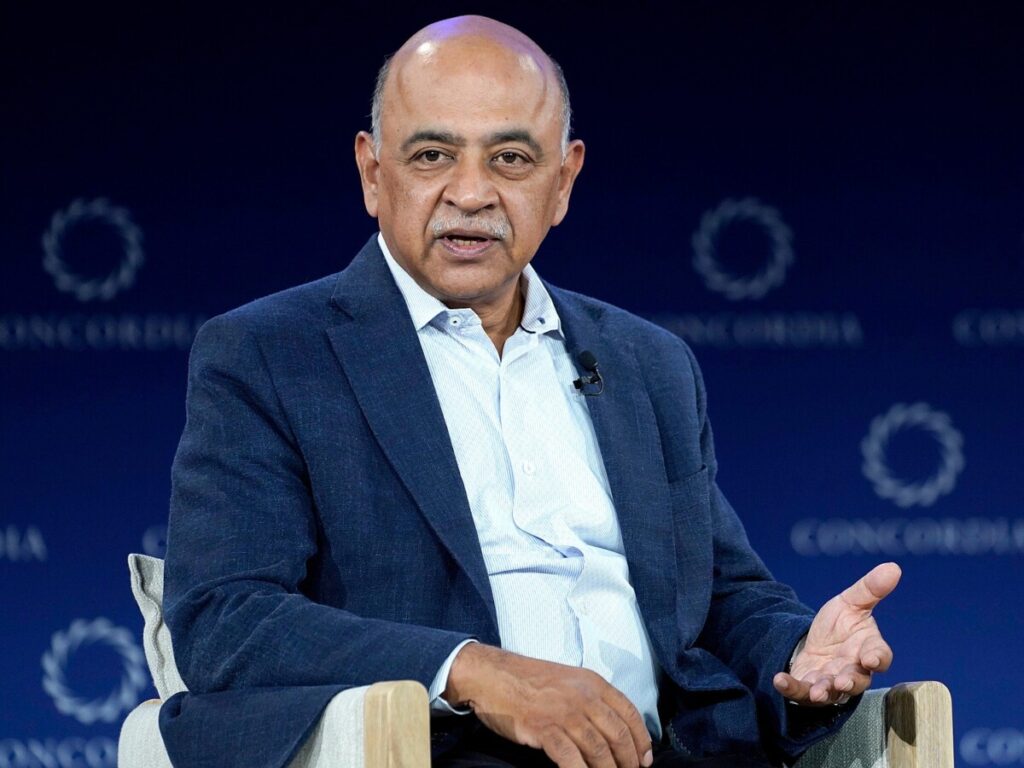
IBM CEO Arvind Krishna was skeptical of the “belief” that data center spending could be profitable.
Riccardo Savi/Getty Images for Concordia Annual Summit
IBM’s CEO walked through some napkin math on data centers— and said that there’s “no way” to turn a profit at current costs.
“$8 trillion of CapEx means you need roughly $800 billion of profit just to pay for the interest,”
Arvind Krishna
told “Decoder.”
Krishna was skeptical of that current tech would reach AGI, putting the likelihood between 0-1%.
AI companies are spending billions on data centers in the race to
AGI
. IBM CEO Arvind Krishna has some thoughts on the math behind those bets.
Data center spending is on the rise. During Meta’s recent earnings call, words like “capacity” and AI “infrastructure” were
frequently used
. Google just announced that it wants to eventually build them
in space
. The question remains: will the revenue generated from data centers ever justify all the capital expenditure?
On the
“Decoder” podcast
, Krishna concluded that there was likely “no way” these companies would make a return on their capex spending on data centers.
Couching that his napkin math was based on today’s costs, “because anything in the future is speculative,” Kirshna said that it takes about $80 billion to fill up a one-gigawatt data center.
“Okay, that’s today’s number. So, if you are going to commit 20 to 30 gigawatts, that’s one company, that’s $1.5 trillion of capex,” he said.
Krishna also referenced the depreciation of the AI chips inside data centers as another factor: “You’ve got to use it all in five years because at that point, you’ve got to throw it away and refill it,” he said.
Investor Michael Burry has recently
taken aim at Nvidia
over depreciating concerns, leading to a downturn in
AI stocks
.
“If I look at the total commits in the world in this space, in chasing AGI, it seems to be like 100 gigawatts with these announcements,” Krishna said.
At $80 billion each for 100 gigawatts, that sets Krishna’s price tag for computing commitments at roughly $8 trillion.
“It’s my view that there’s no way you’re going to get a return on that, because $8 trillion of capex means you need roughly $800 billion of profit just to pay for the interest,” he said.
Reaching that number of gigawatts has required
massive spending
from AI companies — and pushes for outside help. In an
October letter
to the White House’s Office of Science and Technology Policy, OpenAI CEO Sam Altman recommended that the US add 100 gigawatts in energy capacity every year.
“Decoder” host Nilay Patel pointed out that Altman believed OpenAI could generate a return on its capital expenditures. OpenAI has committed to spending some $1.4 trillion in a
variety of deals
. Here, Krishna said he diverged from Altman.
“That’s a belief,” Krishna said. “That’s what some people like to chase. I understand that from their perspective, but that’s different from agreeing with them.”
Krishna clarified that he wasn’t convinced that the current set of technologies would get us to AGI, a yet to be reached technological breakthrough generally agreed to be when AI is capable of completing complex tasks better than humans. He pegged the chances of achieving it without a further technological breakthrough at 0-1%.
Several other high-profile leaders have been skeptical of the acceleration to AGI. Marc Benioff said that he was “extremely suspect” of the AGI push,
analogizing it to hypnosis
. Google Brain founder Andrew Ng said that AGI was ”
overhyped
,” and Mistral CEO Arthur Mensch said that AGI was a ”
marketing move
.”
Even if AGI is the goal, scaling compute may not be the enough. OpenAI cofounder Ilya Sutskever said
in November
that the age of scaling was over, and that even 100x scaling of LLMs would not be completely transformative. “It’s back to the age of research again, just with big computers,” he said.
Krishna, who began his career at IBM in 1990 before rising to eventually be named CEO in 2020 and chairman in 2021, did praise the current set of AI tools.
“I think it’s going to unlock trillions of dollars of productivity in the enterprise, just to be absolutely clear,” he said.
But AGI will require “more technologies than the current LLM path,” Krisha said. He proposed fusing hard knowledge with LLMs as a possible future path.
How likely is that to reach AGI? “Even then, I’m a ‘maybe,'” he said.
Read the original article on
Business Insider


