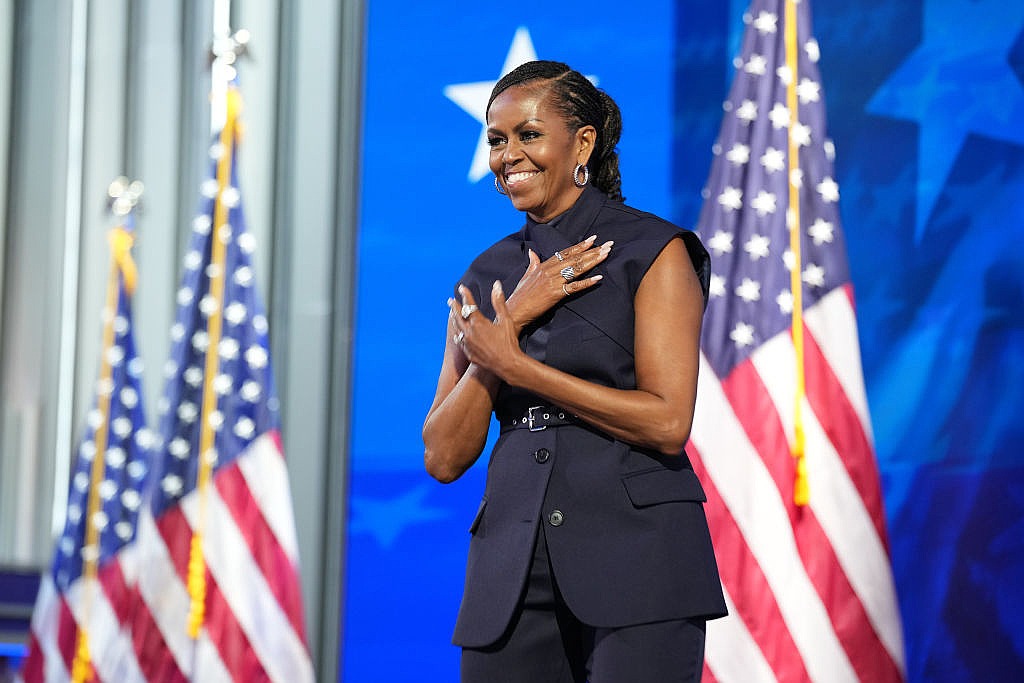
Cal Thomas: Not ready for a female president?
In a series of recent interviews promoting her new book, former First Lady Michelle Obama expressed her belief that America is not yet ready to elect a female president. Pointing to the electoral setbacks of prominent women like Kamala Harris and Hillary Clinton, she argues that these losses are indicative of underlying sexism in American society. Obama’s comments resonate with historical sentiments once expressed about the unlikelihood of electing a Catholic president, as was the case with John F. Kennedy, or a Black president, as many claimed prior to Barack Obama’s election. Despite these assertions, she acknowledges that a significant percentage of white voters supported her husband in both the 2008 and 2012 elections, suggesting that readiness for change can shift over time.
Critics of Obama’s perspective contend that her focus on identity politics detracts from more substantive discussions about policies and qualifications. For instance, some argue that Kamala Harris’s defeat was not solely due to her gender but rather her perceived inability to communicate her beliefs effectively. Similarly, Hillary Clinton faced challenges related to her public image and likability, rather than a straightforward rejection of her gender. This ongoing debate highlights the complexities of political identity in America, where women hold more political offices than ever, yet the discourse often revolves around race and gender rather than competency and policy.
The conversation around female leadership is further complicated by international examples, such as Japan’s recent election of its first female prime minister, who has garnered popularity and respect. However, the effectiveness of female leadership is not guaranteed by gender alone, as evidenced by the tumultuous political history of female leaders in other countries, including Bangladesh. Ultimately, the discourse around female candidates in the U.S. illustrates a broader struggle with identity politics, as voters often prioritize personal beliefs and qualifications over demographic identities. As the political landscape continues to evolve, the question remains whether America will embrace a female president based on her policies, rather than her gender.
https://www.youtube.com/watch?v=gHAQUhmWag0
Former f
irst lady Michelle Obama
says America is
not ready
for a female president. In a series of recent interviews promoting her new book, Michelle Obama points to the losses of Kamala Harris and Hillary Clinton as evidence of what she regards as sexism.
Recall that similar things were once said about John F. Kennedy, that America was not ready for a Catholic president. More recently some said America wasn’t ready for a Black president. And yet in
2008
, 43 percent of white voters voted for Barack Obama. In
2012
, it was 39 percent.
Michelle Obama’s comments continue the focus on identity politics, rather than the substance of one’s ideas and policies. What difference does it make (to quote Hillary Clinton in a different context) about one’s race or gender? Harris lost not because she is a woman, but because some thought she could not articulate what she believed in a language they could understand. Clinton lost because some found her “
unlikeable
.”
Michelle Obama is from a middle-class
background
anyone might find admirable, even enviable. She grew up in a two-parent home. A Google search notes that “After excelling in public schools, she earned a sociology and African-American studies degree from Princeton University and a law degree from Harvard Law School. She then became a lawyer in Chicago, where she met her future husband, Barack Obama, before dedicating her career to public service in roles at Chicago City Hall and the University of Chicago.”
One might think with such a resume she would be praising a nation that gave her the opportunity to rise to such a high level. Instead, recall her
comment
after her husband was elected president: “For the first time in my adult lifetime, I am really proud of my country. And not just because Barack has done well, but because I think people are hungry for change. And I have been desperate to see our country moving in that direction.”
How sad is that – for her, not for her country? She seems to have chips on both shoulders. She is always criticizing someone or something, but to what end?
Women hold more political offices in America than ever before. Some are strong and competent conservatives. Others are drowning in the sewer of identity politics. A
Wall Street Journal
editorial quotes Seattle mayor-elect Katie Wilson: “I will appoint a cabinet of exceptional leaders whose lived experiences reflect the diversity of Seattle’s Black, Indigenous, Asian and Pacific Islander, Latinx/Hispanic, and People of Color communities as well as that of women, immigrants and refugees, 2SLGBTQIA+ communities, people with disabilities, people of all faith traditions, and residents from every socio-economic background.”
Notice the absence of any reference to capabilities or policies. This is the dead end of identity politics.
Japan recently elected the country’s first female prime minister, who seems popular and competent. Being female, though, does not mean women are necessarily better at leading nations than men. The female former prime minister of Bangladesh,
Sheikh Hasina
, has been sentenced to death in absentia (she fled to India after her ouster) by a special court for her role in the killing of
1,400
protesters who participated in nationwide demonstrations last year.
This isn’t really about gender and race. When a Black or female Republican is running for office against a woman who is white, female and a Democrat (I give you the recent election for governor in
Virginia
), liberal, Black and female Democrats mostly vote for the white women.
A
New York Post
letter writer said this about Harris: “We are not ready to vote for a candidate who did not win one presidential primary. We are not ready to vote for an individual who was selected for the vice presidency based on identity, not qualifications. We are not ready to vote for a candidate appointed by former President Joe Biden.”
A female presidential candidate with the policies of the late British Prime Minister Margaret Thatcher would likely get support from most conservative Republicans. I would be among them.
Readers may email Cal Thomas at
tcaeditors@tribpub.com
. Look for Cal Thomas’ latest book “A Watchman in the Night: What I’ve Seen Over 50 Years Reporting on America” (HumanixBooks).


