Winter storms blanket the East, while the U.S. West is wondering: Where’s the snow?
As the 2026 ski season kicks off, the Western United States finds itself grappling with an unusually slow start to snowfall, contrasting sharply with the winter storms currently blanketing the eastern half of the country. By December 1, 2025, snowpack levels across much of the West were significantly below normal, with Denver recording its latest first measurable snowfall on November 29—over a month later than usual. However, experts caution against panicking, as a late start does not necessarily predict a poor snow year. Adrienne Marshall, a hydrologist from Colorado, emphasizes that while the early season conditions raise questions, various atmospheric patterns, including the influence of La Niña, play a crucial role in determining snowfall outcomes.
La Niña, characterized by cooler-than-average sea-surface temperatures in the central Pacific, is expected to shape the weather patterns for the upcoming winter. Historically, La Niña conditions have led to wetter and cooler weather in the Pacific Northwest while bringing warmer, drier conditions to the Southwest. This year, the National Oceanic and Atmospheric Administration (NOAA) predicts that many areas, including Colorado and Utah, will experience a mix of these patterns, resulting in uncertain snowfall predictions. The variability of individual storms further complicates forecasts, as they can significantly impact the overall snowpack. Additionally, long-term climate trends indicate a worrying decline in snowfall across the West, exacerbated by rising temperatures and more frequent midwinter melting, which could have serious implications for water supply and wildfire risks in the region.
The interplay between snowpack and water supply is particularly critical, as many Western states rely heavily on snowmelt for their annual water needs. With climate change leading to earlier snowmelt and increased instances of rain-on-snow events, water managers face the dual challenge of managing flood risks while ensuring adequate water storage for summer use. This precarious balance is further strained by declining reservoir levels in key water sources like the Colorado River basin. Moreover, the ecological ramifications of reduced snowfall extend beyond water supply; lower snowpack can lead to drier soils and increased fire risks, which have already been observed in recent years. As climate projections suggest that both extreme low-snow years and less snowy winters may become more common, the choices made today regarding greenhouse gas emissions will significantly influence the future of snowfall and the broader climate in the West.
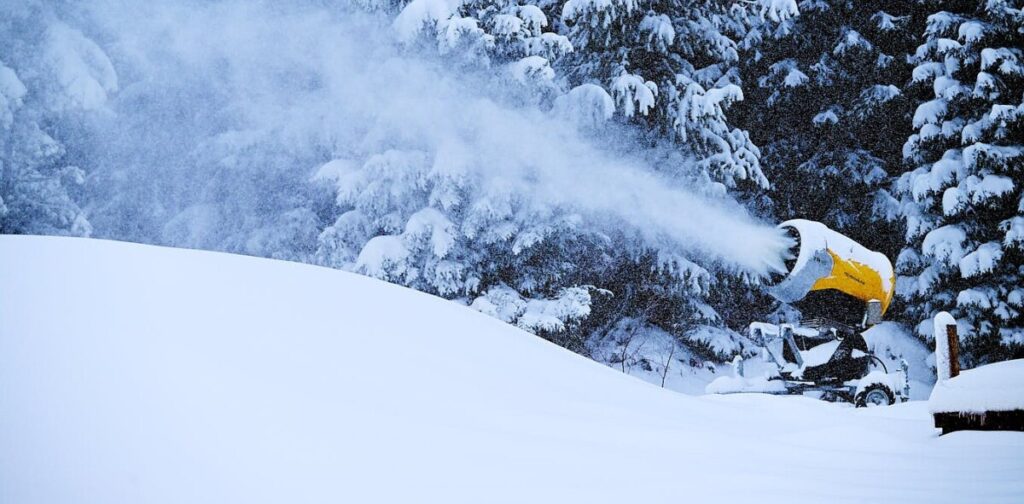
Much of the West has seen a slow start to the 2026 snow season.
Hyoung Chang/The Denver Post
Ski season is here, but while the eastern half of the U.S.
digs out from winter storms
, the western U.S. snow season has been off to a very slow start.
The snowpack was
far below normal
across most of the West on Dec. 1, 2025. Denver didn’t see its first measurable snowfall until Nov. 29 – more than a month past normal, and its
latest first-snow date on record
.
But a late start to snow season isn’t necessarily reason to worry about the season ahead.
Adrienne Marshall, a
hydrologist in Colorado
who studies how snowfall is changing in the West, explains what forecasters are watching and how rising temperatures are affecting the future of the West’s beloved snow.
The National Weather Service Climate Prediction Center’s seasonal outlook for January through March 2026 largely follows a typical La Niña pattern, with warmer and drier conditions to the south, and wetter and cooler conditions to the north.
NOAA
What are snow forecasters paying attention to right now?
It’s still early in the snow season, so there’s a lot of uncertainty in the forecasts. A late first snow doesn’t necessarily mean a low-snow year.
But there are some patterns that we know influence snowfall that forecasters are watching.
For example, the National Oceanic and Atmospheric Administration is
forecasting La Niña conditions for this winter
, possibly switching to neutral midway through. La Niña involves cooler-than-usual sea-surface temperatures in the Pacific Ocean along the equator west of South America. Cooler ocean temperatures in that region
can influence weather patterns
across the U.S., but so can several other factors.
La Niña – and its opposite, El Niño – don’t tell us what will happen for certain. Instead, they load the dice toward wetter or drier conditions, depending on where you are. La Niñas are
generally associated
with cooler, wetter conditions in the Pacific Northwest and a little bit warmer, drier conditions in the U.S. Southwest, but not always.
When we look at the consequences for snow, La Niña does tend to mean more snow in the Pacific Northwest and less in the Southwest, but, again, there’s a lot of variability.
Scientists often gauge snow conditions by snow-water equivalent, a measure of the amount of water stored in a snowpack. Most of the Western U.S. was far below normal on Nov. 30, 2025. Parts of the Southwest were above normal, but this early in the season, normal is very low to begin with in many of those areas.
USDA Natural Resources Conservation Service
Snow conditions also depend heavily on individual storms, and those are more random than the seasonal pattern indicated by La Niña.
If you look at
NOAA’s seasonal outlook maps
, most of Colorado and Utah are in the gap between the cooler and wetter pattern to the north and the warmer and drier pattern to the south expected during winter 2026. So, the outlook suggests roughly equal chances of more or less snow than normal and warmer or cooler weather across many major ski areas.
How is climate change affecting snowfall in the West?
In the West, snow measurements date back a century, so we can see some trends.
Starting in the 1920s, surveyors would go out into the mountains and
measure the snowpack
in March and April every year. Those records suggest
snowfall has declined
in most of the West. We also see evidence of
more midwinter melting
.
How much snow falls is driven by both temperature and precipitation, and
temperature is warming
In the past few years, research has been able to
directly attribute observed changes
in the spring snowpack to human-caused climate change. Rising temperatures have led to decreases in snow, particularly in the Southwest. The effects of warming temperatures on overall precipitation are less clear, but the net effect in the western U.S. is a decrease in the spring snowpack.
When we look at
climate change projections for the western U.S.
in future years, we see with a high degree of confidence that we can
expect less snow in warmer climates
. In scenarios where the world produces more greenhouse gas emissions, that’s
worse for snow seasons
.
Should states be worried about water supplies?
This winter’s forecast isn’t extreme at this point, so the impact on the year’s water supplies is a pretty big question mark.
Snowpack – how much snow is on the ground in March or April –
sums up the snowfall
, minus the melt, for the year. The snowpack also affects water supplies for the rest of the year.
The
West’s water infrastructure system
was built assuming there would be a natural reservoir of snow in the mountains. California relies on the snowpack for
about a third
of its annual water supply.
However, rising temperatures are leading to
earlier snowmelt in some areas
. Evidence suggests that climate change is also expected to cause
more rain-on-snow events
at high elevations, which can cause very rapid snowmelt.
When snow melts quickly, it can cause flooding. That happened in 2023 in California, when fast melting from a heavy snow season flooded wide areas of farmland and almond orchards covering what was once Tulare Lake.
Luis Sinco/Los Angeles Times via Getty Images
Both create challenges for water managers, who want to store as much snowmelt runoff as possible in reservoirs so it’s available through the summer, when states need it most for agriculture and for generating hydropower to meet high electricity demand. If the snow melts early, water resource managers face some tough decisions, because they also need to leave room in their reservoirs to manage flooding. Earlier snowmelt sometimes means they have to release stored water.
When we look at reservoir levels in the Colorado River basin, particularly the big reservoirs – Lake Powell and Lake Mead – we see a
pattern of decline over time
. They have had some very good snow and water years, and also particularly challenging ones, including a
long-running drought
. The long-term trends suggest an imbalance between supply and
growing demand
.
What else does snowfall affect, such as fire risk?
During low-snow years, the snowpack disappears sooner, and the
soils dry out earlier
in the year. That essentially leaves a longer summer dry period and
more stress on trees
.
There is evidence that we tend to have
bigger fire seasons after low-snow winters
. That can be because the forests are left with drier fuels, which sets the ecosystem up to burn. That’s obviously a major concern in the West.
Snow is also important to a lot of wildlife species that are adapted to it. One
example is the wolverine
, an endangered species that requires deep snow for denning over the winter.
What snow lessons should people take away from climate projections?
Overall, climate projections suggest our biggest snow years will be
less snowy in anticipated warmer climates
, and that
very low snow years
are expected to be more common.
But it’s important to remember that climate projections are
based on scenarios
of how much greenhouse gas might be emitted in the future – they are not predictions of the future. The world
can still reduce its emissions
to
create a less risky scenario
. In fact, while the most ambitious emissions reductions are looking less likely, the
worst emissions scenarios are also less likely
under current policies.
Understanding how choices can change climate projections can be empowering.
Projections are saying
: Here’s what we expect to happen if the world emits a lot of greenhouse gases, and here’s what we expect to happen if we emit fewer greenhouse gases based on recent trends.
The choices we make will affect our future snow seasons and the wider climate.
Adrienne Marshall receives funding from the National Science Foundation, the National Oceanic and Atmospheric Administration, the United States Geological Survey, the Colorado Department of Transportation, and the Alfred P. Sloan Foundation, and has received previous funding from the Carnegie Institution of Washington.


