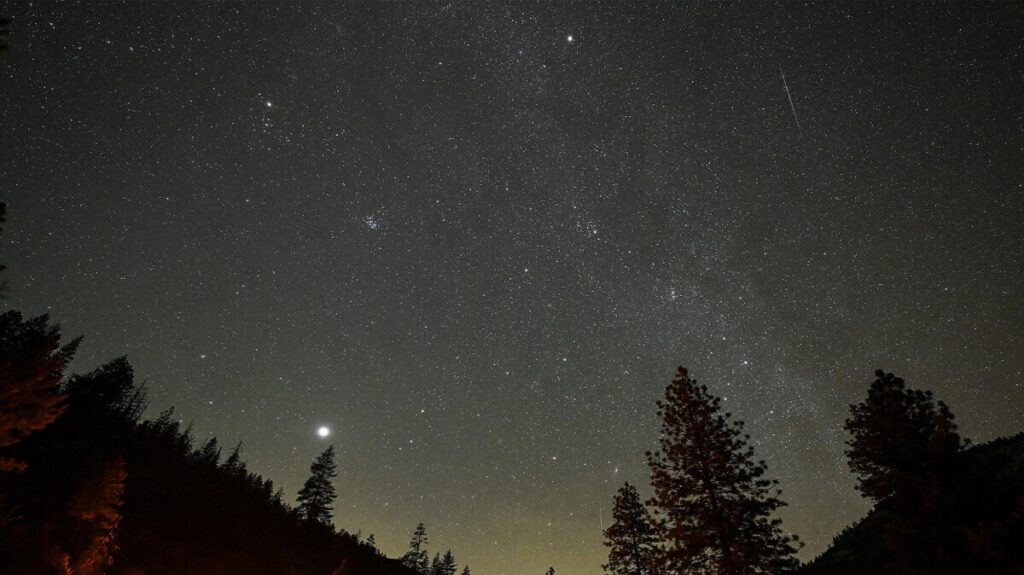
December stargazing: An infamous comet and one last supermoon for 2025
December is a celestial wonderland for stargazers, offering a series of spectacular astronomical events that are perfectly timed with the long, dark nights of winter. Kicking off the month is the Full Cold Supermoon on December 4, which reaches its peak at 6:14 p.m. EST. Although it may not be as grand as November’s supermoon, it still promises a stunning sight in the night sky, setting the stage for a month filled with exciting stargazing opportunities. As the moonlight fades, the stage is set for two major meteor showers and a rare interstellar comet, making December an ideal time for both seasoned astronomers and casual sky-watchers.
The highlight of the month is undoubtedly the Geminids meteor shower, peaking on the nights of December 13 and 14. Renowned for its reliability and abundance, this shower can produce up to 75 meteors per hour at its peak, making it a must-see event. Observers should look toward the constellation Gemini, particularly around 3 a.m. on December 14, when the meteors will appear to radiate from the twin stars Castor and Pollux. Following closely is the closest approach of Comet 3I/ATLAS on December 19, an interstellar visitor that has captivated astronomers. Although it will be about 170 million miles away—twice the distance from Earth to the Sun—those with telescopes can catch a glimpse of this rare comet in the constellations Virgo and Leo.
As December progresses, the winter solstice on December 21 marks the shortest day of the year in the Northern Hemisphere, providing an excellent backdrop for stargazing enthusiasts. The long nights culminate in the Ursids meteor shower, which peaks on December 22. While not as prolific as the Geminids, the Ursids will benefit from minimal moonlight interference, making it easier to spot meteors just before dawn. For the best stargazing experience, experts recommend escaping light pollution and allowing your eyes to adjust to the darkness. With a remarkable lineup of celestial events, December is truly a month to embrace the wonders of the night sky before the year comes to a close.
December 4
Full Cold Supermoon
December 13 and 14
Geminids Meteor Shower Predicted Peak
December 19
Comet 3I/ATLAS Closest Approach to Earth
December 21
Winter Solstice
December 22
Ursids Meteor Shower Predicted Peak
As one might expect from a month full of long, dark nights, December is a highlight for those with a penchant for
looking to the stars
. This year, the
stargazing
on offer promises to be particularly good. The
full moon
—a supermoon, mind you—happens early in the month, leaving the rest of December blanketed in blissful darkness: perfect for catching two meteor showers, one very special comet, and savoring the longest night of the year.
December 4: Full Cold Supermoon
December brings Moonfest ’25 to a close with the last of three consecutive supermoons. As per The Old
Farmer’s Almanac
, the aptly named Cold Moon will reach its full size on December 4 at 6:14 p.m. EST.While it won’t be quite as large as
November’s most super of supermoons
, it will still be a fittingly impressive moon for a packed month of stargazing.
December 13 and 14: Geminids Meteor Shower Predicted Peak
If you’re only going to see one meteor shower a year, pretty much every stargazing source out there agrees that the Geminids are the one to choose. While the Perseids might be more famous, and the Draconids more likely to yield an unexpected full-blown meteor storm, the Geminids are steady, reliable, and occur at a time of year when there’s plenty of night to devote to seeing them. They also start early—just a couple of hours after dusk—and continue throughout the night. At their peak—which is expected to be around 3 a.m. on December 14—you can expect to see up to 75 meteors an hour!
To see the show,
look to the constellation Gemini
, in the eastern sky and will reach its greatest elevation above the horizon at about 2 a.m. The meteors will appear to originate from near the constellation’s twin stars Castor and Pollux, and will appear to move away from the constellation as they burn up in our atmosphere.
December 19: Comet 3I/ATLAS Closest Approach to Earth
Enthusiastic stargazers will no doubt have been following the story of 3I/ATLAS, the interstellar comet of which NASA has released a
series of spectacular images
. The “3I” part of the comet’s name is a testament to the rarity of this type of object: it’s only the third such object of interstellar origin ever discovered.
The Hubble Space Telescope captured this image of the interstellar comet 3I/ATLAS on July 21, 2025, when the comet was 277 million miles from Earth. Hubble shows that the comet has a teardrop-shaped cocoon of dust coming off its solid, icy nucleus.
Image: NASA, ESA, David Jewitt (UCLA); Image Processing: Joseph DePasquale (STScI).
In October, 3I/ATLAS reached its perihelion—the point at which it came closest to the sun..While it was technically at its brightest around that time, the comet was also lost in the glare of the sun, making it impossible to see from Earth. It will make its closest approach to us on December 19, although closest doesn’t necessarily mean particularly close (or dangerous). Comet 3I/ATLAS will still be 170 million miles away, which is about twice the distance between the Earth and the sun. While it will be visible throughout December, the naked eye won’t cut it; you’ll need a decent telescope to spot it. And you won’t be able to see anything rivalling NASA’s images unless you have a radio telescope casually stashed in the garage.
If you have a telescope ready,
The Live Sky
recommends looking at the constellations Virgo and Leo.It’s worth a try since you’ll be able to say that you’ve seen something genuinely rare: a comet that originated outside the solar system.
December 21: Winter Solstice
‘Tis the year’s midnight, as poet John Donne
once wrote
. For those of us in the Northern Hemisphere, December 21 will be the shortest day of 2025 aka the winter solstice!
Solstices occur because Earth’s axis isn’t perfectly aligned with the plane of its orbit around the sun. If that
was
the case, both Northern and Southern hemispheres would always receive the same amount of light, and we wouldn’t have opposite summers and winters north and south of the equator.
During the solstices, Earth reaches a point where its tilt is at the greatest angle to the plane of its orbit, causing one hemisphere to receive more daylight than the other.
Image: NASA/Genna Duberstein.
In reality, the Earth’s axis is tilted at a 23.4 degree angle. This angle remains constant in relation to Earth’s orbital plane, which means that over the course of a year, it changes in relation to the sun. The Northern Hemisphere’s winter solstice is the day on which the tilt takes the North Pole furthest from the sun. This means that it’s also the day on which the South Pole is closest, so that the Northern Hemisphere’s winter solstice is the Southern Hemisphere’s summer solstice, and vice versa.
Anyway, while long nights are bad news for sun bunnies, they’re good news for stargazers—and especially this year, because…
December 22: Ursids Meteor Shower Predicted Peak
Just a day after the winter solstice, there’s another meteor shower to see! While the Ursids don’t attain the same level of celestial pyrotechnics as the Geminids, they still provide a steady supply of meteors The fact that they’re happening on the second-longest night of the year and with
very little moonlight to interfere with their glow
, means that you really couldn’t pick a better year to try to catch them.
As per the
Old Farmer’s Almanac
, the best time to do so will be just before dawn, so set an alarm clock, look to the north, and settle in for one last meteor session for 2025.
Whatever you’re looking for in the sky, remember that you’ll get the best experience if you get away from any sources of light pollution and let your eyes acclimatize to the darkness—
and
you check out our
stargazing tips
before you head off into the night.
Until next year!
The post
December stargazing: An infamous comet and one last supermoon for 2025
appeared first on
Popular Science
.


