NASA’s Roman Observatory Passes Spate of Key Tests
NASA’s Nancy Grace Roman Space Telescope is making significant progress as it approaches its anticipated launch date in 2027. Recently, the telescope’s outer assembly successfully completed rigorous vibration and acoustic testing, simulating the intense conditions it will face during launch. This testing involved subjecting the telescope to sound levels exceeding 138 decibels—louder than a jet takeoff—inside a specialized chamber designed to replicate the thunderous noise of a rocket launch. Engineers monitored the assembly’s response using advanced sensors to ensure its resilience against the stresses of launch. Meanwhile, the core portion of the telescope underwent a comprehensive 65-day thermal vacuum test, designed to mimic the extreme temperatures of space and assess the functionality of its optics and instruments. This crucial phase marked the first time the telescope and its instruments were operated together, a milestone celebrated by the team at NASA’s Goddard Space Flight Center.
The Nancy Grace Roman Space Telescope is poised to become NASA’s flagship observatory, addressing fundamental questions in astrophysics, including the mysteries surrounding dark energy and exoplanets. With a team of over 200 professionals collaborating across multiple NASA centers and research institutions, the telescope’s development is a testament to collective scientific effort. As the outer and inner components prepare for final integration in November, the observatory is on track for launch preparations at NASA’s Kennedy Space Center in Florida, with a targeted launch window opening in May 2027. The Roman Space Telescope promises to enhance our understanding of the universe and its complexities, making it a highly anticipated addition to NASA’s fleet of space exploration tools. For more information about this groundbreaking mission, visit NASA’s dedicated page on the Roman Space Telescope.
NASA’s nearly complete Nancy Grace Roman Space Telescope has made another set of critical strides toward launch. This fall, the outer portion passed two tests — a shake test and an intense sound blast — to ensure its successful launch. The inner portion of the observatory underwent a major 65-day thermal vacuum test, showing that it will function properly in space. As NASA’s next flagship space telescope, Roman will address essential questions in the areas of dark energy, planets outside our solar system, and astrophysics.
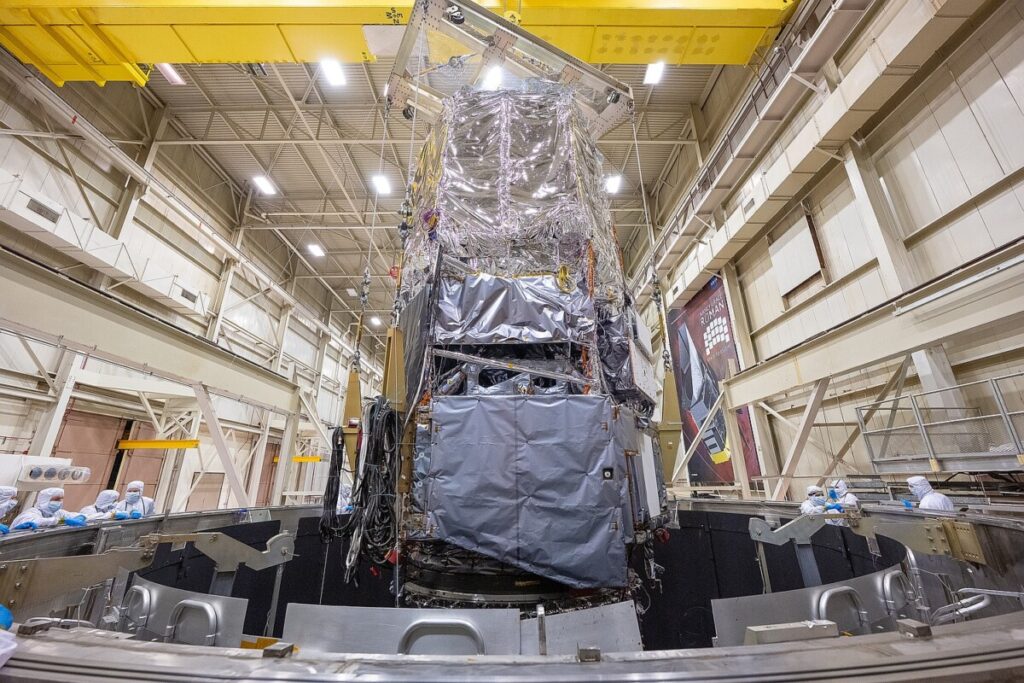
The inner portion of NASA’s Nancy Grace Roman Space Telescope (which consists of the telescope, instrument carrier, two instruments, and spacecraft) recently passed thermal vacuum testing. In this photo, the assembly is being lifted out of the Space Environment Simulator after completing 65 days of assessments.
Credit: NASA/Jolearra Tshiteya
“We want to make sure Roman will withstand our harshest environments,” said Rebecca Espina, a deputy test director at NASA’s Goddard Space Flight Center in Greenbelt, Maryland. “From a mechanical standpoint, our heaviest loads and stresses come from launch, so we use testing to mimic the launch environment.”
The vibration and acoustic testing were the final round of launch simulations for the outer portion of the Roman observatory, which consists of the outer barrel assembly, deployable aperture cover, and recently
installed
flight solar panels.
During acoustic testing, a large chamber with gigantic horns emulated the launch’s thunderous sounds, which cause high-frequency vibrations. Test operators outfitted the chamber and assembly with various sensors to monitor the hardware’s response to the sound, which gradually ramped up to a full minute at 138 decibels — louder than a jet plane’s takeoff at close range!
After moving to a massive shaker table, Roman’s outer assembly went through testing to replicate the rocket launch’s lower-frequency vibrations. Each individual test lasts only about a minute, sweeping from 5 to 50 hertz (the lowest note on a grand piano vibrates at 27.5 hertz), but NASA engineers tested three axes of movement over several weeks, breaking up the tests with on-the-spot data analysis.
Like in acoustic testing, the team installed sensors to capture the assembly’s response to the shaking. Structural analysts and test operators use this information not only to evaluate success but also to improve models and subsequent assessments.
“There’s a real sense of accomplishment when you get a piece of hardware this large through this test program,” said Shelly Conkey, lead structural analyst for this assembly at NASA Goddard. “I am proud of the work that our team of people has done.”
The outer portion of NASA’s Nancy Grace Roman Space Telescope (which consists of the outer barrel assembly, deployable aperture cover, and solar panels) recently passed vibration and acoustic testing. The structure is shown here in the acoustic testing chamber at NASA’s Goddard Space Flight Center in Greenbelt, Md., where it was blasted with intense sound to simulate launch conditions.
Credit: NASA/Jolearra Tshiteya
The core portion of the observatory (the telescope, instrument carrier, two instruments, and
spacecraft bus
) moved into the
Space Environment Simulator
test chamber at NASA Goddard in August. There, it was subjected to extreme temperatures to mimic the chill of space and heat from the Sun. A team of more than 200 people ran simulations continuously for more than two months straight, assessing the telescope’s optics and the assembly’s overall mission readiness.
“The thermal vacuum test marked the first time the telescope and instruments were used together,” said Dominic Benford, Roman’s program scientist at NASA Headquarters in Washington. “The next time we turn everything on will be when the observatory is in space!”
Following extensive assessments, the core portion of NASA’s Nancy Grace Roman Space Telescope was removed from the test chamber (as shown in this gif) and returned to the largest clean room at NASA’s Goddard Space Flight Center in Greenbelt, Md. Next, it will be prepped for final integration.
Credit: NASA/Sophia Roberts
The team expects to connect Roman’s two major parts in November, resulting in a complete observatory by the end of the year. Following final tests, Roman will move to the launch site at NASA’s Kennedy Space Center in Florida for launch preparations in summer 2026. Roman remains on schedule for launch by May 2027, with the team aiming for as early as fall 2026.
The Nancy Grace Roman Space Telescope is managed at NASA’s Goddard Space Flight Center in Greenbelt, Maryland, with participation by NASA’s Jet Propulsion Laboratory in Southern California; Caltech/IPAC in Pasadena, California; the Space Telescope Science Institute in Baltimore; and a science team comprising scientists from various research institutions. The primary industrial partners are BAE Systems Inc. in Boulder, Colorado; L3Harris Technologies in Rochester, New York; and Teledyne Scientific & Imaging in Thousand Oaks, California.
For more information about the Roman Space Telescope, visit:
https://www.nasa.gov/roman
By Laine Havens and Ashley Balzer
NASA’s Goddard Space Flight Center
, Greenbelt, Md.
Media contact:
Claire Andreoli
NASA’s Goddard Space Flight Center, Greenbelt, Md.
301-286-1940
Explore More
6 min read
NASA’s Roman Mission Shares Detailed Plans to Scour Skies
Article
7 months ago
6 min read
How NASA’s Roman Space Telescope Will Illuminate Cosmic Dawn
Article
1 year ago
6 min read
Unveiling Rogue Planets With NASA’s Roman Space Telescope
Article
5 years ago
Share
Details
Last Updated
Nov 25, 2025
Editor
Ashley Balzer
Contact
Ashley Balzer
ashley.m.balzer@nasa.gov
Location
Goddard Space Flight Center
Related Terms
Nancy Grace Roman Space Telescope
Goddard Space Flight Center


