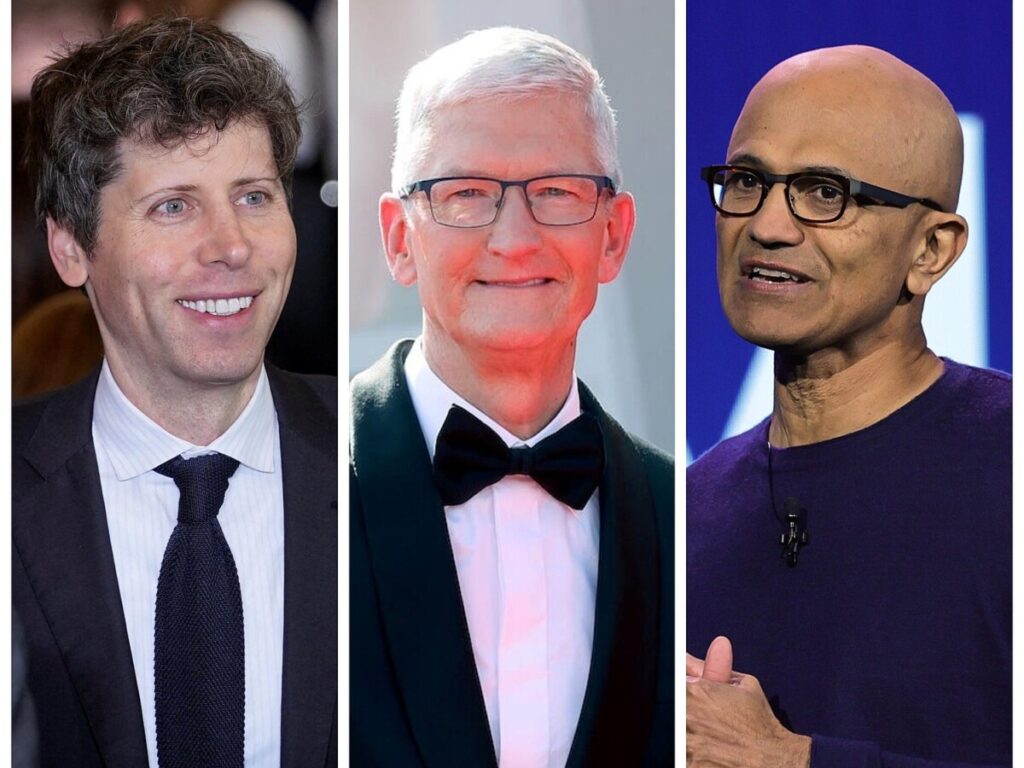
How CEOs are using AI in their daily lives
In today’s fast-paced business landscape, artificial intelligence (AI) is increasingly becoming a vital tool for CEOs, transforming how they manage their personal and professional lives. As the AI market is projected to reach a staggering $4.8 trillion by 2033, industry leaders are harnessing this technology to enhance efficiency and decision-making processes. Notable figures such as Nvidia’s Jensen Huang, Apple’s Tim Cook, and Microsoft’s Satya Nadella are leading the charge, integrating AI into their daily routines to streamline tasks ranging from email management to research.
For instance, Satya Nadella, who has been at the helm of Microsoft since 2014, has embraced AI not only in the workplace but also in his personal life. He utilizes Microsoft’s Copilot to summarize emails and prepare for meetings, stating, “I’m an email typist.” This tool allows him to process large volumes of information quickly, enabling him to focus on more strategic tasks. Similarly, Tim Cook has incorporated AI into his workflow, leveraging Apple Intelligence to condense lengthy emails, which he claims has significantly improved his productivity. Cook’s enthusiasm for AI was evident when he remarked, “If I can save time here and there, it adds up to something significant across a day, a week, a month. It’s changed my life.”
Moreover, AI’s influence extends beyond traditional tech giants. CEOs like Jeremy Wacksman of Zillow and Brian Armstrong of Coinbase are also capitalizing on AI to enhance their operational efficiency. Wacksman has implemented AI-powered tools to summarize meeting notes and documentation, allowing for quicker decision-making. Armstrong, on the other hand, has taken a more experimental approach, recently announcing that Coinbase’s development team has conducted its first AI-to-AI transaction, showcasing the potential of AI in the cryptocurrency space. This trend reflects a broader movement among business leaders to not only adopt AI but to actively encourage their teams to explore its capabilities, fostering a culture of innovation and adaptability.
As AI continues to evolve, its integration into the daily lives of CEOs signifies a shift in how leaders approach their roles. By leveraging AI tools, these executives are not only enhancing their productivity but also setting a precedent for the future of work, where technology and human intelligence collaborate to drive success. With projections indicating that AI could contribute approximately $15.7 trillion to the global economy by 2030, the implications of this technology are profound, promising to reshape industries and redefine leadership in the years to come.
https://www.youtube.com/watch?v=CHqG5Ca4BRQ
CEOs are using AI to research topics and summarize emails.
Franco Origlia/Ethan Miller/Getty Images; Alexander Drago/via REUTERS
CEOs are integrating AI into their personal and professional lives.
Nvidia’s Jensen Huang uses AI as a tutor, while Apple’s Tim Cook organizes emails with the tech.
The AI market is projected to hit $4.8 trillion by 2033.
It seems like
artificial intelligence
is everywhere these days. CEOs seem to like it that way.
The technology continues to impact numerous sectors across the global market, including
education
,
healthcare
, and
entertainment
. By 2030, AI could contribute around $15.7 trillion to the global economy by 2030, according to
consulting firm PwC
.
From Jensen Huang to Tim Cook, here’s how seven CEOs are integrating AI into their daily lives.
Microsoft’s Satya Nadella
Mustafa Suleyman will report directly to Satya Nadella
Ethan Miller
Microsoft
has invested heavily in AI, including introducing its
Copilot assistant
in 2023, inking a
$13 billion partnership with OpenAI
in 2024, and creating teams dedicated to
developing the tech
.
CEO
Satya Nadella
, who took charge of the company in 2014, previously discussed how recent developments in
AI will change workflows
and
humans’ cognitive labor.
For Nadella, AI has become a necessary part of his life, both in and out of the office, according to
Bloomberg
.
During an interview published in May, Nadella said he enjoys podcasts but doesn’t listen to them. Instead, he uploads the transcripts of podcasts to the Copilot app on his phone so he can discuss the content with a voice assistant during his commute.
When he reaches Microsoft’s headquarters in Washington State, Nadella uses Copilot to summarize his Outlook and Teams messages. He utilizes at least 10 custom agents from Copilot Studio to help with meeting prep and research.
“I’m an email typist,” Nadella told the outlet.
OpenAI’s Sam Altman
OpenAI CEO Sam Altman at Trump’s inauguration.
Alexander Drago/via REUTERS
Sam Altman,
the CEO of OpenAI, has become one of Silicon Valley’s most prominent tech giants thanks to
OpenAI
‘s premier product,
ChatGPT
.
The company launched a chatbot demo in 2022, and it quickly went viral on social media as people inquired about everything from diets to recipes. Over the last three years, OpenAI has shared
more advanced GPT programs
with users and is working to
expand its global reach
despite competition from Chinese
tech companies like DeepSeek
.
This January, President Donald Trump announced a $500 billion private-sector investment in AI infrastructure called
Stargate
. OpenAI was among the companies asked to help with that project.
So, it’s unsurprising that Altman uses AI to streamline tasks his his personal life. Altman appeared on Adam Grant’s
“ReThinking” podcast
this January, saying, “Honestly, I use it in the boring ways.”
Altman said the AI bots help him process emails or summarize documents. The tech has also helped him with fatherhood.
During an
OpenAI podcast
interview published in June, Altman said he used AI “constantly” after welcoming his first child in February.
“Clearly, people have been able to take care of babies without ChatGPT for a long time,” Altman said. “I don’t know how I would have done that.”
Now, Altman said he mostly uses ChatGPT to research developmental stages.
Nvidia’s Jensen Huang
Nvidia’s CEO, Jensen Huang, showing off products from the tech company.
Ann Wang/Reuters
Another major player on the global tech scene is
Jensen Huang,
Nvidia’s
CEO. The California-based company is one of the
most valuable in the world
, with a market value of over $3 trillion, according to Google Finance. The company is focused on designing and manufacturing hardware, including chips and
graphical processing units to assist AI
.
During the 28th annual Milken Institute Global Conference in May, Huang told the audience he uses
AI programs to learn new concepts.
“I use it as a tutor every day,” Huang said. “In areas that are fairly new to me, I might say, ‘Start by explaining it to me like I’m a 12-year-old,’ and then work your way up into a doctorate-level over time.”
AI’s ability to rapidly collect, analyze, and communicate information could close the tech gap, according to Huang.
“In this room, it’s very unlikely that more than a handful of people know how to program with C++,” Huang said. “Yet 100% of you know how to program an AI, and the reason for that is because the AI will speak whatever language you wanted to speak.”
In a 2024 interview with
Wired
, Huang said he uses
Perplexity
and ChatGPT “almost every day” for research.
“For example, computer-aided drug discovery. Maybe you would like to know about the recent advancements in computer-aided drug discovery,” Huanng said. “And so you want to frame the overall topic so that you could have a framework, and from that framework, you could ask more and more specific questions. I really love that about these large language models.”
Apple’s Tim Cook
Tim Cook attends a red carpet event for an Apple TV show.
Franco Origlia/Getty
Apple
is navigating the global AI market under CEO
Tim Cook
, who announced
Apple Intelligence
— a generative AI system — at the company’s Worldwide Developers Conference in 2024. He also unveiled a slew of other AI-based features at the time, including the Image Playground and the ability to remove unwanted background details from photos.
Cook, who became CEO in 2011, publicly spoke about how he uses AI day-to-day in a 2024 interview with
The Wall Street Journal
. He said Apple Intelligence helps him summarize long emails.
“If I can save time here and there, it adds up to something significant across a day, a week, a month,” Cook told the outlet. “It’s changed my life,” he says. “It really has.”
One year earlier, Cook appeared on “Good Morning America” and said he was
“excited” about developments in AI
.
“I think there’s some unique applications for it and you can bet that it’s something that we’re looking at closely,” Cook said.
Zillow’s Jeremy Wacksman
Jaap Arriens/NurPhoto
Real estate tech companies like
Zillow
are also leaning into AI. The company announced in 2023 that it implemented an “AI-powered natural-language search” to help users navigate the website.
CEO Jeremy Wacksman
, like the other executives, has begun using AI to be more efficient.
“I spend a lot of time either catching up on meetings I’ve missed or on asynchronous documentation,” Wacksman told
The New York Times Dealbook
. “You can tell ChatGPT, ‘Treat me like my role. Here’s all this data — summarize it for me the way I would need to know going forward,’ and you can get a personalized summary. That’s just — that’s far more valuable to me than to try to read a transcript at one-and-a-half speed or watch a video at one-and-a-half speed.”
Wacksman added that he wants Zillow staffers to experiment with the technology.
“We’ve had what we call ‘AI days,’ where we showcase work and celebrate examples,” Wacksman said. “We’ve also started weaving it into our bigger meetings, like product reviews: When a product manager-design-engineering team is prototyping, oftentimes, they’re now using an AI tool called Replit. They’re prototyping really quickly to get something in front of a user.”
Coinbase’s Brian Armstrong
Coinbase Founder and CEO Brian Armstrong attends Consensus 2019 at the Hilton Midtown on May 15, 2019 in New York City.
Steven Ferdman/Getty Images
Like many other companies,
Coinbase
has recently sought to expand its operations using AI. The
cryptocurrency exchange
acquired Agara, an AI support platform, in 2021 to expand its customer experience tools. Nearly three years later,
CEO Brian Armstrong
said in an
X post
that his development team witnessed their first “AI to AI crypto transaction.”
“What did one AI buy from another? Tokens! Not crypto tokens, but AI tokens (words basically from one LLM to another). They used tokens to buy tokens,” Armstrong said.
Coinbase partnered with Perplexity AI to give traders access to real-time crypto data, CEO Brian Armstrong said in an
X post
this July.
“Perplexity is now ingesting our market data, including COIN50, and using it to power market analysis,” Armstrong said.
Armstrong, who cofounded Coinbase in 2012, said he was enthusiastic about the tech during a “Cheeky Pint” podcast episode published in August 2025.
“Even as CEO, by the way, I use it a lot,” Armstrong said, adding that he and the Coinbase team are testing the limits of decision-making in AI.
“We use a decision-making process called RAPIDS, and everyone writes their input,” Armstrong said. “We have a row now for AI that writes its input in as one of the people that help make decisions. We’re testing the limits of it. Like, when can it actually start to be the decision-maker on some things and do better than humans?”
During the same interview, Armstrong said he
fired Coinbase employees
who hadn’t adopted AI into their workflow before a given deadline.
“Some of them had a good reason because they were just getting back from a trip or something,” Armstrong said. “Some of them didn’t, and they got fired.”
LinkedIn’s Ryan Roslanksy
Yves Herman/REUTERS
LinkedIn
has followed in the footsteps of its parent company, Microsoft, by integrating AI into its platform, including an AI-powered coaching tool that provides professionals with tips and resources. In November 2025, the company announced that premium subscribers gained access to an AI-powered people search.
During a fireside chat at the company’s San Francisco office in October 2025, CEO
Ryan Roslanksy
said using AI to complete tasks is like “having a second brain.” One way he uses AI in his daily life is drafting “high-stakes emails” to executives, including Microsoft CEO Satya Nadella.
“A lot of the time when I’m sending a super high-stakes email to Satya Nadella or other CEOs or world leaders or etcetera, you’ve got to make sure you sound super smart when you do that. I would say that without a doubt, almost every email that I send these days is being sent with the help of Copilot,”
Rolansky, referring to Microsoft’s AI assistant, said.
However, Rolansky said AI doesn’t write the entirety of emails. Instead, the tech guides him through a step-by-step process to determine the end result.
“Historically, there’d be a button that said, ‘Draft the reply for me.’ And it would just try to draft the reply,” Rolansky said. “The problem is that you’re actually asking AI to make tons of decisions for you when you ask it to blindly reply to an email.”
Eli Lilly’s David Ricks
Raquel Natalicchio/Houston Chronicle via Getty Images
Eli Lilly
, a pharmaceutical company, is one of many in healthcare learning how to use AI.
In September 2025, the company announced it’s creating an AI-powered platform designed to give five biotech companies access to drug discovery models. Eli Lilly, in October 2025, said the supercomputer it is building with Nvidia could take AI to the next level.
“Our supercomputer will be the most powerful in the pharmaceutical industry and enable AI-based research at a scale previously thought impossible,” a press release said. “It has the potential to expand our ability to discover, develop and distribute new medicines faster.”
During an episode of the “Cheeky Pint” podcast published in November 2025, CEO David Ricks said he finds the technology quite helpful for meetings.
“I read a lot of medical journals. I go to conferences where data is presented,” Ricks said. “I spend time with our scientists to stay curious. Yeah, now I have at least one or two AIs running every minute of every meeting I’m in, and I just am asking science questions.”
When it comes to AI, Ricks said he prefers to use Anthropic’s Claude or xAI’s Grok rather than OpenAI’s ChatGPT.
Read the original article on
Business Insider


