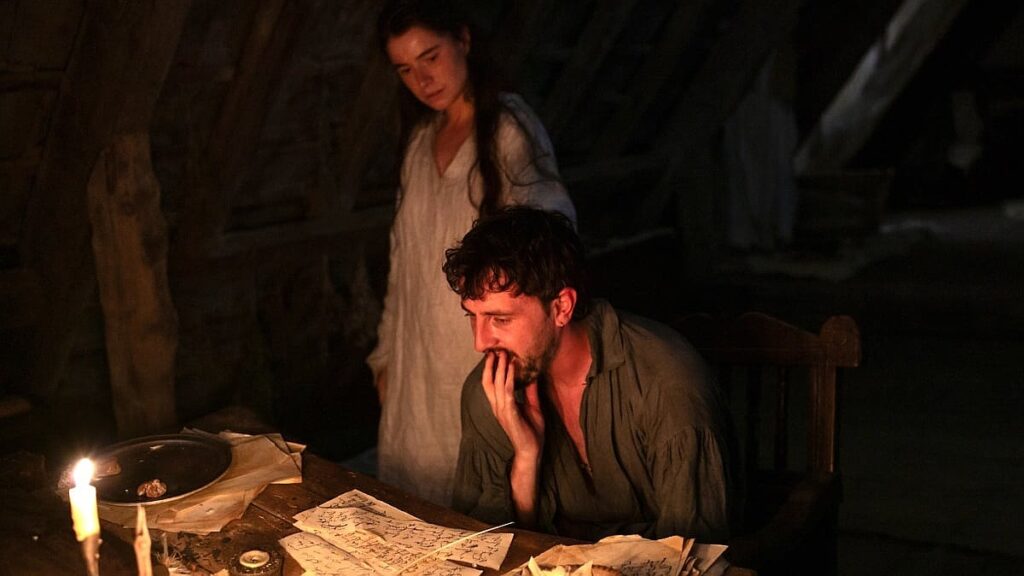
The real history behind Hamnet
The film *Hamnet*, directed by Chloé Zhao and based on Maggie O’Farrell’s novel, delves into the poignant narrative surrounding William Shakespeare’s family, particularly the tragic loss of his son, Hamnet. Set in 16th-century England, the story follows Shakespeare (played by Paul Mescal), his wife Agnes (Jessie Buckley), and their three children as they navigate the strains of Shakespeare’s burgeoning career in London and the heart-wrenching death of their 11-year-old son from the plague. The film suggests that Shakespeare’s grief over Hamnet’s death inspired him to write *Hamlet*, adding a layer of emotional depth to the already rich tapestry of Shakespearean lore. However, while the film is rooted in historical context, it also takes creative liberties, blending fact with artistic interpretation to engage viewers with the Shakespeare family’s story.
The historical accuracy of *Hamnet* is a complex subject, as much of what we know about Shakespeare’s family comes from sparse records, such as baptisms and burial documents. Scholars have speculated about Shakespeare’s life and relationships, with historian Stephen Greenblatt proposing that Shakespeare may have obscured details of his family life due to their Catholic background during a time of Protestant persecution. The film portrays Agnes as a wild, pagan figure, a characterization stemming from O’Farrell’s imagination rather than historical fact. Additionally, the film’s choice to refer to Shakespeare’s wife as Agnes instead of Anne Hathaway reflects the ambiguity of historical records, which feature both names. The film does, however, accurately depict the family dynamics and financial struggles faced by the Shakespeares, setting a believable backdrop for the emotional turmoil that follows Hamnet’s death.
As for the tragic fate of Hamnet, historical records confirm his burial in 1596, coinciding with a plague outbreak, but the specifics surrounding his death remain largely speculative. The film suggests that Shakespeare’s grief led him to retreat into his work, a notion supported by the fact that he continued to produce plays during this challenging period. However, the timeline presented in the movie, which implies that *Hamlet* was written immediately after Hamnet’s death, is historically inaccurate; the play was penned several years later. Despite these discrepancies, *Hamnet* effectively captures the essence of parental grief and the complexities of Shakespeare’s life, leaving audiences to ponder the enduring impact of loss on creativity and legacy. Ultimately, the film serves as a compelling exploration of one of history’s greatest playwrights, inviting viewers to reflect on the interplay between personal tragedy and artistic expression.
Few historical movies make you want to know the real story behind them more than
Hamnet
.
And few areas of popular history have so few answers to offer as the biography of the 16th-century Shakespeare family that lies behind it.
The new film by acclaimed director Chloé Zhao is based on the 2020 novel by Maggie O’Farrell, also called
Hamnet
. O’Farrell and Zhao collaborated on the script, which is a largely faithful adaptation of the book.
Spoiler alert: This discusses the plot of
Hamnet
in detail, including the ending.
Both follow the Stratford life of William Shakespeare (Paul Mescal) his wife Agnes (Jessie Buckley), and their three kids. The family’s bliss is ripped apart by Shakespeare’s increasingly long absences in the London theaters, and the death of Shakespeare’s only son Hamnet from the plague, age 11. In its tear-jerking final act, the tale suggests Shakespeare wrote
Hamlet
to grieve Hamnet.
So what’s accurate, and what’s artistic invention? As with Shakespeare’s own history plays, the answer is: a light sprinkling from column A, and a hefty draught of column B.
How historically accurate is
Hamnet
?
Here’s the first thing you need to know about Shakespeare and his immediate family: We barely know the first thing about Shakespeare and his immediate family. We have some written evidence, like baptisms, funerals, and the Shakespeare wedding; we have records of disputes over his coat of arms. But history’s greatest playwright never, to our knowledge, wrote a word about himself or his kin.
This makes Shakespeare something of a blank canvas — and a lot of his fans have done a lot of painting on it over the centuries.
Some of that speculation is more grounded in educated guesses than others. In his award-winning book
Will in the World: How Shakespeare Became Shakespeare
(2004), Harvard historian Stephen Greenblatt makes a persuasive case that Shakespeare was deliberately obscuring himself because his family was secretly Catholic, at a time when Protestant fears of Catholic plots against Queen Elizabeth made that a very dangerous identity.
At the other end of the sensible scale is what scholars these days largely dismiss: the authorship controversy. This is the conspiracy theory, invented by aristocrats 300 years after his death, that Shakespeare, the son of a glove-maker in Stratford-upon-Avon, couldn’t
possibly
have written all those great plays. Rather, it was Sir Francis Bacon or some other elite candidate working through Shakespeare, for some reason.
If that’s the scale, then
Hamnet
is much closer to the Greenblatt end. The movie paints its picture within the bounds of reason and doesn’t contradict the details we know. And it contains more than a few Easter eggs to keep Shakespeare nerds happy.
Was Shakespeare’s wife Agnes or Anne?
Credit: Focus Features
You may know Shakespeare’s wife by the name Anne Hathaway (no relation to the modern actress). But you will also note that when the character is named in the movie, she’s called Agnes. Which one is right?
The answer, so far as we can tell, is both.
In documents dated around her wedding, in November 1582, she’s “Anne Hathwey.” (This was an era with no fixed spellings for last names; just ask her husband on the form, “William Shagspere”). But in the will of her father, a yeoman farmer, she’s listed as Agnes. Again on her tomb, she’s Anne.
The portrayal of Anne/Agnes as a wild, pagan woman of the woods is O’Farrell’s invention (sorry, WitchTok). But it’s not unlikely that she had a thing or two to teach her future husband, thanks to one detail that goes unmentioned in the film: Anne/Agnes was 26 when they were wed, while Will Shakespeare was a mere 18.
Otherwise, the movie portrays the Hathaways well. You’ll notice their actual cottage, still a tourist attraction, in the movie. It is accurate to suggest that the Hathaway family was fancier than the Shakespeares, who were in financial difficulty due to John Shakespeare’s poor business decisions.
And yes, Anne/Agnes was pregnant at the time of the marriage; Susana, their first daughter, was born around six months later. As to how deliberate a decision this was, your guess is as good as an army of scholars.
How did Hamnet die?
Credit: Focus Features
The Shakespeares’ second and third kids, fraternal twins Judith and Hamnet — probably named for neighbors — were baptised in February 1585. Their father was an in-demand London actor and playwright by the end of that decade. Hamnet was buried in August 1596, around the same time bubonic plague was making one of its periodic sweeps through England.
These are the bare details of Hamnet’s life; all else is invention. We think Shakespeare was probably touring in Kent with a company of players at the time. We assume Shakespeare came home for the funeral — “Hamnet, filius William Shakespeare,” the burial register says — but even that we don’t know for sure.
In 16th-century England, more than one in three children died before the age of 10. It was a common occurrence, and it almost always happened at home. Shakespeare himself would have seen his sister die, age 7. But that doesn’t mean Shakespeare
wasn’t
distraught; many of his contemporary poets, like Ben Jonson, wrote grief-stricken poems on the death of their children.
Was
Hamlet
written for Hamnet?
Yeah, this bit probably didn’t happen.
Credit: Focus Features
We may not know the state of the Shakespeare marriage at this point. But the movie is on pretty firm ground suggesting that the playwright retreated to the playhouse more than before; this was, in fact, his most productive period.
“Whether in the wake of Hamnet’s death Shakespeare was suicidal or serene,” as historian Stephen Greenblatt puts it, “he threw himself into his work.”
To believe the movie, however, you’d think Shakespeare wrote the play immediately after Hamnet’s death. In fact, a lot of plays that followed were comedies, such as
As You Like It
and
Much Ado About Nothing
. The closest he got to portraying parental grief was in
King John,
where a woman is driven to suicidal thoughts by the death of her son.
As for
Hamlet
? That came to Shakespeare about four years after Hamnet died. But like a lot of his work, it wasn’t an original story; another play based on the legend of Hamlet, a Prince of Denmark who avenged his murdered father, had been performed in London when Shakespeare was an aspiring actor (and is now lost).
But why did Shakespeare make
his
Hamlet like that — a protagonist unlike any other before or since, teetering on the brink of madness, suicide, depression, and lost love? There’s a question we’ll keep pondering for many more centuries.
By highlighting a few lines of its father-son dialogue, and imagining Anne/Agnes seeing hir first play in this way,
Hamnet
offers one pretty convincing answer.
Was it happily ever after for the Shakespeares?
Credit: Focus Features
We don’t know how much Shakespeare was an absent dad during his theater career, but there’s one piece of evidence that he wanted to leave London and return to his family: He did come back, for good, in 1613.
Shakespeare died three years later, age 52, leaving his wife “the second best bed” in his will. Anne would outlive him by another seven years. Their daughter Susanna married a local merchant and had one daughter of her own, the last of the Shakespeare line. Judith also had kids, but all three died before her.
Much has been made of that “second-best bed” bit, but historians generally don’t believe Shakespeare intended to insult his wife. The opposite is more likely: In a fancy Tudor-era house, the best bed was generally reserved for guests, so the second-best bed is likely the one the pair slept in.
And as long as we’re painting things on the blank Shakespeare canvas, let’s imagine Anne/Agnes smiling a secret smile when she heard about the last gift her late husband left her. It isn’t evidence that she ever got over Hamnet, but it does suggest a life well lived.