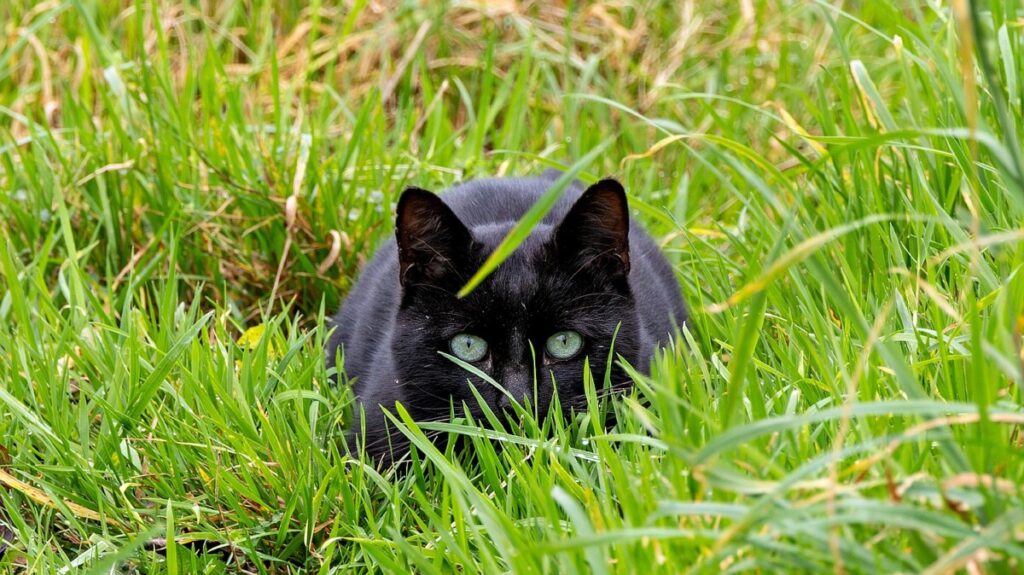
Cats love to massacre bugs, and scientists have the videos to prove it
In a fascinating exploration of the predatory habits of house cats, recent research from the University of Campinas in Brazil reveals that these seemingly adorable pets are more than just cuddly companions—they are also highly effective insect hunters. The study highlights that nearly one in three U.S. households hosts a feline capable of wreaking havoc on local bug populations. Utilizing an innovative approach, the researchers analyzed over 17,000 social media videos and images, focusing on 550 instances where cats were observed hunting insects. This method allowed them to identify 14 different orders of arthropods that cats commonly target, with grasshoppers and crickets (Orthoptera) topping the list at 20.7%, followed closely by bed bugs and cicadas (Hemiptera) at 14.5%, and cockroaches (Blattodea) at 14.4%.
This study not only sheds light on the types of insects that fall victim to feline hunters but also emphasizes the potential of social media as a valuable resource for ecological research. Traditional methods, often reliant on examining cat feces for remains, have historically overlooked the extent of cats’ impact on invertebrate populations. This new approach, termed “iEcology,” demonstrates how user-generated content can provide unprecedented insights into animal behavior and biodiversity. The findings indicate that cats are indiscriminate in their hunting, with larger insects like crickets being easier targets, while smaller prey like spiders are less frequently captured, possibly due to the risk of injury to the cat. Notably, the study revealed that cockroaches were more commonly observed in social media videos than previously recorded in scientific literature, suggesting that cats may pose a greater threat to certain insect populations than previously understood.
The implications of this research extend beyond mere curiosity about cat behavior; they also touch on broader ecological concerns. Cats have been identified as invasive species that significantly impact biodiversity, with estimates suggesting they kill billions of birds and mammals annually. This study serves as a reminder of the hidden ecological roles that domestic cats play, particularly in urban environments where their predatory behavior can have cascading effects on local ecosystems. As the researchers point out, the ability to harness social media data for scientific inquiry opens new avenues for understanding human influence on wildlife and biodiversity, making it clear that our furry companions are not just passive observers of the natural world but active participants in shaping it.
Nearly one in three U.S. households harbor a cold-hearted killer. These stealthy murderers l
urk in the shadows
, silently stalking their targets. Some even have a well-known proclivity for torture. These sadists aren’t even human—they’re house
cats
. And while the popular pets are best known for
downing birds
and
cornering mice
, they are also adept at hunting all manner of bugs. Host a cat in your home long enough and you’ll likely become accustomed to regular deliveries of amputated
insect
legs, wings, or the occasional whole carcass. It’s easy to see that domestic felines have a knack for bug extermination, but understanding exactly which creatures are most likely to end up on a cat’s kill list is a bit trickier. To find that out, researchers from the University of Campinas in Brazil turned to one of the internet’s most reliable forms of content: silly cat videos.
The bugs cats can’t get enough of
The team
collected 17,000 photos and videos
pulled from TikTok and the photo-sharing platform iStock using search terms related to cats and insects. That initial search was narrowed to 550 examples of predation events involving house cats. They then analyzed each of those records for signs of prey and identified 14 distinct arthropod orders.
Orthoptera
(think grasshoppers, locusts, and crickets) were the most frequently preyed-upon bugs, appearing in
20.7 percent of the videos
. Insects from the expansive Hemiptera order, which includes bed bugs and cicadas, appeared 14.5 percent of the time. Bugs from the order Blattodea, which most notably includes cockroaches and termites, came in a close third at
14.4 percent
.
The team says that the findings highlight the power of mining
social media
for research and shed some new light on the cat’s bug diet that largely went undetected using prior methods. Most notably, the cats appeared to target cockroaches with greater frequency than past studies would suggest. The findings are detailed in a study recently
published in the journal
Insect Conservation and Diversity
.
“Our results document cases of cats attacking groups of arthropods that have never been identified in academic papers as cats’ prey,” study co-author and University of Campinas Raul Costa-Pereira said in a statement.
Evolution’s perfect killer
With their sharp retractable claws and night vision, cats are evolutionary fine-tuned assassins. A study on the topic of cat killings published in
Nature Communications
estimates North American house cats may be responsible for the death of somewhere between 6.3 and 22.3 billion mammals and 1.3 to 4 billion birds
in a single year
. They have even wiped out entire species. In 1894, domestic cats in New Zealand famously hunted the
rare Stephens Island wren into extinction
only one year after being introduced to the country
Writing in their 2016 book
Cat Wars
,
authors Peter P. Marra and Chris Santella make the case that these cuddly fur balls should be considered among the world’s first true invasive species. They even compare cat’s product mark on biodiversity as akin to the devastating impact of insecticide DDT (dichlorodiphenyltrichloroethane).
“Like DDT, they [cats] can cause great harm and, once introduced, can be exceptionally difficult to remove from the environment,”
they write
.
Why poke at cat poop when you can watch TikTok?
While feline impact on
birds
and mammals is
well documented
, it’s harder to determine the role they play as bug hunters. That’s because most studies analyzing cat diets rely on looking through their
poop
for signs of skeletal remains. While that’s useful for detecting bones or feathers from vertebrates, signs of invertebrates with exoskeleton can go undetected. Researchers say that can potentially lead to an underestimation of the types and overall amount of bus cats pray on.
Sifting through scat also only accounts for ingested prey, which leaves out plenty of cases where a cat kills a creature, seemingly for the thrill of it, and then abandons the carcass. In other cases, roaches or spiders might narrowly escape a cat’s clutches with a missing limb, only to die from their wounds later.
Analyzing videos of cats attacking bugs on social media offers an alternative approach. The team from this new study say this steady stream of observational data, provided regularly and by willing volunteers looking to get some quick clicks, offers “unprecedented data” to study cats’ impact on arthropod populations. There’s even a term for this approach of using platform-generated data to quantify biological patterns called
iEcology
.
“By capturing their daily lives, people provide information that can be used as unprecedented data to study the structure and functioning of ecosystems under human influence,” the researchers write in the paper.
For their experiment, the team of biologists
analyzed TikTok and iStock between March and April of 2024
using simple search terms like “cat insects” and “cat hunting insects.” They selected only samples that depicted cats consuming or hunting arthropods, as well as examples where cats attempted to capture or stalk them. To keep the results as natural as possible, they removed any examples where it appeared that humans were getting involved or offering the bugs to the cats.
Related: [
Feral Cats Are A Huge Threat To The Global Ecosystem
]
Overall, these findings suggest that cats aren’t all that picky when it comes to what they choose to kill. Crickets and grasshoppers were likely the most commonly targeted bugs simply because their relatively large size makes them easy prey. By contrast,
spiders
made up just four percent of the bugs in the videos, possibly due to their smaller size and the potentially higher risk of injury to the attacking cat.
While cockroaches were commonly observed in the videos, they weren’t well-detected in earlier fecal analysis studies. That result alone highlights the potential opportunity in analyzing social media videos for science.
“The most exciting aspect of our research is that we were able to use social media data to reveal an impact of domestic cats on biodiversity that has been relatively overlooked by the scientific literature,” study lead author and undergraduate student Leticia Alexandre
said in a statement
.
One thing is certain. When it comes to data, there’s no shortage of cats getting up to trouble online.
The post
Cats love to massacre bugs, and scientists have the videos to prove it
appeared first on
Popular Science
.


