‘Jeffrey Epstein is not unique’: What his case reveals about the realities of child sex trafficking
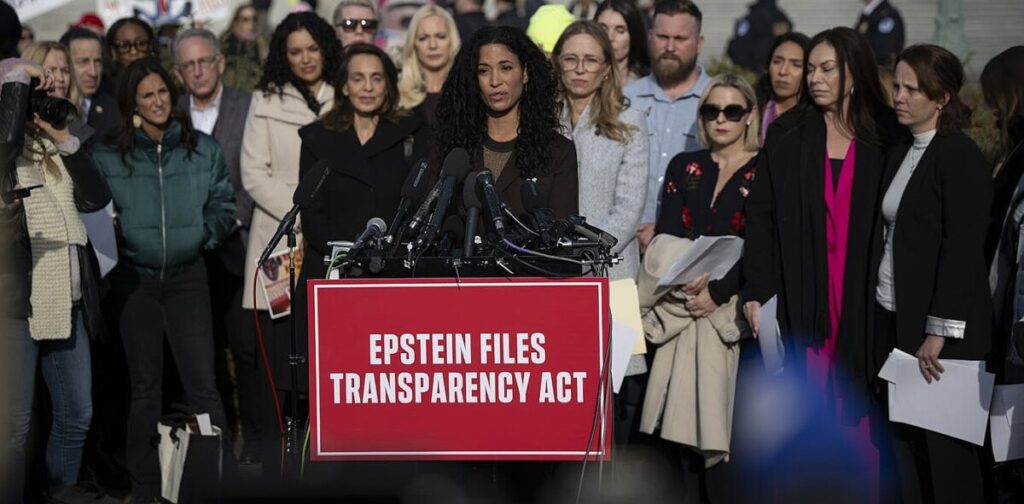
On November 18, 2025, Congress passed the Epstein Files Transparency Act, urging the Justice Department to release records related to the federal investigation into Jeffrey Epstein, the notorious convicted sex offender, and his accomplice, Ghislaine Maxwell. This legislative move comes amidst a renewed focus on child sex trafficking, a grave issue that has gained significant attention in the wake of Epstein’s case. Lisa Phillips, a survivor of Epstein’s abuse, spoke at a press conference highlighting the importance of transparency and accountability in addressing the systemic failures that allow such exploitation to occur. The act aims to shed light on the mechanisms of trafficking and the societal and legal frameworks that often fail to protect vulnerable children.
In a discussion with Alfonso Serrano, Kate Price, an associate research scientist at the Wellesley Centers for Women, elaborated on the complexities of child sex trafficking. Price emphasized that child sex trafficking involves the exploitation of minors under the age of 18 through force, fraud, or coercion, and that societal attitudes often misplace blame on the victims. This victim-blaming mentality is particularly harmful, as it ignores the developmental vulnerabilities of children and the manipulative tactics used by traffickers. Price pointed out that language matters significantly; terms like “child prostitution” have fallen out of favor as they obscure the reality of exploitation and the power dynamics at play. Instead, the focus has shifted to understanding trafficking as a crime rooted in coercion, where children are victims rather than willing participants.
Price further contextualized Epstein’s actions within the broader framework of child sex trafficking, noting that his case exemplifies common patterns seen in such crimes. Traffickers often exploit their wealth and power to insulate themselves from detection, and they frequently dehumanize their victims, labeling them as “trash,” as Maxwell reportedly did. The systemic issues surrounding law enforcement responses and the legal treatment of minors in trafficking cases exacerbate the problem, with many states retaining the right to criminalize sexually exploited minors. This creates a chilling effect, where victims may distrust law enforcement due to past trauma or fear of prosecution. To combat these injustices, Price advocates for a cultural shift in how society views and supports victims, urging a collective responsibility to hold perpetrators accountable and provide necessary resources for recovery. As the conversation around Epstein’s legacy continues, it is imperative that society recognizes the need for comprehensive support systems to protect children and prevent future exploitation.
Jeffrey Epstein abuse survivor Lisa Phillips speaks during the press conference on the Epstein Files Transparency Act in Washington, D.C., on Nov. 18, 2025.
Celal Gunes/Anadolu via Getty Images
Congress on Nov. 18, 2025, passed legislation that calls on the Justice Department to
release records related to Jeffrey Epstein
, the late convicted sex offender. Those records on the
federal investigation of Epstein and his accomplice, Ghislaine Maxwell
, have brought renewed attention to sex trafficking. Alfonso Serrano, a politics editor at The Conversation, spoke with Kate Price,
an associate research scientist at the Wellesley Centers for Women
at Wellesley College, where she studies child sexual exploitation and child sex trafficking policy.
What is child sex trafficking and how does it differ from other kinds of trafficking?
It is a child being traded for sex via force, fraud or coercion. These are children who are under the age of 18. Often what happens, in terms of victim blaming, if a child is, say, 15, 16, 17, there’s this level of blame from perpetrators, the media, relatives, law enforcement, jurors: “She knew what she was doing.” I recently heard this with
the Epstein files back in the news
: “He wasn’t into like 8-year-olds. … There’s a difference between a 15-year-old and a 5-year-old.” That’s not true. Children cannot make decisions that adults can. Neuroscience shows that
children’s brains are not developed
until their mid 20s. Children do not have the same decision-making capacity. That very vulnerability is what is preyed upon by perpetrators.
Why do we not use terms like “child prostitution” anymore, and why does language matter?
In the late 1990s and early aughts, at the beginning of
the anti-human trafficking movement
, people did use the term child prostitution. In fact, I used it in a white paper that I did, and I’m a survivor. But once we really adopted and embraced the terminology of force, fraud and coercion of human trafficking, that gave us a new frame to think of the power dynamics that are involved in the commercial sexual exploitation of children. This phrasing captures the true essence of what is happening within child sex trafficking.
This is not a child somehow deciding that they’re going to go out and trade sex for money, heat, food, anything of value. This is a case of perpetrators, whether they are family members or nonfamily traffickers, who are preying on the vulnerability of children who have often been sexually abused prior to their commercial sexual exploitation. This prior abuse adds another layer of vulnerability.
A billboard in Vadnais Heights, Minn., in 2023 calls for help for survivors of sex trafficking.
Michael Siluk/UCG/Universal Images Group via Getty Images
How do Epstein’s actions fit into the paradigm of trafficking – is he a classic case or an unusual one?
Jeffrey Epstein is not unique. This is absolutely a classic case, for four primary reasons. Child sex trafficking perpetrators are
primarily white men, with wealth and power
. Epstein was, granted, among the uber rich and really powerful men. But power is relative to whatever context in which a child is being exploited. The most powerful person in a small town may not be a billionaire like Epstein, but they have disposable income and high socioeconomic status for the area, or they may hold a prominent position in government, church or a civic organization.
The Epstein case is also not unique in that
victims are often dehumanized
, by perpetrators and in the media. They are blamed, even though they are children who are developmentally incapable of making adult choices. There are
transcripts of Maxwell calling the girls “trash
.” These are seen as disposable children, not worthy of protections. And they have already been dehumanized within our culture prior to exploitation, whether it be through poverty, lack of educational or employment opportunities, or prior sexual violence. That makes them even more vulnerable to perpetrators such as Epstein and Maxwell, who are looking to prey upon those vulnerabilities.
Third, traffickers often
insulate themselves from detection
and trafficking charges by having others, such as women or girls, recruiting victims for them,
which is exactly what Epstein did
. Lastly,
traffickers and buyers often plea down their trafficking charges
. That results in low trafficking prosecution rates. They plea down from a charge like trafficking of a minor to assault, so this does not count toward trafficking prosecution rates.
Epstein did exactly this in 2008
when he accepted prosecutor Alex Acosta’s nonprosecution agreement to plead guilty to two lesser Florida state-level prostitution charges rather than facing the multiple federal child sex trafficking charges for which Epstein was being investigated. This ability to use their wealth and power hides the truth of what is happening.
What systems allow sex trafficking to happen, and how can we change those systems?
Law enforcement often looks the other way. In the Epstein case, one of the
victims had reached out to the FBI
decades ago and nothing happened. It’s really been the persistence of the survivors, saying people really need to look at this.
Child sex trafficking is not a political issue. It’s one of
the few bipartisan issues in our country
that is so culturally divided. Yet Americans need to acknowledge that perpetrators comes from all political affiliations, they come from all races, socioeconomic status. As a culture, we really need to not blame victims and survivors. These are children who are being manipulated and violated. So recognizing the truth of power differences between perpetrators and victims is something that we as a culture very much need to do. By supporting victims, we can use our power – as relatives, jurors, constituents, elected officials – to hold traffickers and buyers to account. Victim-blaming creates a diversion that cements perpetrators’ ability to exploit and abuse children without fear of detection.
Audrey Strauss, acting U.S. attorney for the Southern District of New York, announces charges against Ghislaine Maxwell on July 2, 2020, for her alleged role in the sexual exploitation and abuse of multiple minor girls by Jeffrey Epstein.
AP Photo/John Minchillo, File
In terms of legislation, most states in the country still retain the right to
criminalize sexually exploited minors
, either through arrests or prosecution. These are laws that all states have considered since 2007, when New York was the first state to
introduce a Safe Harbor law
.
In Massachusetts, where I live, law enforcement retains the right to
arrest or prosecute a minor for prostitution
. That often doesn’t happen. But the reason law enforcement says
it needs to have these laws
is because it
encourages children to get services
. It’s a leverage point.
But oftentimes children do not trust law enforcement. And often for good reason.
Some law enforcement are perpretrators
. Other times, law enforcement tells sex-trafficked minors, “We’re doing this for your protection, we’re going to lock you up.” Both instances are deeply traumatizing and lead to mistrust of the police. That being said, so many extraordinary law enforcement agents are committed to supporting child sex trafficking victims and holding perpetrators to account.
Much of this retraumatization happens because local and state governments do not have the money for social services, trauma-informed, child sex trafficking-specific services, and housing opportunities for children to be able to heal. What we have is a robust criminal legal system. So, until we have a robust system that can support children who have been trafficked, sex trafficking is going to continue, in my experience.
Any last thoughts?
We need to acknowledge low prosecution rates of child sexual abuse cases, that 14% of all reported – just reported –
child sexual abuse perpetrators are convicted
or plead guilty. Similarly, in terms of adult rape charges,
1% of cases end in a conviction
or guilty plea. So much of this lack of perpetrator accountability comes through this employment of plea deals and dehumanizing and retraumatizing victims during legal proceedings.
So we need to acknowledge when our criminal-legal system is not doing justice to victims whatsoever, and they’re allowing perpetrators to walk free. In the Epstein case, we’re focused on a few people, while hundreds of perpetrators continue to walk free. By employing these tactics, predators will continue to use the societal silence and misperceptions to their advantage. If it takes a village to raise a child, it also takes a village to sexually exploit a child.
Kate Price does not work for, consult, own shares in or receive funding from any company or organization that would benefit from this article, and has disclosed no relevant affiliations beyond their academic appointment.


