A look back at the biggest presidential Thanksgiving scandals, surprises
Thanksgiving is traditionally a time for family gatherings and reflection, but it has also become a backdrop for some of the most significant political scandals in American history. As families come together to celebrate, the political drama in Washington, D.C. often intensifies, leading to surprising developments that capture the nation’s attention. Fox News Digital recently highlighted several key controversies and events that have unfolded during the Thanksgiving season, reminding us that the holiday can amplify the political stakes and controversies.
One of the most notable incidents occurred in 1973 when President Richard Nixon famously declared, “I am not a crook,” during a press conference in Orlando, Florida, amidst the escalating Watergate scandal. This scandal involved Nixon’s efforts to cover up the break-in at the Democratic National Committee headquarters and his subsequent attempts to obstruct justice. As the investigation intensified, Nixon’s televised remarks were a desperate attempt to quell public concern, but ultimately, he resigned in 1974 as impeachment proceedings loomed. His legacy was forever tainted by the scandal, which serves as a reminder of the profound consequences that political misdeeds can have, particularly during a time meant for unity and gratitude.
Fast forward to the 1980s, when the Iran-Contra affair emerged just before Thanksgiving in 1986. The scandal revolved around secret U.S. arms sales to Iran, intended to secure the release of American hostages, with proceeds funneled to support Contra rebels in Nicaragua. President Ronald Reagan faced significant fallout from this revelation, including the dismissal of key officials and the establishment of a special review board to investigate the National Security Council’s actions. This incident not only rocked Reagan’s administration but also had lasting implications, as the fallout extended into the following administrations, showcasing how political controversies can linger well beyond their initial emergence.
In more recent history, Thanksgiving has also seen the unfolding of the impeachment inquiry against President Bill Clinton in 1998. As Americans shopped on Black Friday, Clinton’s written responses to questions about his affair with Monica Lewinsky were delivered, intensifying the scrutiny surrounding his presidency. His denial of wrongdoing and the subsequent impeachment process highlighted the intersection of personal conduct and public office, a theme that resonates in contemporary political discussions. Similarly, in 2020, President Donald Trump issued a pardon to his former national security advisor, Michael Flynn, just before Thanksgiving, further igniting debates over justice and political influence. These examples illustrate how the Thanksgiving holiday, while a time for celebration, can also serve as a critical juncture for political revelations and controversies, shaping the national conversation in profound ways.
https://www.youtube.com/watch?v=YGj-sbD2Sw4
Thanksgiving
typically slows the news as Americans gather with family and friends. But the holiday also has a habit of amplifying Washington, D.C.’s political drama and surprises.
Americans are no strangers to controversy and scandals, including a handful that have played out across the decades as citizens gathered around the dinner table for Thanksgiving or headed out for Black Friday shopping.
Fox News Digital took a look back at the biggest scandals and political events that rocked
Washington, D.C.,
around the fall holiday.
5 FACTS ABOUT THE HISTORY OF THANKSGIVING YOU CAN SHARE BETWEEN BITES OF TURKEY THIS HOLIDAY
The Saturday before Thanksgiving in 1973, President Richard Nixon held a press conference in Orlando, Florida, where he famously said he was not a “crook” as the Watergate break-in and subsequent scandal came to light.
At the heart of the scandal were Nixon’s efforts to obstruct justice by directing a cover-up of the Watergate office complex break-in, including suppressing the FBI’s investigation, paying hush money and misusing federal agencies to shield his administration from scrutiny.
As the scandal surrounding the break-in of the Democratic National Committee headquarters heated up, Nixon defended himself in a televised Q&A with newspaper editors gathered at Walt Disney World for a convention.
“Let me just say this, and I want to say this to the television audience: I made my mistakes, but in all of my years of public life, I have never profited, never profited from public service. I have earned every cent,” Nixon said, initially answering questions about his personal finances. “And in all of my years of public life, I have never obstructed justice.
“And I think, too, that I could say that in my years of public life, that I welcome this kind of examination, because people have got to know whether or not their
president
is a crook. Well, I am not a crook. I have earned everything I have got.”
Nixon resigned in August 1974 with an impeachment process underway and a grand jury prepared to indict him on charges of bribery, conspiracy, obstruction of justice and obstruction of a criminal investigation related to the Watergate cover-up.
Nixon was later pardoned and did not face any federal prosecution in the matter.
Details unraveled about the Iran–Contra affair in the early days of November 1986 before crescendoing the week of Thanksgiving, including then-President Ronald Reagan dismissing Lt. Col. Oliver North and announcing the resignation of National Security Advisor John Poindexter two days before the holiday.
News began to percolate overseas in early November 1986 that the U.S. made a secret arms sale to Iran to secure the release of American hostages held in Lebanon. U.S. officials later divulged the funds from the deal were used to fund an anti-communist rebel group in Nicaragua called the Contras.
Two days before Thanksgiving, Reagan announced he had dismissed North from the National Security Council, with Poindexter resigning that same day. On Thanksgiving eve, Reagan announced the creation of a Special Review Board to review the National Security Council’s role in the deal, later known as the Tower Commission.
MEET THE AMERICAN WHO GAVE THE NATION OUR FIRST THANKSGIVING ORIGIN STORY: PILGRIM EDWARD WINSLOW
The fallout from the report continued over the holiday and even into the George H.W. Bush administration, when the president granted pardons to a handful of individuals involved on Christmas Eve 1992.
While many Americans were out shopping on Black Friday in 1998, the Clinton
White House
delivered President Bill Clinton’s written responses to 81 questions from House Judiciary related to his affair with intern Monica Lewinsky as part of an impeachment inquiry.
Clinton already had declared to the nation that he “did not have sexual relations with that woman, Miss Lewinsky” in January 1998, and the House authorized an impeachment inquiry in October that intensified around the Thanksgiving holiday. The Judiciary had sent Clinton 81 questions that focused on his relationship with Lewinsky based on independent counsel Kenneth Starr’s report that included evidence related to the affair allegations.
Clinton returned the 81 questions on Black Friday, which included questions about his relationship with Monica Lewinsky and his conduct in the Paula Jones case, which accused him of sexual harassment in 1994. Judiciary Republicans accused Clinton of playing “word games” in his responses, which included Clinton denying he committed perjury or obstructing justice, and the impeachment inquiry continued.
TRUMP, DEMOCRATS LOCKED IN ENDLESS CYCLES OF PAYBACK AFTER COMEY INDICTMENT AND TARGETING PRESIDENT’S ENEMIES
The House ultimately impeached Clinton on charges of perjury to a grand jury and obstruction of justice related to his efforts to conceal the affair with an intern, while the Senate voted to acquit Clinton on both articles of impeachment.
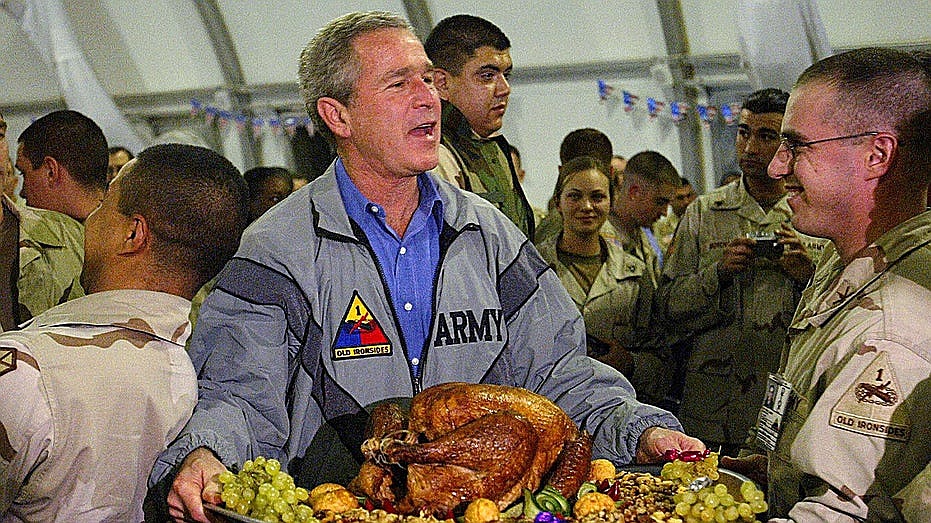
In a more light-hearted Thanksgiving political event, President George W. Bush quietly traveled to Iraq in 2003 to meet with the troops stationed in Baghdad. The visit, cloaked in secrecy until he was there, marked the first time a sitting president visited Iraq.
AMERICA’S ‘UNIQUE’ THANKSGIVING STUFFING PREFERENCES STATE-BY-STATE
“Our planners worked to answer every question,” Bush said at the time about the intense planning for the trip. “I had a lot of questions.”
Bush was on the ground for over two hours before he made the trip back to the U.S. The trip set off some claims that the president was working for a political gain ahead of the 2004 election, while the administration brushed off such claims while stressing the commander in chief’s visit was focused on supporting the troops amid a war.
Just after 4 p.m. on the eve of Thanksgiving in 2020, Trump announced he delivered a full pardon to his former national security advisor, retired Army Gen. Michael Flynn.
The White House later in the day released a statement saying Flynn “should never have been prosecuted” and that the pardon ends “the relentless, partisan pursuit of an innocent man.”
TRUMP ISSUES SWEEPING PARDONS FOR 2020 ELECTION ALLIES — WHAT THE MOVE REALLY MEANS
“While today’s action sets right an injustice against an innocent man and an American hero, it should also serve as a reminder to all of us that we must remain vigilant over those in whom we place our trust and confidence,” the statement continued.
The pardon ended a yearslong legal battle stemming from then-special counsel Robert Mueller’s investigation into Russian interference in the
2016 election
. Flynn’s pardon was preceded by his 2017 guilty plea for lying to the FBI about contacts with Russia. He also had admitted to filing paperwork under the Foreign Agents Registration Act. His sentencing, however, was stalled due to his cooperation with authorities.
In 2019, Flynn claimed he was innocent in the case and sought to withdraw his guilty plea, citing alleged government misconduct.
The Department of Justice was in the midst of moving to dismiss the case when Trump pardoned Flynn.