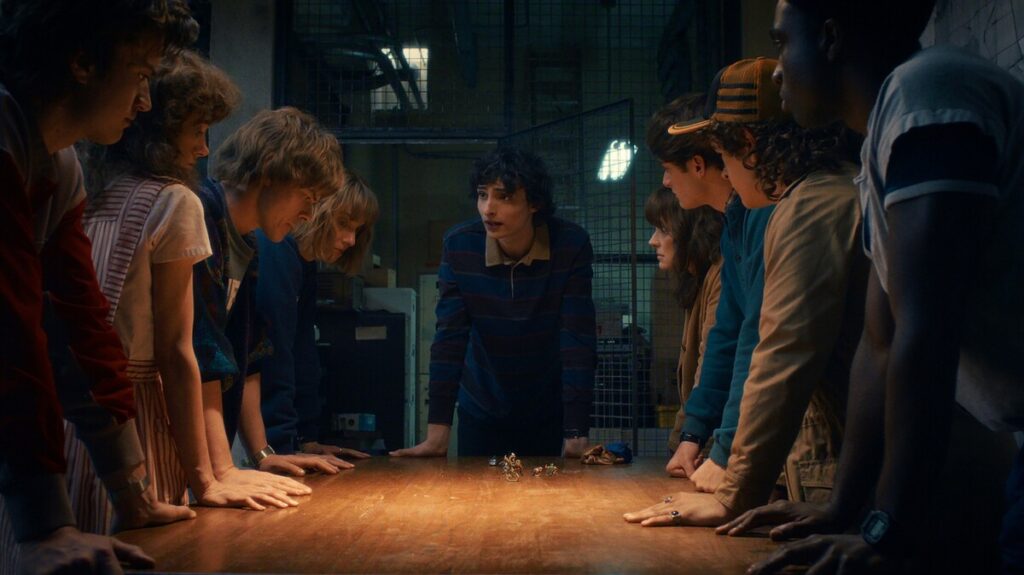
Stranger Things Comes to an Exhausting End
In a thought-provoking article for *The Atlantic*, W. David Marx critiques the current state of popular culture, describing it as a “hoarder’s paradise” overflowing with recycled content and rehashed ideas. He highlights how our everyday lives are inundated with an endless array of media—songs, memes, videos, and more—often lacking originality and coherence. For instance, he mentions how his 5-year-old enjoys a meowed version of the hit song “Golden” from Netflix’s *KPop Demon Hunters* and a baking show called *Is It Cake?*, which is rooted in a viral TikTok trend. This saturation of recycled content exemplifies the modern cultural landscape, where the dominant art form has become the remix, showcasing a blend of nostalgia and innovation, yet often leading to a cluttered and chaotic experience.
As a prime example of this phenomenon, Marx discusses the cultural impact of *Stranger Things*, which debuted nine years ago and quickly became a pop-culture juggernaut by drawing heavily from 1980s cinematic nostalgia. The show’s creators, the Duffer Brothers, managed to craft a series that resonated with audiences by paying homage to iconic filmmakers like Spielberg and Hughes while still producing original content. However, as the series enters its fifth and final season, it grapples with the complexities of maintaining its artistic integrity amid extensive commercialization, including product placements and influencer partnerships. The upcoming season, set in November 1987, finds the characters navigating a military-occupied Hawkins while trying to confront the villain Vecna, yet it struggles with pacing and character development as it juggles numerous plotlines and branded moments.
Marx’s analysis suggests that while *Stranger Things* has the potential to recapture its original charm and thematic depth, the overwhelming clutter of commercial interests and an expansive cast may hinder its ability to do so. The first four episodes of the final season, while filled with nostalgic references and thrilling set pieces, have been criticized for lacking the emotional connections that once defined the series. As audiences continue to consume this content, the challenge remains for *Stranger Things* to rediscover the heart of its narrative, focusing on the triumph of its underdog characters in a world that feels increasingly disconnected and commercialized. If the series can find that balance, it may yet leave a lasting legacy in a culture that often prioritizes spectacle over substance.
In a
recent article
for
The Atlantic
, W. David Marx argued that culture as we know it today is a hoarder’s paradise, a hopelessly cluttered landscape of rubbish. “Everyday life has never contained more
stuff
—an endless reel of words, ideas, games, songs, videos, memes, outrageous statements, celebrity meltdowns, life hacks, extremely talented animals,” he writes. My 5-year-old’s favorite song is a version of “Golden,” the standout hit from Netflix’s
KPop Demon Hunters
,
meowed by fake cats
. Her favorite TV show is
Is It Cake?
, a Netflix baking competition seemingly inspired by a viral TikTok trend that involved making trompe l’oeil cakes disguised as random objects. Everything in popular culture feels recycled or reanimated or patched together out of preexisting elements. The dominant art form of the 21st century is the remix.
Stranger Things
got there first. When the show debuted nine years ago, at the tail end of Barack Obama’s presidency, what was most astonishing about it was how unabashedly it pillaged the Blockbuster Video archives, borrowing from
Spielberg
and
Hughes
and
Cameron
to produce a pop-cultural behemoth that managed to both gratify audience nostalgia and create fresh intellectual property. Matt and Ross Duffer, its genial creators, were able to sell
Stranger Things
as a sincere homage, a love letter to 1980s media born out of admiration, not a cynical cash grab in an era of supercuts and sequels. Thanks to them, even in its fifth and final season, the series still has a pure heart. In the background, though, are product-placement deals featuring more than 100 carefully selected brands, a curated
Spotify “experience”
,
influencer tie-ins
, and prime Demogorgon placement inside the new
Netflix House
at the King of Prussia mall, in Pennsylvania—the latter truly a potent postmodern symbol of art becoming consumption. “Who wouldn’t want an $80 cookie house modeled after Vecna’s death mansion?”
Fast Company’
s Jeff Beer
wondered
recently about the show’s branded partnership with Williams Sonoma.
[
Read: Stranger Things isn’t TV. It’s something else.
]
It would be hard for any show to carry the weight of all this late-capitalist ambition, and the series’s last season embodies all the best and worst aspects of the
Stranger Things
decade. (The first four episodes were made available for review, and are streaming today.) It’s been almost three and a half years since Season 4, during which time the once-tweenage actors have hit drinking age (or, in Millie Bobby Brown’s case, become a parent); the teenagers have entered their 30s; and David Harbour’s beard has reached Rip Van Winkle proportions. I struggled to remember the specific plot nuances from a time before Sabrina Carpenter’s adult-pop era, but the story doesn’t really require thoughtful comprehension. At the end of
Season 4
,
Vecna
(Jamie Campbell Bower)—the antagonist who possessed and murdered victims after manipulating their minds—was revealed to be the ruler of the Upside Down, the parallel dimension Will Byers (Noah Schnapp) was transported to after being kidnapped in the first season. Once a sadistic child with telekinetic abilities named Henry Creel, Vecna was experimented on in the same government lab as the show’s heroine,
Eleven
(Brown); this allowed him to control the gruesome creatures of the Upside Down in service of a larger plan, and to create a rupture between the two dimensions.
Season 5 jumps forward in time 18 months to November 1987. Hawkins, Indiana, is under military quarantine, surrounded by metal fencing. Robin (Maya Hawke) and Steve (Joe Keery) are broadcasting a radio show that periodically roasts the occupying forces and delivers coded messages to the core characters—Chief Hopper, Joyce, Eleven, Nancy, Mike, Will, Dustin, Lucas—who occasionally try to infiltrate the Upside Down to conduct sweeps in search of Vecna. Winona Ryder’s Joyce and David Harbour’s Hopper are still technically together, albeit with apparently minimal interest on the part of the writers. Eleven is wanted by the military and so mostly spends her time doing drills with Hopper, whose overprotectiveness as a parent is matched only by Joyce’s constant fretting over Will.
[
Read: Stranger Things won’t save Netflix
]
When everyone is a fan favorite, no one is expendable, which is why the cast has sprawled out to such an unmanageable extent. There’s no time for characterization—not when Mike has to purchase a Coke from an ostentatiously branded vending machine, or a group breakfast has to be written in to showcase Mrs. Butterworth’s pancake syrup and Sunny Delight. The first episode is largely devoted to catching viewers up; everything that comes after follows the formulaic grooves of previous seasons—propulsive set pieces, meme-able moments, heavy allusions to a pop-cultural touchstone that will likely be
important
(in previous seasons, the show has nodded directly to Wes Craven and Stephen King; this time, the crucial text is Madeleine L’Engle’s
A Wrinkle in Time
). The violence seems brutal for a series so heavily invested in childhood; the characters barely get to relate to one another; the capers are slapdash and illogical; and for some reason Murray, the grating conspiracy theorist, seems to get more screen time than Eleven, the ostensible star of the show.
All of this might change in the episodes still to come. (Not the violence—the Duffers have acknowledged that the final season features one of the most gruesome deaths yet.) I found the first four episodes largely joyless and grim, right up until a moment that seemed to reset the show, or at least to capture some of the connection and spirit that used to make it so compelling. At its best,
Stranger Things
has been a show about the triumph of underdogs, outcasts, and aliens—not an original concept, sure, but a winning one even now, as the government posts
propagandistic imagery celebrating white heritage
and
children are snatched
not by fictional monsters but by masked officers. If
Stranger Things
can locate more of that humanity in its last few episodes, it’ll be much easier to swallow everything else it’s trying to sell us.


