Here’s how big-name hedge funds are using and investing in AI
In the fast-evolving world of finance, hedge funds are increasingly harnessing the power of artificial intelligence (AI) to navigate the complexities of data-driven investing. The hedge fund industry, valued at approximately $5 trillion, is characterized by its diverse strategies and investment approaches. As firms strive to outsmart competitors and enhance decision-making, many are investing heavily in AI technologies, particularly in machine learning and generative AI capabilities. This trend is not just a passing phase; it represents a significant shift in how hedge funds operate, with firms like Citadel, Balyasny, and Bridgewater leading the charge. According to Umesh Subramanian, Citadel’s chief technology officer, the volume of data consumed by these funds is staggering, with firms processing petabytes of information—equivalent to millions of gigabytes—thanks to AI tools that help sift through this vast sea of data.
The application of AI in hedge funds extends beyond mere data processing; it is transforming the very structure of investment teams. For instance, Balyasny has developed an AI bot that automates routine tasks typically assigned to senior analysts, allowing them to focus on more strategic decision-making. This innovation is indicative of a broader trend, as many firms are now integrating AI tools into their daily operations. Notably, quant funds such as D.E. Shaw and Two Sigma have been leveraging AI for years, with the latter’s core AI team reporting significant advancements in generative AI. Furthermore, hedge funds are not only using AI to enhance internal operations but are also actively investing in AI startups, recognizing the potential for high returns in this burgeoning sector. High-profile investors and funds have poured billions into companies like OpenAI and Anthropic, further fueling the growth of the AI landscape.
Despite the enthusiasm surrounding AI, some industry leaders remain cautious about fully entrusting investment decisions to machines. Figures like Ken Griffin of Citadel and Paul Singer of Elliott Management emphasize the importance of human oversight in the investment process, arguing that while AI can process data more efficiently, it cannot yet outperform human intuition and creativity. This sentiment underscores a crucial takeaway: AI is viewed as a powerful tool that complements human judgment rather than a replacement for it. As hedge funds continue to explore the capabilities of AI, the consensus appears to be that the most effective strategies will involve a collaborative approach, where human expertise and AI-driven insights work in tandem to navigate the complexities of the market. The future of hedge fund investing may very well hinge on this delicate balance between technology and human intellect.
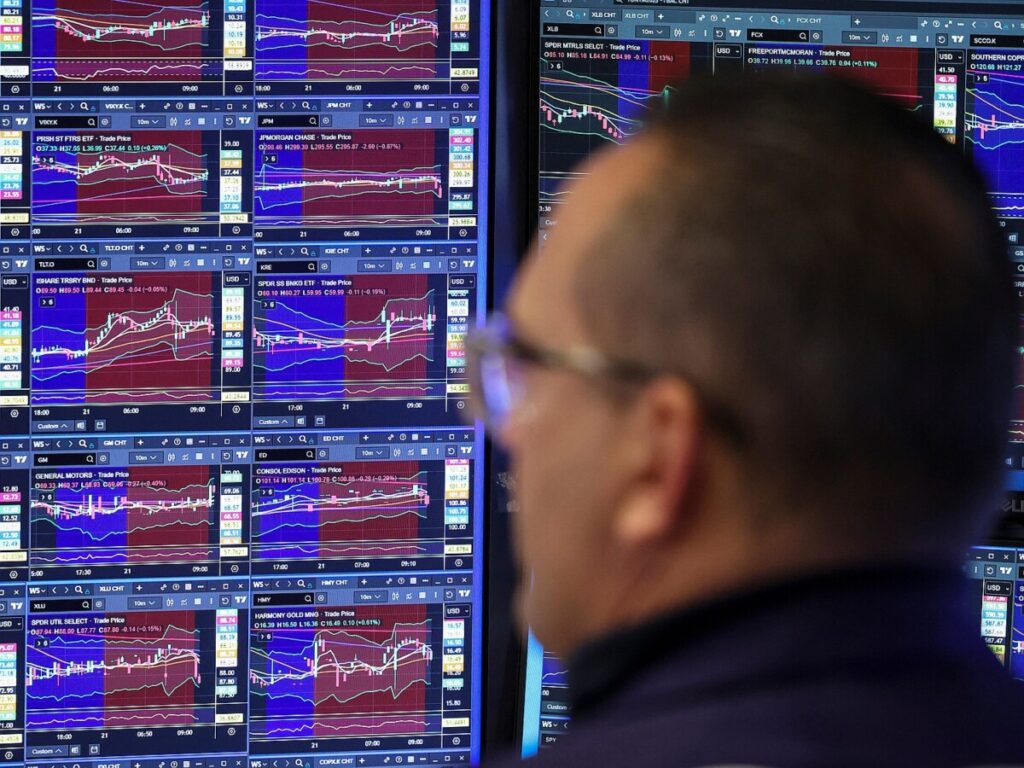
Artificial intelligence helps hedge funds find value in noisy data.
ANGELA WEISS/AFP via Getty Images
Hedge funds have been quick to use artificial intelligence to help their investing teams.
The so-called smart money has also been quick to invest in the trend across public and private companies.
Quant funds have used machine-learning techniques for years.
Artificial intelligence has already changed the way many industries operate, and hedge funds are no exception.
The $5 trillion field is diverse in the type of strategies different firms employ and the type of securities they invest in. But everyone wants to be the smartest manager in the world — or at least the best-informed.
To do that, funds have pumped resources into building out generative AI capabilities and use cases. Many firms, especially quantitative traders, are expanding initiatives they were already pursuing in areas such as machine learning. And nearly every firm is putting capital behind the trend that has dominated the public and private equity markets for several years now.
Business Insider rounded up how some of the biggest and well-known managers are leveraging and backing the development of AI. It’s an extensive, but not exhaustive, rundown.
How funds are using AI
It is, first and foremost, about the data.
Hedge funds have spent countless hours and astronomical amounts of money to get more information than their rivals as fast as possible. Their insatiable appetite for new and unique data has created a thriving
alternative data industry
, which is filled with firms scouring the world for new information to sell.
As
Umesh Subramanian
, the chief technology officer of Ken Griffin’s $69 billion Citadel, said at a Bloomberg event in October, the data firms like his are now consuming is in petabytes. A single petabyte is 1 million gigabytes and can store hundreds of millions of photos or hundreds of thousands of high-definition movies.
The only reason funds like Citadel are able to consume this amount of information without feeling overwhelmed is because of AI. And, given the hypercompetitive nature of the industry, even the slightest advantage over a competitor is worth the cost.
“It’s an arms race to be able to consume the right kind of data in the right kind of way to be able to make the right decisions,” Subramanian said.
$29 billion hedge fund
Balyasny has built an AI bot
that it believes will be able to do the grunt work that typically falls to senior analysts — a potential huge timesaver for investment teams. The manager told Business Insider in 2024 that roughly 80% of the firm’s staff use its AI tools, which include the internal chatbot BAMChatGPT, and recently hired Matthew Henderey, one of the CIA’s AI developers, as a data science executive.
Balyasny isn’t the only firm that has its own chatbot. Man Group and Viking Global have also developed their own internal offerings.
Quant funds like D.E. Shaw, Bridgewater, and Two Sigma and proprietary trading firms and marketmakers like Jane Street, Citadel Securities, and Hudson River Trading have been at the cutting edge of AI and machine learning for years.
For example, Two Sigma’s Mike Shuster, who is the head of the quant’s core AI team, said at a Columbia University event in November 2024 that his firm had been using generative AI for more than five years at that point.
Bridgewater launched a $2 billion fund
in the summer of 2024 that is run by machine learning; the manager’s CEO, Nir Bar Dea, said this year the strategy produces “a unique alpha uncorrelated to what our humans do.”
To stay at the vanguard of a new technology, you need top talent. These firms have often been able to lure top technical talent with eye-popping pay packages, but AI companies have been able to match, and in some cases, surpass compensation offers.
As Business Insider
reported
, young quants drawn to the work AI startups are doing now “don’t even have to take a pay cut” to choose Silicon Valley over East Coast trading floors.
How funds are investing in AI
One of the reasons AI startups like OpenAI and Anthropic can afford hedge-fund talent is the tens of billions of capital that have been invested into them by big-name venture capital firms,
as well as Tiger Cubs
like Tiger Global, Coatue, and D1. Tiger Cubs are hedge funds with connections to the billionaire Julian Robertson and his firm, Tiger Management, that often focus on growth stocks in industries such as technology.
Stockpicking funds like the Tiger Cubs have increasingly turned their attention to the AI trend in the public and private markets. Stocks like Nvidia, AMD, and Korean chipmaker SK Hynix are often significant holdings in their public portfolios, alongside tech giants such as Alphabet, Microsoft, and Meta.
Maverick, a smaller Tiger Cub run by Lee Ainslie, focuses less on picking the winners and losers among AI players and more on supporting the chipmaking ecosystem. The firm’s private fund, Maverick Silicon, which invests in that space, is run by one of the firm’s longtime investors, Andrew Homan.
Steve Cohen, whose $40.5 billion Point72 has dozens of teams that invest in equities, was so convinced by AI’s potential that he created a standalone strategy in October 2024, named Turion, a play on the famous computer scientist Alan Turing’s name, to invest in the space. Point72 rarely offers new funds outside its flagship.
Turion, which is run by portfolio manager Eric Sanchez,
has outperformed
the manager’s flagship offering in 2025.
Where AI still falls short
While some firms have turned over investing decision-making to AI, other industry leaders are not yet convinced that the machines can outperform the market.
Citadel’s Ken Griffin said at an October conference that AI can not yet beat the markets. Man Group’s Numeric unit has created an internal “large language model-based workflow” called AlphaGPT that “still requires human oversight and strategic direction.” Elliott’s Paul Singer said
in a podcast
at the start of the year that AI’s use cases are “way exaggerated.”
There’s no doubt that funds are using AI more than ever before and processing more data than ever imagined. However, human creativity remains important for investment giants, and, for the most part, AI is seen as a tool, not a replacement, for flesh-and-blood traders.
At a
London quant conference in October
, the conclusion many systematic funds reached is that humans, not machines, are the edge required to beat the markets, Business Insider reported.
“Our key takeaway so far is that AlphaGPT doesn’t replace human judgment but amplifies it. The most effective use of the system involves human researchers working alongside AI, with each contributing their unique strengths,” a pair of Man Numeric executives wrote in a note on AlphaGPT from earlier in November.
“Numeric Humans provide strategic direction, market context, and final decision-making, while AlphaGPT handles the heavy lifting of data processing, hypothesis generation, and initial analysis.”
Read the original article on
Business Insider


