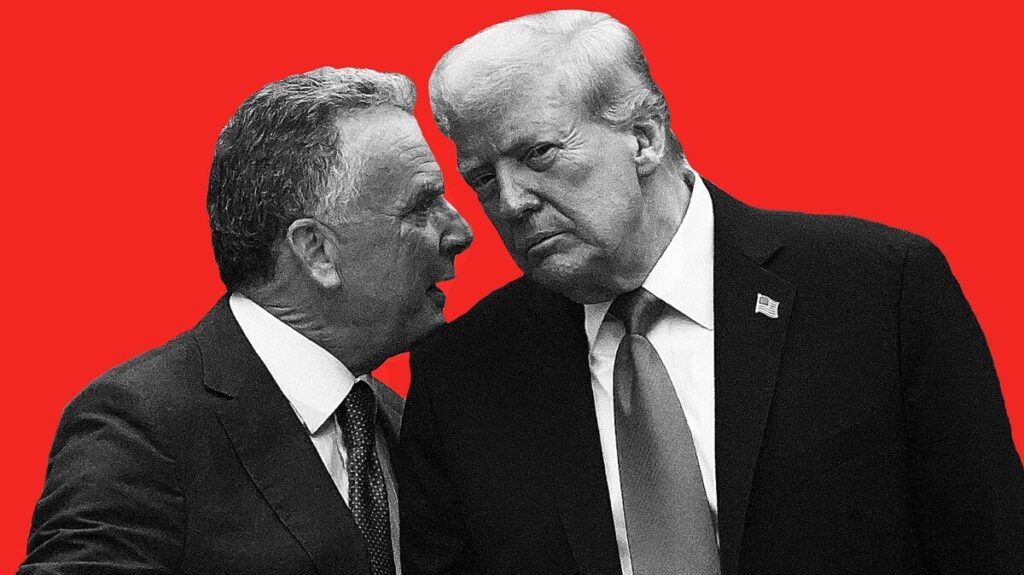
Why Does Steve Witkoff Keep Taking Russia’s Side?
In a striking turn of events, Steve Witkoff, a former real estate developer and current negotiator for peace between Russia and Ukraine, has been thrust into the spotlight for his controversial role in potentially prolonging the ongoing war. On October 14, Witkoff had a significant conversation with Yuri Ushakov, a senior Russian official, during which he suggested that Russian President Vladimir Putin should reach out to former President Donald Trump. This call occurred just two days before Trump was scheduled to meet with Ukrainian President Volodymyr Zelensky in Washington, D.C. While Trump had hinted at the possibility of supplying long-range Tomahawk missiles to Ukraine, he ultimately refrained from doing so, a decision that may have been influenced by Witkoff’s advice to Ushakov. This has raised questions about Witkoff’s true intentions and the implications of his actions on the war’s trajectory.
Witkoff’s leaked conversation reveals a strategic maneuvering that could be seen as aligning with Russian interests rather than advocating for a genuine resolution to the conflict. He advised Ushakov to have Putin compliment Trump on his achievements and express a desire for peace, framing the narrative in a way that could sway Trump’s decision-making. Following their discussion, Putin indeed called Trump on October 16, a two-hour conversation that Trump later described as productive. However, during his meeting with Zelensky, Trump shifted focus, attempting to persuade Ukraine to cede territory in Donetsk—a move that aligns with longstanding Russian demands and could further destabilize Ukraine. Critics argue that Witkoff’s influence has not only thwarted potential military support for Ukraine but has also emboldened Russia to continue its aggressive posture, undermining peace efforts.
The implications of Witkoff’s actions are profound. Many believe that true peace can only be achieved when Russia ceases its hostilities and acknowledges Ukraine’s sovereignty. However, Witkoff appears to be advocating for a peace plan that may inadvertently serve Russian interests, allowing them to regroup and prepare for future aggression. His lack of diplomatic experience raises concerns about his motivations and the potential for personal or financial ties to Russia influencing his decisions. As the conflict continues to claim lives and devastate infrastructure, the question remains: is Witkoff genuinely pursuing peace, or is he inadvertently facilitating a prolonged war? The answers to these questions could have lasting effects on the region and the international response to the ongoing crisis.
https://www.youtube.com/watch?v=katXmNtOEnc
Pay attention to the dates, because the timing matters. Steve Witkoff
spoke
with Yuri Ushakov, a Russian official, on October 14. Ukrainian President Volodymyr Zelensky held a meeting with President Donald Trump in Washington, D.C., on October 17. Trump had been hinting that he would offer to sell Tomahawks, long-range cruise missiles, to the Ukrainian army. But he did not.
Why not? Perhaps because Ushakov listened to Witkoff’s advice and persuaded Russian President Vladimir Putin to call Trump on October 16. Witkoff, in other words, may have helped block that sale. And that would make Witkoff responsible for prolonging the war.
Let me back up and explain.
Witkoff, a former real-estate developer, is supposed to be negotiating a peace settlement between Russia and Ukraine. He is in theory acting on behalf of the United States but also on behalf of millions of people who want peace in Ukraine and security in Europe. Ushakov, a former Russian ambassador to the United States, has different interests: Like his boss, he wants Russia to win the war.
[
Read: Trump’s real secretary of state
]
A tape of the October 14 conversation has been
leaked to
Bloomberg
. That’s how we know Witkoff suggested to Ushakov that Putin call Trump. He also offered advice about what Putin should say. The Russian leader should flatter Trump, of course, which is standard advice for speaking to the American president: “Compliment him on his great success in Gaza, congratulate the president on this achievement.” After that, Witkoff said, “It’s going to be a really good call.”
Then, Witkoff advised, Putin should impress upon Trump this idea: “The Russian Federation has always wanted a peace deal. That’s my belief. I told the president I believe that.” Together, the two of them would cook up a peace plan, just like Trump’s recent Gaza peace plan.
Ushakov gave Putin this advice. Putin followed it. How do we know? Because Putin did, in fact, call Trump, on October 16. The call lasted for
more than two hours
. Trump said the call was productive, and that the two leaders would soon meet, potentially in Budapest (which never happened). During his meeting with Zelensky on the following day, he did not offer Tomahawk missiles to Ukraine. Instead, he became emotional and angry.
In keeping with a long-standing Russian demand, Trump tried to persuade the Ukrainians to give up Ukrainian land in Donetsk province that they currently control—land that the Russians have not been able to conquer after more than a decade of fighting. This is what Putin wants: to obtain Ukrainian territory without fighting for it, to weaken Ukraine, and to use any temporary cease-fire as an opportunity to plan the next invasion.
“With a single phone call,” one insider
told
Politico
last month
, “Putin appears to have changed President Trump’s mind on Ukraine once again.” This was Witkoff’s achievement. Working with another Kremlin insider, Kirill Dmitriev, he went on last week to
propose the 28-point peace plan
that could, if carried out, temporarily stop the fighting but position Russia to invade a weakened Ukraine at a later date.
[
Anne Applebaum: The murky plan that ensures a future war
]
I’ve
written this before
, but it cannot be repeated often enough: This war will end only when Russia stops fighting. The Russians need to halt the invasion, recognize the sovereignty of Ukraine, and drop their imperial ambitions. Then Ukraine can discuss borders, prisoners, and the fate of thousands of kidnapped Ukrainian children.
But the only way to persuade Russia to stop fighting is to put pressure
on Russia
. Not Ukraine,
Russia
. The Ukrainians have already said they will stop fighting and agree to a cease-fire right now, on the current lines of conflict. Yet Witkoff is seeking to persuade Trump
not
to put pressure on Russia, and we don’t really know why.
Witkoff has no previous diplomatic experience, so perhaps he is naive. He spent many years in New York real estate, at a time when Russians were spending fortunes on property, so perhaps he feels gratitude. Maybe he’s helping Russia win because he has “the deepest respect for President Putin,” as he told Ushakov, and admires his brutality. Maybe he, or others in the White House entourage, have business interests tied to Russia—or hope to. In addition to discussing “peace,” Witkoff has also been, according to the document made public last week, talking with the Russians about American investments “in the areas of energy, natural resources, infrastructure, artificial intelligence, data centers, rare earth metal extraction projects in the Arctic.”
Whatever the reason, Witkoff is prolonging the conflict. He is not promoting peace. His call to Ushakov was not, as Trump
said last night
, a normal negotiating tactic. Every time he intervenes, advocating for Putin’s positions, he encourages the Russians to think they can get Trump on their side, pull America away from Europe, break up NATO, and win the war. In other words, every time he intervenes on behalf of the Russians, he contributes to the deaths of Ukrainians, the attacks on infrastructure, the ongoing tragedy that affects millions of people.
If this were a normal American administration, he would be fired immediately. But nothing about this negotiation, or this administration, is normal at all.


