Peace plan presented by the US to Ukraine reflects inexperienced, unrealistic handling of a delicate situation
On November 20, 2025, the Trump administration unveiled a controversial 28-point proposal aimed at ending the ongoing war in Ukraine, which has persisted for nearly four years. Secretary of State Marco Rubio, leading the U.S. delegation, faced the Ukrainian representatives in Geneva just days later, amidst escalating tensions as Russian bombings continued across Ukraine. The proposal has been met with significant backlash from Ukraine and its allies, who argue that it disproportionately favors Russia. Critics assert that the plan demands Ukraine relinquish territory not currently occupied by Russia, reduce its military size, and compromises its long-term sovereignty. This has led to accusations that the Trump administration is prioritizing Russian interests over Ukraine’s security and territorial integrity.
The peace plan’s implications are profound, as it includes provisions that would allow Russia to regain access to international markets by lifting economic sanctions and rejoining the G7 industrialized nations. This move could provide a substantial economic boost to Russia, enabling President Vladimir Putin to replenish his military resources. Furthermore, the proposal prohibits Ukraine from seeking NATO membership—a point many observers expected would be a sticking issue in any peace negotiations. This situation has sparked intense debate within the U.S. government, with Rubio caught in a public dispute over whether the plan was drafted by American officials or directly influenced by Russian demands. The chaotic nature of the negotiations raises concerns about the administration’s diplomatic approach, with experts suggesting that the absence of seasoned diplomats in key positions has resulted in a lack of coherent strategy and execution.
As winter approaches, the urgency for a resolution intensifies, particularly for European countries reliant on Russian energy supplies. The timing of the proposal, coinciding with the potential for increased energy shortages in Northern Europe, suggests that the administration may be motivated by more than just peace. Experts like Donald Heflin emphasize that a credible peace deal requires careful, professional diplomacy, which has been lacking in the current process. The rush to finalize an agreement by Thanksgiving is viewed as unrealistic, given the complexities of the conflict and the need for thorough negotiation. As the situation unfolds, the involvement of European nations and the expertise of professional diplomats will be crucial in shaping a sustainable resolution to the ongoing crisis.
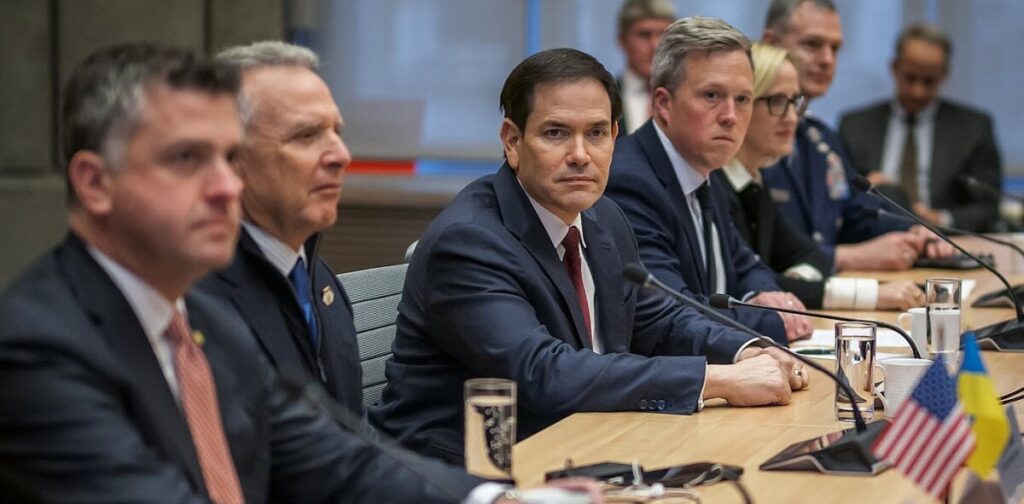
U.S. Secretary of State Marco Rubio, center, with U.S. delegation members faces the Ukrainian delegation during discussions in Geneva on Nov. 23, 2025, on a plan to end the war in Ukraine.
Fabrice Coffrini/ AFP via Getty Images
As
Russian bombs continued to pound Ukraine
, a different conflict has blown up over plans to end that almost four-year-long war. The Trump administration on Nov. 20, 2025,
formally presented Ukraine
with a 28-point proposal to end the war, and President Donald Trump announced the country had until Thanksgiving to sign it. But Ukraine and its European and U.S. allies said
the plan heavily favored Russia
, requiring Ukraine to give up territory not even held by Russia, diminish the size of its military and, ultimately, place its long-term sovereignty at risk. The Trump administration was accused by policy experts and some lawmakers of fashioning
a plan to serve Russia’s interests
, and Secretary of State Marco Rubio got enmeshed in an argument with U.S. senators over whether the U.S. or Russia had authored the document. On Nov. 23, Ukrainian and U.S. officials held talks in Geneva, which Rubio declared were “
productive and meaningful
,” and
those negotiations continue
. The Conversation U.S. politics editor Naomi Schalit asked
longtime diplomat Donald Heflin
, now teaching at Tufts University’s Fletcher School, to help make sense of the chaotic events.
I have a whole list of questions to ask you, but my first question is what on earth is going on?
It’s hard to say. Ever since the Trump administration took power for the second time, it’s
alternated between leaning towards Russia
in this war or being more neutral, with occasional leaning towards Ukraine. They go back and forth.
This particular peace plan
gives Russia a lot at once
. It gets the size of the Ukrainian army cut down from 800,000-plus to 600,000, when the country is barely hanging on defending itself with 800,000 troops. Russia gets land, including land that it has conquered. A lot of people expected that might be one of the conditions of a Ukraine-Russia peace deal. But this also
gives Russia land that it hasn’t taken yet
and may never take.
It bars Ukraine from seeking NATO membership. That’s not a huge surprise. That was probably always going to be part of an eventual deal. Ukraine gets security guarantees from the West. Unfortunately, the U.S. gave
ironclad security guarantees in 1994
when Ukraine gave up its nuclear weapons voluntarily. It’s been invaded by Russia twice since then, in 2014 and 2022. So our security guarantees really don’t mean a whole lot in that area of the world.
Rescue workers extinguish a fire at the site of a Russian drone strike on residential buildings in Kharkiv, Ukraine, on Nov. 24, 2025.
Viacheslav Mavrychev/Suspilne Ukraine/JSC ‘UA:PBC’/Global Images Ukraine via Getty Images
And there’s more, right?
I think this is the most important part, what Putin is looking for more than anything else. Russia gets
released from economic sanctions
and it rejoins the group of G7 industrialized countries.
Putin’s economy is
under a lot of stress
. The cash that would flow in for the sale of Russian goods, particularly energy, would enable him to build a whole new army from scratch, if he needed to. That’s a huge strategic advantage. This would be a major shot in the arm for the Russian economy and for the Russian war economy.
So this is a very pro-Russian deal, unless it’s modified heavily, and there’s argument in Washington now whether the Russians just plain drafted it, or whether our State Department drafted it but for some reason leaned heavily towards Russia.
I’m inclined to think the original draft came from the Russians. It’s just too loaded up with the stuff that they want.
There was a fair amount of confusing back-and-forth on Nov. 23 that Rubio had told some senators that, in fact, the plan wasn’t generated by the United States, that
it reflected a Russian wish list
. The senators revealed this publicly. Then a State Department spokesman called that claim “
blatantly false
.” You’re a former diplomat. When you see that kind of thing happening, what do you think?
It’s amateur hour. We’ve seen this before. With this administration, it
puts a lot of very amateurish people
– Rubio’s not one of them – in place in important offices,
like Steve Witkoff
, the special envoy for Russia and Ukraine who is also the special envoy for the Middle East. And they’ve
gotten rid of all the professionals
. They either just fired some or ran some off.
So you know, the problem here is implementation. Politicians can have great thoughts, but they usually then turn to the professionals and say, “Here’s what I’m thinking.” The people they would turn to are gone. And that was their own doing – the left hand doesn’t know what the right hand is doing.
How does having allies help the U.S.? Gaining independence, defending freedom and keeping the peace didn’t happen going solo. But ever since George Washington, the U.S. has been wary of getting caught up in international friend drama. Former diplomat Don Heflin looks at how this debate has unfolded over the past 250 years.
How might that affect the ultimate goal, which is peace?
This is a very delicate situation that calls for delicate peace talks from professional diplomats. There are a couple of things that need to happen and aren’t happening very much. First off, this is a war in Eastern Europe.
Europe should be very involved
now.
They lean against Russia
, so they probably can’t be honest brokers, but they need to be involved in every step of this process. If there’s going to be any rebuilding of Ukraine,
Europe’s going to have to help with that
. If there’s going to be pressure on Russia, Europe buys a lot of
its goods, especially energy
. They’re just a necessary player, and they haven’t been included.
Ukrainian President Volodymyr Zelenskyy meets with U.S. President Donald Trump at the 80th session of the United Nations General Assembly on Sept. 23, 2025. in New York City.
Chip Somodevilla/Getty Images
What else?
The other is that when people have these great ideas, normally they would turn to their professionals. Those professionals would then talk to the professionals on the other side or other sides. Staff work would be done, then your presidents or your prime ministers or your secretaries of state would meet and hammer out the deal.
None of that’s happening in this process. People are having great thoughts and getting on planes, and that’s not a recipe for a permanent peace deal.
Europe is champing at the bit to try to get involved in this, because they’ve got professional diplomats still in place, and it affects them.
Why is this happening now?
The timing of all this is really interesting. Winter’s coming, and Northern Europe, particularly Germany, is
very dependent on Russian natural gas
to heat their homes. These sanctions against Russia make that difficult. They make it more expensive. Should Russia decide it wanted to play hardball, it could cut off its natural gas in Northern Europe, and people in Germany would be freezing in the dark this winter. This timing is not an accident.
Trump said he wanted an agreement by Thanksgiving. Is that a reasonable requirement of a process to bring peace after a multiyear war?
No, it’s not. I don’t know if they even realize this in the
Trump administration, but that’s another sign – just as we had ahead of
the Alaska Summit between Putin and Trump
– that this isn’t really about trying to make peace. It’s for show and to get credit. In a war that’s been going on now for almost four years, you don’t say, “OK, within the next week, come up with a very complicated peace deal and sign off on it and it’s going to stick.” That’s just not the way it works.
Donald Heflin does not work for, consult, own shares in or receive funding from any company or organization that would benefit from this article, and has disclosed no relevant affiliations beyond their academic appointment.


