First Amendment in flux: When free speech protections came up against the Red Scare
In recent years, the United States has witnessed a resurgence of book banning and increasing governmental intervention in the arts, echoing a historical period marked by similar fears and repressions during the Cold War. The House Un-American Activities Committee (HUAC) hearings of the late 1940s and 1950s serve as a poignant reminder of how the First Amendment’s protections of free speech were tested under the specter of anti-communist paranoia. In 1947, ten prominent screenwriters and directors, collectively known as the Hollywood Ten, were subpoenaed by HUAC to testify about their political affiliations, particularly any ties to communism. Defiantly, they invoked their First Amendment rights, arguing that the committee was infringing upon their freedom of expression. This act of resistance led to their citation for contempt of Congress, with eight receiving prison sentences and all facing blacklisting in the industry, illustrating the precarious nature of free speech in times of political fear.
As the Cold War intensified, the term “unfriendly” emerged to label those who resisted HUAC’s inquiries, leading many artists to abandon the First Amendment as a defense strategy in favor of the Fifth Amendment, which protects against self-incrimination. This shift was notably adopted by various artists and intellectuals who, while avoiding imprisonment, still faced significant repercussions, including job loss and social ostracism. Amidst this climate of fear, figures like Albert Einstein began to advocate for a revival of the First Amendment as a means of resistance. Einstein’s encouragement for individuals to embrace noncompliance with HUAC’s demands marked a turning point, inspiring others, including folk musician Pete Seeger and playwright Arthur Miller, to challenge the legitimacy of the committee’s inquiries and assert their rights to free expression openly. Their refusal to invoke the Fifth Amendment in favor of the First became a rallying cry for the protection of civil liberties, ultimately reshaping public discourse and contributing to the decline of McCarthyism.
The narrative of the Hollywood Ten and subsequent dissenters reveals that while the First Amendment did not initially protect the rights of those who stood up against HUAC, it played a crucial role in the eventual triumph of free expression. By the late 1950s, public sentiment began to shift, and figures like Seeger and Miller experienced legal victories that underscored the importance of standing firm in the face of oppression. Their courageous acts of dissent not only helped to dismantle the oppressive atmosphere of the Second Red Scare but also emphasized that protecting free speech requires both individual bravery and collective action. These historical events serve as a powerful reminder of the fragility of First Amendment rights and the ongoing need to safeguard them against any form of governmental overreach, a lesson that resonates strongly in today’s socio-political climate.
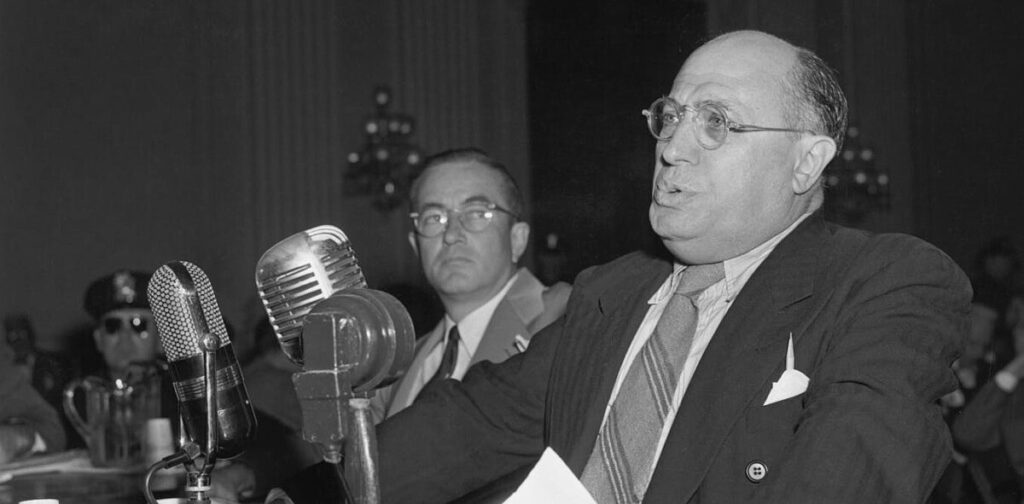
Hollywood screenwriter Samuel Ornitz speaks before the House Un-American Activities Committee in Washington, D.C., on Oct. 29, 1947.
UPI/Bettmann Archive via Getty Images
As the United States faces
increasing incidents of book banning
and threats of
governmental intervention
– as seen in
the temporary suspension of TV host Jimmy Kimmel
– the common reflex for many who want to safeguard free expression is to turn to the
First Amendment
and its free speech protections.
Yet, the First Amendment has not always been potent enough to protect the right to speak. The Cold War presented one such moment in American history, when the freedom of political expression collided with
paranoia over communist infiltration
.
In 1947, the
House Un-American Activities Committee
subpoenaed 10 screenwriters and directors
to testify about their union membership and alleged communist associations. Labeled the
Hollywood Ten
, the defiant witnesses – Alvah Bessie, Herbert Biberman, Lester Cole, Edward Dmytryk, Ring Lardner Jr., John Howard Lawson, Albert Maltz, Samuel Ornitz, Adrian Scott and Dalton Trumbo – refused to answer questions on First Amendment grounds. During his dramatic testimony, Lawson proclaimed his intent “to fight for the Bill of Rights,” which he argued the committee “was trying to destroy.”
They were
all cited for contempt of Congress
. Eight were sentenced to a year in federal prison, and two received six-month terms. Upon their release, they
faced blacklisting in the industry
. Some, like writer Dalton Trumbo,
temporarily left the country
.
As a
researcher focused on the cultural cold war
, I have examined the role the First Amendment played in the anti-communist hearings during the 1940s and ’50s.
The conviction and incarceration of the Hollywood Ten left a
chilling effect on subsequent witnesses
called to appear before congressional committees. It also established a period of repression historians now refer to as the
Second Red Scare
.
Although the freedom of speech is enshrined in the Constitution and prized by Americans, the story of the Second Red Scare shows that this freedom is even more fragile than it may now seem.
The Fifth Amendment communists
After the 1947 hearings, the term “
unfriendly
” became a label applied by the House Un-American Activities Committee and the press to the Hollywood Ten and any witnesses who refused to cooperate with the committee. These witnesses, who wanted to avoid the fate of the Hollywood Ten, began to shift away from the First Amendment as a legal strategy.
They chose instead to plead the
Fifth Amendment
, which grants people the right to protect themselves from self-incrimination. Many prominent artists during the 1950s, including playwright
Lillian Hellman
and singer and activist
Paul Robeson
, opted to invoke the Fifth when called before the committee and asked about their political affiliations.
The
Fifth Amendment shielded hundreds
of “unfriendly” witnesses from imprisonment, including artists, teachers and federal workers. However, it did not save them from
job loss and blacklisting
.
While they could avoid contempt citations by pleading the Fifth, they could not erase the stain of perceived guilt. This legal approach became so widespread that
U.S. Sen. Joseph McCarthy
, the country’s leading anti-communist crusader, disparaged these witnesses as “
Fifth Amendment Communists
” and boasted of purging their ranks from the federal government.
Three portraits of Albert Einstein taken in Princeton, N.J., in March 1953.
AP Photo
From Fifth back to First
In 1953, the physicist Albert Einstein became instrumental in
revitalizing the force of the First Amendment
as a rhetorical and legal tactic in the congressional hearings. Having fled Germany after the Nazis came to power, Einstein took a position at Princeton in 1933 and became an important voice in American politics.
Einstein’s philosophical battle against McCarthyism began with
a letter to a Brooklyn high school teacher
named William Frauenglass.
In April of that year, Frauenglass was subpoenaed to appear before the Senate Internal Security Subcommittee, “
the Senate counterpart
” of the House Un-American Activities Committee, to testify about his involvement in an intercultural education seminar. After the hearing, in which Frauenglass declined to speak about his political affiliations, he risked potential termination from his position and wrote to Einstein seeking support.
In his response, Einstein urged Frauenglass and all intellectuals to enact a “
revolutionary” form of complete “noncooperation
” with the committee.
While Einstein advised noncompliance, he also
acknowledged the potential risk
: “Every intellectual who is called before one of the committees ought to refuse to testify, i.e., he must be prepared for jail and economic ruin, in short, for the sacrifice of his personal welfare in the interest of the cultural welfare of his country.”
Frauenglass shared his story with the press, and
Einstein’s letter was published in full
in The New York Times on June 12, 1953. It was also quoted in local papers around the country.
One week later, Frauenglass was fired from his job.
After learning about Einstein’s public position, McCarthy labeled the Nobel laureate “
an enemy of America
.” That didn’t stop Einstein’s campaign for freedom of expression. He continued to encourage witnesses to rely on the First Amendment.
When the engineer
Albert Shadowitz received a subpoena in 1953
to appear before McCarthy’s Senate Permanent Subcommittee on Investigations, to answer questions about alleged ties to the Communist Party, he traveled to Einstein’s home to seek out the physicist’s advice. After consulting with Einstein, Shadowitz opted for the First Amendment over the Fifth Amendment.
On Dec. 16, 1953,
Shadowitz informed the committee
that he had received counsel from Einstein. He then voiced his opposition to the hearing on the grounds of the First Amendment: “I will refuse to answer any question which invades my rights to think as I please or which violates my guarantees of free speech and association.”
He was cited for contempt in August 1954 and indicted that November, facing a potential year in prison and US$1,000 fine. As an indicator of McCarthy’s diminishing power, the charge was thrown out in July 1955 by a federal judge.
Singer Paul Robeson appears before the House Un-American Activities Committee in Washington, D.C., in 1956.
Bettmann Archive/Getty Images
The triumph of dissent
Well-known public figures also began to turn away from the Fifth Amendment as a legal tactic and to draw on the First Amendment.
In August 1955, when the
folk musician Pete Seeger
testified before the House Un-American Activities Committee, he voiced his rejection of the Fifth Amendment defense during the hearing. Seeger asserted that he wanted to use his testimony to call into question the nature of the inquiry altogether.
Pleading the protection of the First Amendment,
Seeger refused
“to answer any questions” related to his “political beliefs” and instead interrogated the committee’s right to ask such questions “under such compulsion as this.”
When the
playwright Arthur Miller
was subpoenaed by the committee in 1956, he also refused to invoke the Fifth. Both were cited for contempt. Seeger was sentenced to a year in prison. Miller was given the option to pay a $500 dollar fine or spend 30 days in jail.
As Seeger and Miller fought their appeals in court, McCarthy’s popularity continued to wane, and public sentiment began to shift.
Prompted by Einstein, the noncompliant witnesses in the 1950s reshaped the public discussion, refocusing the conversation on the importance of freedom of expression rather than the fears of imagined communist infiltration.
Although the First Amendment failed to keep the Hollywood Ten out of prison, it ultimately prevailed. Unlike the Hollywood Ten, both Miller and Seeger won their appeals. Miller spent no time in prison and Seeger only one day in jail. Miller’s conviction was reversed in 1958, Seeger’s in 1962. The Second Red Scare was over.
As the Second Red Scare shows, when free speech is under attack, strategic compliance may be useful for individuals. However, bold and courageous acts of dissent are critical for protecting First Amendment rights for everyone.
I met Pete Seeger personally while directing a documentary film about his environmental legacy.


