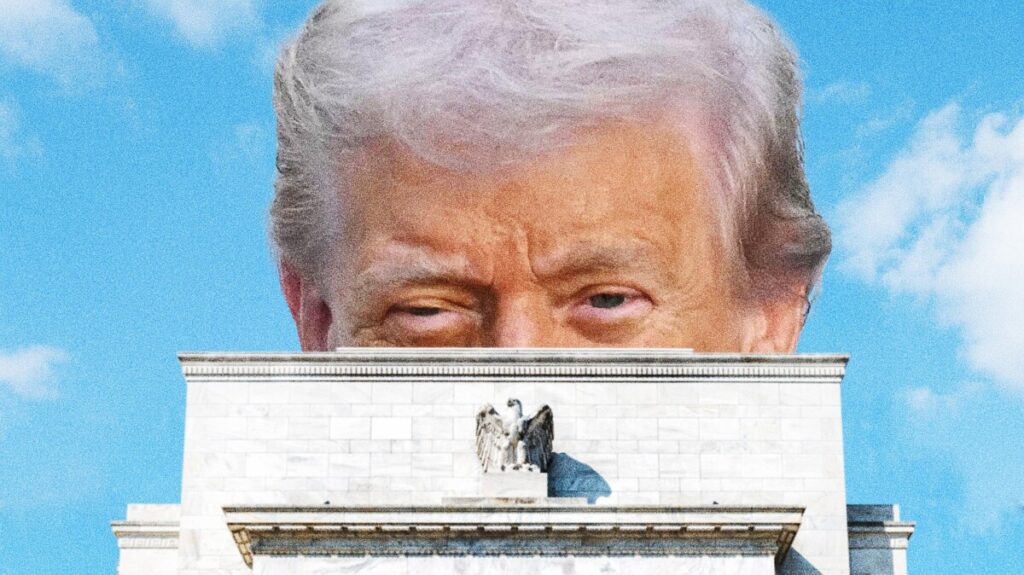
The Court Has an Easy Answer on the Fed
In the wake of President Donald Trump’s second inauguration, a pivotal legal question has emerged regarding the Federal Reserve’s independence and the president’s authority over it. The Supreme Court’s recent ruling in *Trump v. Wilcox* has intensified the debate, affirming the president’s power to remove officials from administrative agencies “without cause.” This ruling is rooted in the controversial unitary executive theory, which posits that the president should exert total control over the executive branch. However, the Court made a notable exception for the Federal Reserve, labeling it a “uniquely structured, quasi-private entity” that follows in the historical tradition of the First and Second Banks of the United States. This characterization, while attempting to preserve the Fed’s autonomy, has raised concerns among legal experts who argue that it lacks a solid legal foundation and fails to adequately protect the Fed from potential presidential overreach.
Critics of the Court’s ruling assert that the Federal Reserve is not akin to the private banks of the past but is instead an independent government entity established by Congress to regulate and supervise commercial banks. This distinction is crucial because it implies that the Fed operates outside the typical bounds of administrative law, where the president’s authority is more pronounced. The article highlights that the Fed functions more like a federal corporation, a status that Congress has historically conferred upon various entities for public purposes. By recognizing the Fed as a federal corporation, it could be argued that the president’s power to interfere is limited, as such corporations are governed by constitutional law rather than the administrative framework that the unitary executive theory seeks to dominate.
The implications of this legal interpretation are profound, especially as Trump appears poised to challenge the Fed’s independence further. His efforts to remove Fed Governor Lisa Cook, with the Supreme Court set to hear her case in January, signify a potential escalation in his attempts to exert control over the central bank. The article warns that if the Court does not clarify the Fed’s status as a federal corporation, it risks enabling a dangerous precedent that could undermine not only the Fed’s autonomy but also the stability of the American economy and the broader international financial system. In light of historical precedent and the constitutional framework, there are compelling arguments for the Court to reaffirm the Fed’s independence, thereby ensuring that it remains insulated from the political winds that could jeopardize its critical role in managing the nation’s monetary policy.
https://www.youtube.com/watch?v=iEPXbtFx8v4
C
an the Supreme Court
impede President Donald Trump from taking control of the Federal Reserve? Can the president remove Fed governors without cause? Since Trump’s second inauguration, these questions have dominated the conversation about the Fed and the future of the American economy.
In its sweeping
Trump v. Wilcox
decision in May,
the Court ruled
that the president “may remove without cause” officials in administrative agencies—a decision grounded in the Court’s ringing endorsement of the so-called
unitary executive
. An elementary application of the unitary-executive theory would allow the White House to interfere, unchecked, with the Fed—just as the Court has empowered Trump to gut every other federal agency. Evidently, though, the Court recognizes the potential
catastrophe
that awaits should Trump exercise absolute authority over the Fed: The
Wilcox
ruling carved out a singular exception for the Federal Reserve System, on the grounds that the Fed is “a uniquely structured, quasi-private entity that follows in the distinct historical tradition of the First and Second Banks of the United States.”
Unfortunately, the Court’s statement—vague on this history—is both misleading and not legally binding. The First and Second Banks were largely private institutions, beholden to their stockholders, with certain important public functions. The Fed, by contrast, is an independent government entity that supervises and regulates the practices and solvency of private commercial banks. On the face of it, these institutions bear little genetic similarity. Moreover, the Court’s statement amounts to dicta—comments made in passing, addressing altogether different parties and facts than the case at issue. Legal
experts
remain
unconvinced
by the Court’s rationale for distinguishing the Fed from other federal agencies.
The implications are extremely dangerous. What some have taken to calling the Court’s
“Federal Reserve exception”
—or, put differently, “Fed exceptionalism”—currently amounts to nothing more than the justices’
desire
for an exception. It provides no substantive defense of the Fed’s independence. Trump, meanwhile, appears intent on
pressing
this weakness.
His effort to remove Fed Governor Lisa Cook
—whose case the Court will hear in January—is only one facet of the matter. A bid for total presidential control over the Fed could yet be on the horizon: Project 2025 suggests that the Fed could be “
effectively abolished
.” America’s economic stability—indeed, the international economic order—may now depend on an exigent and legally dubious assertion by the Court.
[
Read: Trump is getting closer to having an ‘infinite money pit’
]
Fortunately, there are very strong constitutional grounds for defending the Fed’s independence that the Court has overlooked. Simply stated, the Federal Reserve is best understood not as an administrative agency but as a federal corporation. Under the Constitution, Congress, not the president, has the power to create federal corporations. The Fed thus falls outside the federal administrative law over which Trump has asserted absolute command under the unitary-executive theory. Recognizing the Fed as the federal corporation that it is would allow the Court to protect the Fed and escape from the corner it now finds itself in—one that the Court backed itself into thanks to its embrace of the unitary executive.
As a federal corporation, the Federal Reserve belongs to an area of law that is distinct from the administrative law that is currently so embattled. It is one of many bodies that take their legal form and authority from Congress’s prerogative to charter corporations—
a constitutional power
dating back to the nation’s founding that has receded into the background since the advent of the modern administrative state during the New Deal.
During the Constitutional Convention in 1787, the Framers discussed whether to authorize the new Congress to charter corporations. They decided not to include the word
corporation
in the Constitution, for obscure reasons primarily having to do with the politics of Pennsylvania. But the historical record shows unequivocally that legal experts at the time assumed that, regardless of the wording, the Framers had invested Congress with the power to charter corporations. Subsequent generations have used that power to significant effect.
A federal corporation is a company or entity created directly by an act of the U.S. Congress through statute or charter, rather than by state law. Along with the member banks of the Federal Reserve, these institutions include the Tennessee Valley Authority, the Federal Deposit Insurance Corporation, and Amtrak. In some cases, such as the TVA, federal corporations are wholly owned by the federal government. Others have mixed ownership; member banks of the Federal Reserve hold the equivalent of restricted stock. In all cases, though, federal corporations have public functions but operate more like private entities—with the authority to generate revenue and, even occasionally, to manufacture goods. By contrast, federal administrative agencies are executive departments or independent commissions led by presidential appointees and funded almost entirely by Congress through the regular appropriations cycle.
When the Fed was created, in 1913, Congress did not invoke its constitutional power to create federal corporations. This is typical for Congress, which does not have to explicitly name its constitutional powers when it uses them. Congress instead referred to the Fed simply as “the Federal Reserve System.” The Fed is constructed as a network of member banks, which together are directed by what is today the Board of Governors. This makes its structure more complex than some federal corporations; given what looks like a double layer of governance, one might think of it as something akin to a private corporation with multiple subsidiaries. Like large corporations, some of which are made up of smaller elements, neither the member banks nor the governing board functions without the other. The board is not a separate “regulatory agency”; it is the board of directors of an independent, self-governing organization.
There are several other reasons to think that Congress was creating a corporation, not an agency, when it created the Fed. To start with, from 1910 to the early 1930s, the federal corporate form was by far the more common of the two. Indeed, it was arguably the primary legal vehicle with which Congress achieved its public policies. For example, during and just after World War I, Congress created several federal corporations to deal with unstable commodity prices. Because many of the entities created around the same time as the Fed, such as the Sugar Equalization Board and the Emergency Fleet Corporation, no longer exist, it is tempting to view those that survive through the lens of the New Deal’s creation of modern administrative law. But distorted history cannot turn a federal corporation into an administrative agency.
Along these lines, the Fed’s size, prominence, and permanence may make it seem intuitively more like a prominent modern regulatory agency, such as the EPA, than a World War I–era federally backed sugar cooperative. But the growth of an organization does not change its fundamental institutional characteristics. The Fed’s hybrid nature—engaging in both regulation and direct financial activity—marks it squarely as a corporation.
With their mixed public and private characteristics, federal corporations, as created by Congress, are governed by constitutional law; but when it comes to financial operations, they are also governed by private-business law. As federal entities, their public status is unalterable, whatever their hybrid character. In some ways, their public and private duties are fused. Some federal corporations, such as the Fed, have board members who are presidential appointees, confirmed by the Senate. This might seem to indicate that the Fed’s Board of Governors is a federal agency, distinct from the 12 congressionally chartered Federal Reserve Banks; indeed, both the Fed
itself
and modern federal statutory
law
confusingly use the term
agency
with respect to the Fed’s board. But these board members are
not simply an extension
of the executive branch as agency heads are. By assuming their board responsibilities, they are more akin to fiduciaries of the corporation, independent of the executive branch. The mere presence of presidentially appointed board members does not transform a federal corporation into an “agency.” Amtrak’s entire board, for example, is presidentially appointed, but its status as a federal corporation has never been in doubt.
Statutory or self-selected labels do not determine federal corporate status. Indeed, the landmark decision in
Cherry Cotton Mills v. United States
, written by the great mid-century Supreme Court Justice Hugo Black,
requires
the Court to look beyond such labels, largely because Congress has often used designations such as
agency
,
instrumentality
, and
corporation
haphazardly and even opportunistically in a bid to force the Court’s hand as to which set of rules applies. In this case, the answer is clear: The Fed is a federal corporation, and thus it is outside the bounds of the president’s lawful interference. All banks are federally chartered corporations, and the Fed is no exception. Federal corporations’ unique charters, mixed public and private nature, and semi-autonomy set them apart categorically from administrative agencies, which is a designation created entirely by 20th-century administrative law. For these reasons, the Fed is immune, on strict constitutional grounds, from the sort of interference with administrative agencies that the Court has ruled lies within the president’s authority.
C
orporations chartered by Congress
have a venerable past, undergirding American economic activity for more than 200 years. Their operations have encompassed a wide variety of activities, such as building the railroads (Union Pacific) and providing liquidity to the mortgage market (Fannie Mae and Freddie Mac). Indeed, both the First and Second Banks of the United States, to which the Court gestures, were federal corporations. That—not an imagined unique genetic similarity between the Banks and the Fed—is what binds the Banks and the Fed together.
[
Annie Lowrey: The markets won’t save the Fed from Trump
]
The body of law governing federal corporations is distinct from the early instances of what would become modern corporate and administrative law, and it has its own profound lineage. Much of it was developed by no less a luminary than Chief Justice John Marshall—seen by many as the founding father of the Supreme Court and a personal hero of the current chief justice, John Roberts—in a series of landmark cases from 1819 to 1824.
The Court’s ruling in one of these cases,
Osborn v. Bank of the United States
, written by Marshall himself in 1824, directly answered the question confronting the Court with respect to the Fed: Are officers of federal corporations independent from the executive branch? The Court said that they are, asserting that under the Constitution, the category of executive “officer” simply didn’t exist within the federal corporate form. There are, to be sure, legitimate questions about the boundaries between executive and legislative power in modern administrative law. But the status of the Federal Reserve is not one of them. As Chief Justice Marshall made clear, federal corporations—like the Fed—are creatures of Congress. The president’s power over them has always been limited to the terms set out in their charter.
In recent months, under the theory of the unitary executive, which says that the president should have total control of the executive branch, the Court has declined to enjoin the president from firing a variety of federal officials without cause. These cases have all involved administrative agencies, not federal corporations. As a federal corporation, the Fed is protected from the unitary-executive theory that has animated the attack on the agencies. By simply stating as much, the Court can protect the Federal Reserve without resorting to the contrived and unconvincing notion of Fed exceptionalism. And it can do so in a manner that both liberals and conservatives can respect, upholding long-established precedent that dates back to rulings by the Marshall Court from two centuries ago.


