CHAPEA Crew Begins Stay Inside NASA’s Mars Habitat for Second Mission
NASA has officially launched its second CHAPEA (Crew Health and Performance Exploration Analog) mission, with a crew of four volunteers stepping into a 1,700-square-foot, 3D-printed habitat at the Johnson Space Center in Houston on October 19, 2025. This mission, which will last 378 days, aims to simulate the conditions of living and working on Mars, providing invaluable data for future space exploration. The crew members—Ross Elder, Ellen Ellis, Matthew Montgomery, and James Spicer—will engage in a variety of activities that mimic the challenges astronauts would face on a real Martian mission. These include conducting simulated “Marswalks” in spacesuits, performing habitat maintenance, and cultivating crops, all while dealing with the stresses of isolation, limited resources, and communication delays.
The significance of this mission extends beyond mere simulation; it serves as a critical research endeavor to inform NASA’s plans for human exploration of Mars and beyond. According to Sara Whiting, project scientist for the Human Research Program, the insights gained from CHAPEA will be instrumental in shaping mission planning, habitat design, and strategies to support crew health and performance. Grace Douglas, the principal investigator for CHAPEA, emphasizes that the data collected will help NASA understand how crews can effectively manage the unique challenges posed by long-duration space missions. This includes studying the psychological and physical adaptations required to thrive in a Martian environment, which is essential for ensuring the safety and success of future crewed missions to the Moon and Mars.
As the crew embarks on this year-long journey, they will also be contributing to a broader understanding of human resilience in extreme conditions. The first CHAPEA mission concluded in July 2024, laying the groundwork for this second mission. By examining how the crew responds to environmental stressors and equipment failures, NASA aims to develop protocols that will enhance astronaut well-being and mission efficiency in the harsh conditions of space. This research is a vital step toward humanity’s goal of exploring and possibly colonizing Mars, making the findings from CHAPEA not just relevant, but essential for the future of space exploration.
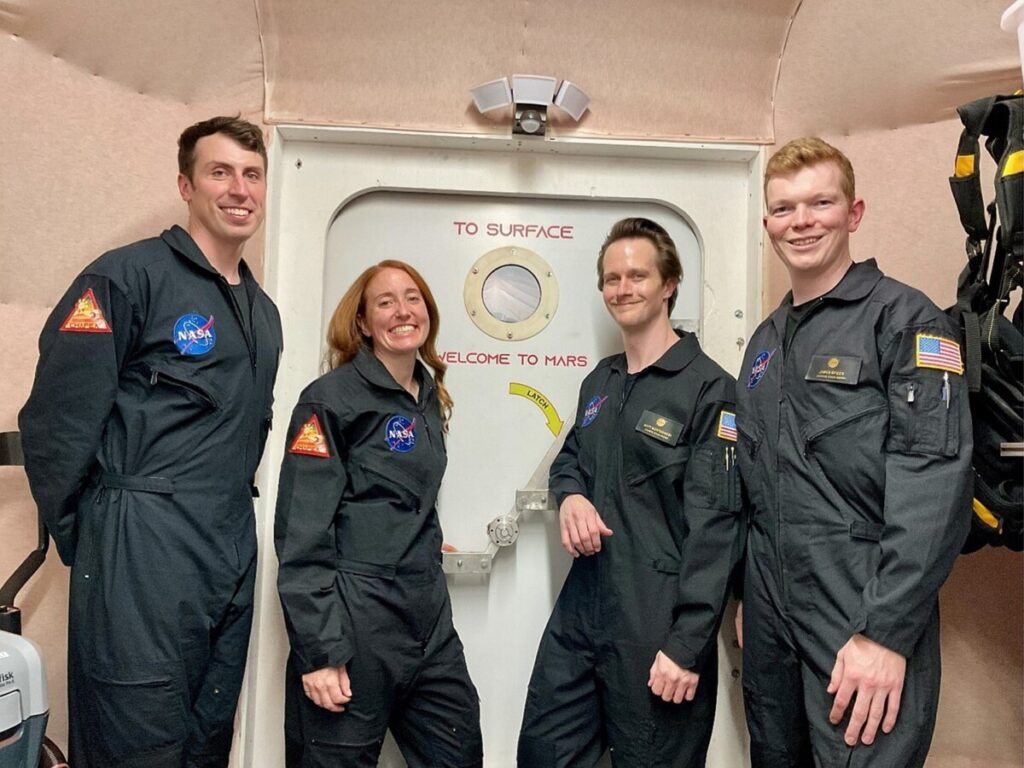
CHAPEA mission 2 crew members (from left) Ross Elder, Ellen Ellis, Matthew Montgomery, and James Spicer pose in front of the door to the simulated Martian landscape for their first photo inside the CHAPEA habitat after their mission began in October 2025.
Credits: NASA/CHAPEA Crew
A crew of four research volunteers stepped inside NASA’s CHAPEA (Crew Health and Performance Exploration Analog) habitat on Oct. 19, marking the start of the agency’s second 378-day simulated Mars mission.
Ross Elder, Ellen Ellis, Matthew Montgomery, and James Spicer are living and working inside the roughly 1,700-square-foot 3D-printed habitat at the agency’s Johnson Space Center in Houston until Oct. 31, 2026.
“The information and lessons learned through CHAPEA will inform real-life mission planning, vehicle and surface habitat designs, and other resources NASA needs to support crew health and performance as we venture beyond low-Earth orbit,” said Sara Whiting, Human Research Program project scientist. “Through these lessons, NASA’s Human Research Program is reducing human health and performance risks of spaceflight to enable safe and successful crewed missions to the Moon, Mars, and beyond.”
The crew will face the challenges of a real Mars mission, and only leave to perform simulated “Marswalk” activities directly outside the habitat, wearing spacesuits, to traverse a simulated Mars environment filled with red sand. During these Marswalks, they will remain isolated within the building that houses CHAPEA at NASA Johnson.
“These crewmembers will help provide foundational data for mission planning and vehicle design and inform trades between resources, methods, and technologies that best support health and performance within the constraints of living on Mars,” said Grace Douglas, CHAPEA principal investigator. “The information gained from these simulated missions is critical to NASA’s goal of sending astronauts to explore Mars.”
During the year ahead, the crew will complete a variety of activities designed to replicate life and work on a long-duration mission on Mars, including high-tempo simulated Marswalks, robotic operations, habitat maintenance, physical exercise, and crop cultivation. The mission also aims to investigate how the crew adapts and responds to various environmental stressors that may arise during a real Martian mission, including limited access to resources, prolonged isolation, 22-minute communication delays, and equipment failures. Researchers will study how the team manages these conditions, which will inform future protocols and plans ahead of future crewed missions to Mars.
The
first CHAPEA mission
, which took place in the same habitat, concluded on July 6, 2024.
The CHAPEA mission 2 main crew and two alternate crew members are pictured in front of the Space Exploration Vehicle, the prototype pressurized rover that transported crew members to the habitat at the start of the mission.
Credits: NASA/James Blair
Ross Elder, CHAPEA mission 2 commander, waves to agency leaders and staff who are supporting the mission before he steps into the habitat.
Credits: NASA/James Blair
Suzanne Bell, CHAPEA Mission 2 Co-Principal Investigator, offers remarks to crew members Matthew Montgomery, James Spicer, Ross Elder, and Ellen Ellis directly before they enter the habitat for the 378-day mission.
Credits: NASA/James Blair
____
NASA’s Human Research Program
NASA’s
Human Research Program
pursues methods and technologies to support safe, productive human space travel. Through science conducted in laboratories, ground-based analogs, commercial missions, the International Space Station and Artemis missions, the program scrutinizes how spaceflight affects human bodies and behaviors. Such research drives the program’s
quest
to innovate ways that keep astronauts healthy and mission ready as human space exploration expands to the Moon, Mars, and beyond.
Explore More
5 min read
NASA’s 2025 Astronaut Candidates: Shaping Artemis Exploration
Article
2 days ago
4 min read
The Overview Effect: Astronaut Perspectives from 25 Years in Low Earth Orbit
Article
3 days ago
8 min read
25 Years of Scientific Discovery Aboard the International Space Station
Article
5 days ago
Keep Exploring
Discover More Topics From NASA
Living in Space
Artemis
Human Research Program
Space Station Research and Technology


