NASA Orbiter Shines New Light on Long-Running Martian Mystery
**Preparations for Next Moonwalk Simulations Underway (and Underwater)**
The European Space Agency (ESA) recently made headlines with its Mars Express orbiter, which, in a groundbreaking study, has enhanced our understanding of the Martian south polar ice cap. Initially, in 2018, scientists detected a signal that suggested the presence of an underground lake, igniting excitement about the potential for life on Mars. However, a new analysis led by researchers from NASA’s Mars Reconnaissance Orbiter (MRO) indicates that this feature is likely not a lake but rather a layer of rock and dust. This revelation is significant as it shifts the narrative about water on Mars, a critical element in the search for extraterrestrial life.
The new findings stem from advanced radar techniques that allow for deeper subsurface observations. The MRO’s Shallow Radar (SHARAD) instrument, operated by scientists Gareth Morgan and Than Putzig, achieved success through a carefully orchestrated maneuver that rolled the spacecraft 120 degrees. This innovative approach enhanced the radar’s ability to penetrate the Martian surface, revealing a faint signal rather than the strong reflection expected from liquid water. The original bright signal detected by ESA’s Mars Express prompted theories about a briny lake capable of sustaining liquid water beneath a thick layer of ice. However, as Morgan noted, the new data raises doubts about this hypothesis, suggesting that the bright signal may instead be attributed to a unique geological feature, such as an ancient lava flow.
The implications of this research extend beyond the immediate findings. The enhanced radar technique opens new avenues for exploration, enabling scientists to investigate other intriguing regions on Mars. For instance, the Medusae Fossae formation, which has long puzzled researchers due to its low radar returns, could potentially reveal valuable insights about Martian geology and water resources. As Putzig pointed out, if ice is indeed found in this equatorial region, it could provide essential resources for future human missions, making it a prime target for exploration. The ongoing collaboration between NASA and ESA exemplifies the global effort to unlock the mysteries of Mars, as both agencies continue to push the boundaries of space exploration and our understanding of the Red Planet.
5 min read
Preparations for Next Moonwalk Simulations Underway (and Underwater)
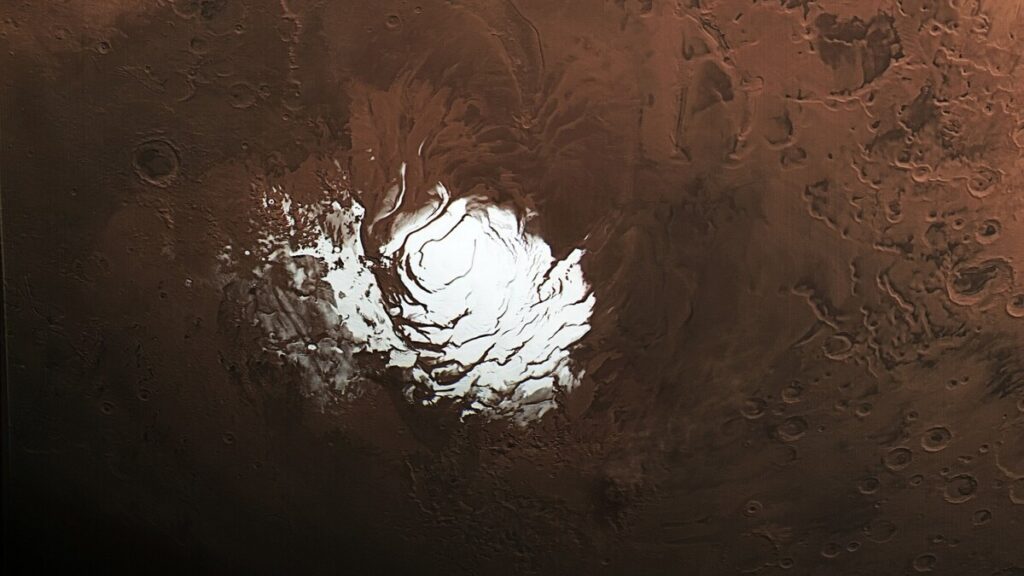
The European Space Agency’s Mars Express orbiter captured this view of Mars’ south polar ice cap Feb. 25, 2015. Three years later, the spacecraft detected a signal from the area to the right of the ice cap that scientists interpreted as an underground lake.
ESA/DLR/FU Berlin, CC BY-SA 3.0 IGO
Results from an enhanced radar technique have demonstrated improvement to sub-surface observations of Mars.
NASA’s Mars Reconnaissance Orbiter (MRO) has revisited and raised new questions about a mysterious feature buried beneath thousands of feet of ice at the Red Planet’s south pole. In a recent study, researchers conclude from data obtained using an innovative radar technique that an area on Mars suspected of being an underground lake is more likely to be a layer of rock and dust.
The 2018 discovery of the suspected lake set off a flurry of scientific activity, as water is closely linked with life in the solar system. While the latest findings indicate this feature is not a lake below the Martian surface, it does suggest that the same radar technique could be used to check for subsurface resources elsewhere on Mars, supporting future explorers.
The paper, published in
Geophysical Research Letters
on Nov. 17, was led by two of MRO’s Shallow Radar (SHARAD) instrument scientists, Gareth Morgan and Than Putzig, who are based at the Planetary Science Institute in Tucson, Arizona, and Lakewood, Colorado, respectively.
The observations were made by MRO with a special maneuver that rolls the spacecraft 120 degrees. Doing so enhances the power of SHARAD, enabling the radar’s signal to penetrate deeper underground and provide a clearer image of the subsurface. These “
very large rolls
” have proved so effective that scientists are eager to use them at previously observed sites where
buried ice might exist
.
This map shows the approximate area where in 2018 ESA’s Mars Express detected a signal the mission’s scientists interpreted as an underground lake. The red lines show the path of NASA’s Mars Reconnaissance Orbiter, which flew both directly overhead as well as over an adjacent region.
Credit: Planetary Science Institute
Morgan, Putzig, and fellow SHARAD team members had made multiple unsuccessful attempts to observe the area suspected of hosting a buried lake. Then the scientists partnered with the spacecraft’s operations team at NASA’s Jet Propulsion Laboratory in Southern California, which leads the mission, to develop the very large roll capability.
Because the radar’s antenna is at the back of MRO, the orbiter’s body obstructs its view and weakens the instrument’s sensitivity. After considerable work, engineers at JPL and Lockheed Martin Space in Littleton, Colorado, which built the spacecraft and supports its operations, developed commands for a 120-degree roll — a technique that requires careful planning to keep the spacecraft safe — to direct more of SHARAD’s signal at the surface.
Bright signal
On May 26, SHARAD performed a very large roll to finally pick up the signal in the target area, which spans about 12.5 miles (20 kilometers) and is buried under a slab of water ice almost 1 mile (1,500 meters) thick.
When a radar signal bounces off underground layers, the strength of its reflection depends on what the subsurface is made of. Most materials let the signal slip through or absorb it, making the return faint. Liquid water is special in that it produces a very reflective surface, sending back a very strong signal (imagine pointing a flashlight at a mirror).
That’s the kind of signal that was spotted from this area in 2018 by a team working with the Mars Advanced Radar for Subsurface and Ionospheric Sounding (MARSIS) instrument aboard the ESA (European Space Agency) Mars Express orbiter. To explain how such a body of water could remain liquid under all that ice, scientists have hypothesized it could be a briny lake, since high salt content can lower water’s freezing temperature.
An antenna sticks out like whiskers from NASA’s Mars Reconnaissance Orbiter in this artist’s concept depicting the spacecraft, which has been orbiting the Red Planet since 2006. This antenna is part of SHARAD, a radar that peers below the Martian surface.
NASA/JPL-Caltech
“We’ve been observing this area with SHARAD for almost 20 years without seeing anything from those depths,” said Putzig. But once MRO achieved a very large roll over the precise area, the team was able to look much deeper. And rather than the bright signal MARSIS received, SHARAD detected a faint one. A different very-large-roll observation of an adjacent area didn’t detect a signal at all, suggesting something unique is causing a quirky radar signal at the exact spot MARSIS saw a signal.
“The lake hypothesis generated lots of creative work, which is exactly what exciting scientific discoveries are supposed to do,” said Morgan. “And while this new data won’t settle the debate, it makes it very hard to support the idea of a liquid water lake.”
Alternative explanations
Mars’ south pole has an ice cap sitting atop heavily cratered terrain, and most radar images of the area below the ice show lots of peaks and valleys. Morgan and Putzig said it’s possible that the bright signal MARSIS detected here may just be a rare smooth area — an ancient lava flow, for example.
Both scientists are excited to use the very large roll technique to reexamine other scientifically interesting regions of Mars. One such place is Medusae Fossae, a sprawling geologic formation on Mars’ equator that produces little radar return. While some scientists have suggested it’s composed of layers of volcanic ash, others have suggested the layers may include heaps of ice deep within.
“If it’s ice, that means there’s lots of water resources near the Martian equator, where you’d want to send humans,” said Putzig. “Because the equator is exposed to more sunlight, it’s warmer and ideal for astronauts to live and work.”
More about MRO
NASA’s Jet Propulsion Laboratory in Southern California manages MRO for the agency’s Science Mission Directorate in Washington as part of NASA’s Mars Exploration Program portfolio. Lockheed Martin Space in Denver built MRO and supports its operations. SHARAD was provided to the MRO mission by the Italian Space Agency (ASI).
News Media Contacts
Andrew Good
Jet Propulsion Laboratory, Pasadena, Calif.
818-393-2433
andrew.c.good@jpl.nasa.gov
Karen Fox / Molly Wasser
NASA Headquarters, Washington
202-358-1600
karen.c.fox@nasa.gov
/
molly.l.wasser@nasa.gov
2025-130
Share
Details
Last Updated
Nov 25, 2025
Related Terms
Mars Reconnaissance Orbiter (MRO)
Mars
Planetary Environments & Atmospheres
Explore More
6 min read
NASA’s Mars Spacecraft Capture Images of Comet 3I/ATLAS
Article
6 days ago
3 min read
View Interstellar Comet 3I/ATLAS Through NASA’s Multiple Lenses
This article was updated to include the full range of dates from the SOHO image.…
Article
6 days ago
4 min read
What Would It Take to Say We Found Life? We Asked a NASA Expert: Episode 63
Article
3 months ago
Keep Exploring
Discover Related Topics
Mars Exploration
Mars is the only planet we know of inhabited entirely by robots. Learn more about the Mars Missions.
Mars Reconnaissance Orbiter
NASA’s Mars Reconnaissance Orbiter (MRO) is the second longest-lived spacecraft to orbit Mars, after 2001 Mars Odyssey.
MRO Science
Overview Among other ongoing achievements, data collected by Mars Reconnaissance Orbiter continues to help Mars scientists and engineers characterize potential…
Mars Express
NASA Participation In partnership with their European colleagues, U.S. scientists are participating in the scientific instrument teams of the Mars…


