Gen Z and boomer shoppers are upping their holiday spending budgets despite a tough economy
As the holiday shopping season approaches, a recent survey by PwC reveals a surprising uptick in consumer spending plans, with shoppers indicating they will spend an average of $770 on gifts this year, marking a 7% increase from $721 in June. This rise in holiday budgets comes despite earlier predictions of a more cautious spending environment, suggesting that the anticipated lean shopping season may not materialize after all. The PwC Holiday Sentiment survey, conducted in October, highlights a notable “say-do gap,” where consumers express intentions to hold back on spending, yet their actual spending plans reflect a more optimistic outlook.
The survey indicates that Baby Boomers and Gen Z shoppers are driving this increase in holiday spending. Boomers plan to spend an average of $858, significantly up from $671 in June, while Gen Z’s budget has risen to $622 from $586. In contrast, Millennials are expecting to spend less this year, averaging $843 compared to $921 previously, and Gen X has also decreased their planned spending from $705 to $679. While the National Retail Federation anticipates this holiday season will reach a historic $1 trillion in total spending, they caution that growth may fall below last year’s 4.3% rate, with EMARKETER predicting a 3.6% increase in holiday retail sales.
Despite mixed signals from various retailers, some chains, like Walmart and Dollar General, are optimistic about consumer spending. Walmart has noted strong performance during smaller shopping events, suggesting that consumers are willing to spend on special occasions if they perceive good value. Meanwhile, Dollar General is focusing on low-priced items to attract budget-conscious shoppers. However, the PwC report warns that increased holiday spending may lead consumers to tighten their budgets in the first quarter of the new year, a traditionally slow period for retail. As the holiday season unfolds, it remains to be seen whether this unexpected surge in consumer confidence will translate into robust sales or if it will result in a spending hangover come January.
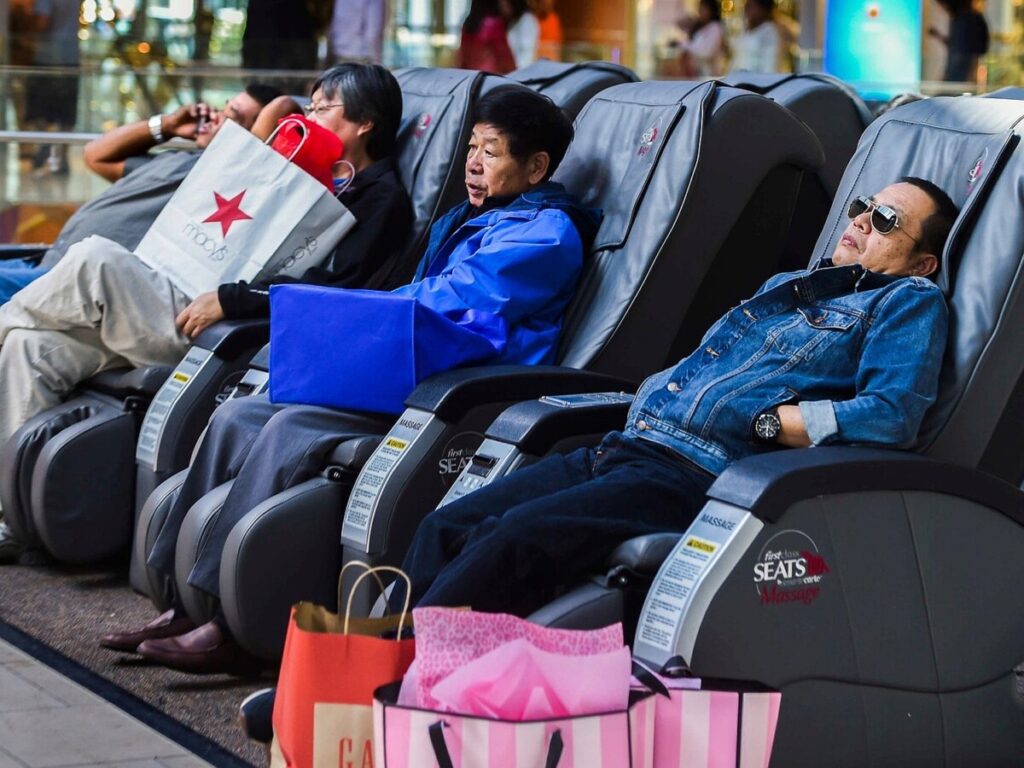
Exhausted Christmas shoppers on Black Friday taking a break on massage chairs at Westfield Santa Anita in Arcadia Friday, November 27, 2015.
Walt Mancini/MediaNews Group/Pasadena Star-News via Getty Images
Shoppers have upped their holiday shopping budgets since this summer, according to a PwC survey.
Baby boomers
and Gen Z are leading the increase.
The results constitute a rosier outlook than many retailers had going into the fall.
Maybe this
holiday season
won’t be so lean after all.
Despite early predictions that shoppers would cut spending as they
bought gifts
this year, a PwC report released Tuesday shows that consumers have upped their spending plans by 7% since June.
PwC’s Holiday Sentiment survey, conducted by the
Big Four firm
in October, shows that shoppers plan to spend an average of $770 on gifts this year. In PwC’s June Holiday Outlook survey, that amount was $721.
The increase contrasts with predictions earlier this year from some analysts and retailers that shoppers would hold back on spending, potentially making this one of the slowest holiday shopping seasons in years.
“This is the tension defining the 2025 holiday season: consumers said they were holding back — but their actual spend since we
conducted our Holiday Outlook survey suggests otherwise,” the report reads.
“In other words, we’re seeing a classic ‘say-do gap,'” it says.
The oldest and youngest shoppers appear to be powering the increase. Baby boomer respondents said that they plan to spend an average of $858 this holiday season, up from $671 in June, while
Gen Z
shoppers upped their planned spending to $622 from $586.
Millennials plan
to spend less — $843 versus $921 in June — while Gen X respondents had averaged $679 in the latest survey, down from $705.
Going into the holiday shopping season, the National Retail Federation
said
that this holiday season would be the first holiday season with $1 trillion in spending. At the same time, the trade group said it expects sales growth to be below last year’s 4.3% rate. EMARKETER, meanwhile, expects holiday retail sales to grow 3.6% this year. (EMARKETER is a sister company to Business Insider.)
As the holidays approach, chains from McDonald’s to Home Depot have warned that
middle-income consumers
are cutting back on spending.
Yet other retailers have expressed optimism about holiday spending at their stores.
Walmart executives
have pointed to strong results from smaller shopping events, such as the back-to-school season and Halloween, as evidence that shoppers are still willing to spend on special occasions — as long as they can get decent value for their money.
And
Dollar General
has said that it is focusing on low-priced items, including many that cost $1, going into the holidays.
If shoppers do indeed spend more this holiday season, the report said it could come at the expense of their spending in the first quarter of the new year, which is historically a slow time for retail sales.
“When it comes to the holidays, people are willing to stretch their budgets, even if it means cutting back in January,” the report reads.
Read the original article on
Business Insider


