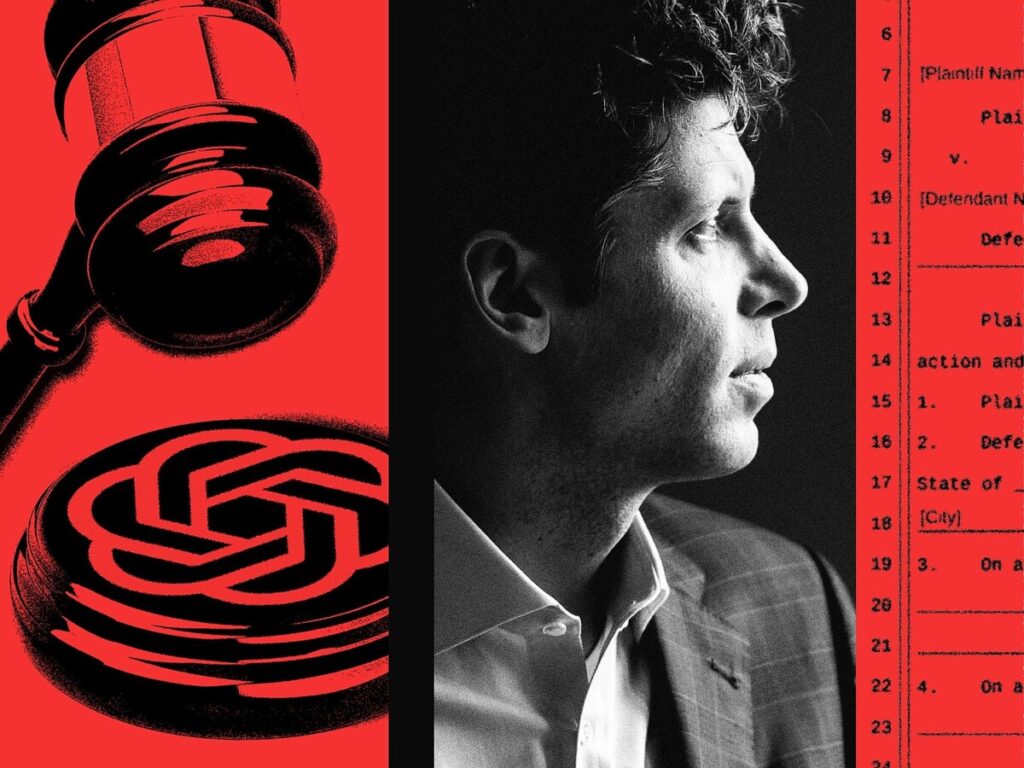
OpenAI’s legal woes are piling up. Here are the toughest battles facing Sam Altman and ChatGPT.
As OpenAI, the creator of ChatGPT, continues its rapid ascent in the tech world, it finds itself embroiled in a series of high-stakes legal battles that could significantly impact its operations and the broader landscape of artificial intelligence. The lawsuits range from accusations of copyright infringement to claims of wrongful death, indicating the diverse challenges the company faces as it transitions from a nonprofit to a for-profit model. This shift has drawn particular scrutiny from co-founder Elon Musk, who has launched multiple lawsuits against OpenAI and its CEO, Sam Altman, claiming that the company has strayed from its original mission of developing AI for the public good. Musk’s lawsuits allege that OpenAI’s partnership with Microsoft, which includes a lucrative licensing agreement, represents a betrayal of their foundational principles. Musk is seeking damages that could amount to millions, while OpenAI maintains that it still operates under the oversight of its nonprofit arm.
In addition to Musk’s lawsuits, OpenAI is also facing significant legal challenges from major media outlets and individual creators. The New York Times has taken a stand against OpenAI and Microsoft for allegedly using its copyrighted articles to train AI models, arguing that this practice amounts to unfair competition and copyright infringement. Similar lawsuits have been filed by other news organizations and prominent authors, including George R.R. Martin and Sarah Silverman, all of whom claim that OpenAI’s practices threaten their intellectual property rights. The outcomes of these cases could establish crucial precedents regarding AI’s use of copyrighted material and may lead to substantial financial penalties for OpenAI. Furthermore, the company is grappling with tragic allegations from the parents of a teenager who died by suicide, claiming that interactions with ChatGPT contributed to their son’s death. This lawsuit emphasizes the urgent need for AI companies to address the potential risks associated with their products, particularly in sensitive contexts like mental health.
As these legal battles unfold, the implications for OpenAI and the AI industry as a whole are profound. The outcomes could redefine how AI companies operate, particularly concerning intellectual property and user safety. With court dates set for early 2024, the tech world will be watching closely to see how these cases will shape the future of AI development and regulation. OpenAI’s rapid growth and the controversies surrounding it serve as a stark reminder that innovation often comes with complex challenges that require careful navigation of ethical and legal landscapes.
https://www.youtube.com/watch?v=R7xjL76Uk18
Florian Gaertner/Getty, Getty Images; Tyler Le/BI
OpenAI and its CEO,
Sam Altman,
face a growing number of lawsuits.
Elon Musk, The NYTimes, and the parents of a boy who committed suicide are among those seeking damages.
Business Insider breaks down the top legal challenges facing the maker of ChatGPT.
OpenAI is disrupting almost every industry in its path. But
moving fast comes with costs.
In its journey to transform from an AI research lab to one of the most valuable companies in the world, OpenAI — and its
CEO, Sam Altman
— faces significant legal challenges. Everything from
OpenAI’s transition to a for-profit business model
to how it trains its large language models has been fodder for lawsuits.
These cases could cost Altman many millions of dollars, impact how all of AI trains its large language models, and potentially even alter how companies and partnerships are organized.
Some, like the two court battles waged against Altman by partner-turned-rival Elon Musk, have an added appeal: as sheer, popcorn-worthy Clash-of-the-Tech-Titans entertainment.
Here’s the latest on the most significant cases. OpenAI did not respond to Business Insider’s request for comment.
Not one, but two Elon Musk lawsuits are bedeviling Sam Altman.
Gonzalo Fuentes/REUTERS
The dispute over OpenAI’s for-profit shift
The issue:
Elon Musk sued Altman last year,
accusing his onetime friend and OpenAI cofounder of betraying their original, 2015 nonprofit mission: to develop AI for the public’s benefit, not for private gain.
Musk says he
invested $38 million
in that early mission only to see OpenAI enter into a multibillion-dollar
exclusive licensing deal with Microsoft,
creating what his lawsuit calls “a $157 billion, for-profit, market-paralyzing gorgon.” Musk added Microsoft as a defendant to the lawsuit this year.
Altman counters that OpenAI is still
controlled by OpenAI’s nonprofit arm.
(Altman also says
Musk himself tried to restructure OpenAI into a for-profit
— under his exclusive control — back in 2017, before severing ties with the company. Musk denies that’s the case.)
What’s at stake:
Musk is demanding a return of “wrongful gains” from the OpenAI and Microsoft partnership — plus damages — in an amount to be set by a jury and potentially in the many millions of dollars.
What’s next:
The case is currently mired in
pretrial evidentiary battles
and litigation surrounding motions to dismiss filed by both Altman and Microsoft. A Phase I trial, limited to Musk’s claim that OpenAI was unlawfully converted into a for-profit, is set for a federal jury trial in March.
xAI disabled Grok on X after it made inflammatory posts.
illustration by Jonathan Raa/NurPhoto via Getty Images
Musk’s suit over ‘poached’ staffers
The issue:
Last month, Musk sued Altman again, this time
accusing OpenAI of stealing his trade secrets
and luring staff at his rival startup, xAI.
OpenAI has “engaged in a deeply troubling pattern” of recruiting xAI employees to gain access to insider intel relating to Musk’s flagship chatbot,
Grok,
the lawsuit says. OpenAI denies any such pattern.
What’s at stake:
The lawsuit seeks a jury verdict that would force OpenAI to halt its “anti-competitive practices” and return “any ill-gotten confidential information.” A jury could also order Altman to pay cash penalties.
What’s next:
Musk said in his lawsuit that he may seek a preliminary ruling halting what he calls xAI’s “unlawful” poaching of his employees and intellectual property.
The case has been assigned to US District Court Judge Rita F. Lin in San Francisco. She has set an initial case management hearing for January 8, 2026.
The New York Times is fighting OpenAI and Microsoft over the use of its copyrighted news articles in training its automated chatbots.
Kylie Cooper/Reuters
A groundbreaking copyright infringement lawsuit
The issue:
In December 2023,
The New York Times
became the largest US news outlet to sue OpenAI and Microsoft over the use of millions of copyrighted news articles in training its automated chatbots. The lawsuit argues that this has provided ChatGPT users with a backdoor to verbatim Times content.
Similar lawsuits were also filed by The Center for Investigative Reporting and a coalition of eight papers owned by Alden Global Capital — including the New York Daily News, Chicago Tribune, and Orlando Sentinel.
OpenAI counters that it only scraped Times articles to train its chatbots, and that this is a fair use under copyright law. OpenAI further argues that it’s rare for ChatGPT to serve up verbatim Times content — an error they are working to fix.
What’s at stake:
These news organizations seek unspecified cash damages and a jury verdict that permanently bars OpenAI from scraping their content.
If successful, the news organizations’ lawsuit could result in a multimillion-dollar verdict
and clearer guardrails for AI’s future use of published content.
What’s next:
In April, these separate news organization cases were combined. Their next joint court date is in January in Manhattan, with evidentiary hearings set for February.
George RR Martin still hasn’t finished “A Song of Ice and Fire.” A judge ruled that ChatGPT’s ideas for a book in the series could violate his copyright.
Craig Barritt/Getty Images for ReedPop
More copyright infringement claims
The issue:
In April, the news organizations’ complaints were combined with a series of lawsuits by
major authors and creators who have also sued OpenAI
for copyright infringement.
Those plaintiffs include the comedian Sarah Silverman, the Authors Guild, and novelists
George R.R. Martin,
Jodi Picoult, and John Grisham.
What’s at stake:
As with the news publishers’ suit, a verdict that could upend the future of AI development. These cases could also force AI companies to disclose closely held training information, although the extent to which that information would be made public is unclear.
What’s next:
In October, US District Judge Sidney H. Stein ruled against OpenAI’s motion to dismiss the combined lawsuits, finding that ChatGPT’s responses to user questions were sufficiently similar to the original works.
Stein also said the consolidated cases had shown “a prima facie claim of copyright infringement based on ChatGPT’s outputs.” The judge’s ruling, however,
did not address the question of fair use, which lawyers on both sides say will be the subject of considerable future debate.
The parties are scheduled to appear in court in January and further hash out discovery-related issues in February.
Some VCs think OpenAI’s ChatGPT could open new doors for consumer AI.
Matthias Balk/picture alliance via Getty Images
Wrongful deaths, mental breakdowns blamed on ChatGPT
The issue:
The parents of Adam Raine
sued OpenAI, Altman, 10 employees, and 10 investors in state court in California in August, blaming ChatGPT for their 16-year-old son’s death by suicide.
The suit alleges that OpenAI’s chatbot encouraged Adam to kill himself by
detailing methods of suicide and discouraging him from seeking support from family members.
As of November, OpenAI has said it is rolling out age-verification features and working with mental health professionals to improve ChatGPT’s responses when a user shows mental distress.
The stakes:
In addition to financial restitution, Raine’s parents are asking for significant changes to
ChatGPT
, including quarterly compliance audits by an independent monitor.
What’s next:
The Raine family’s case is still in its early stages. In November, four similar wrongful death suits were filed against OpenAI in California state court.
As with the Raine case, the new suits concern OpenAI’s GPT-4o, a now-outdated model that Altman has previously said acted “too sycophant-y” in its responses.
They were filed by the Social Media Victims Law Center and the Tech Justice Law Project, which has filed a similar lawsuit against
Character.AI,
plus three additional lawsuits claiming ChatGPT contributed to plaintiffs’ mental breakdowns.
Sora 2 is the new social video platform from OpenAI
Samuel Boivin/NurPhoto via Getty Images
A video trademark infringement case
The issue:
Cameo, the company known for personalized celebrity videos, filed suit in federal court in California in October,
accusing OpenAI of trademark infringement
for naming one of the core features of its Sora app “cameo.”
“We disagree that anyone can claim exclusive ownership over the word ‘cameo,'” an OpenAI spokesperson said in a previous
statement to Business Insider.
The stakes:
OpenAI could have to change the name of the core feature of Sora, which is used as the basis for the app’s AI-generated content. OpenAI has also expanded the feature beyond humans, covering pets and objects.
What’s next:
US District Judge Eumi K. Lee granted Cameo a temporary block on OpenAI using the term “cameo” through December 22. Days before the deadline, both sides are due in court to argue over whether Lee’s order should be made permanent.
Read the original article on
Business Insider


