10 Years of Students Helping NASA Grow Space Food with Growing Beyond Earth
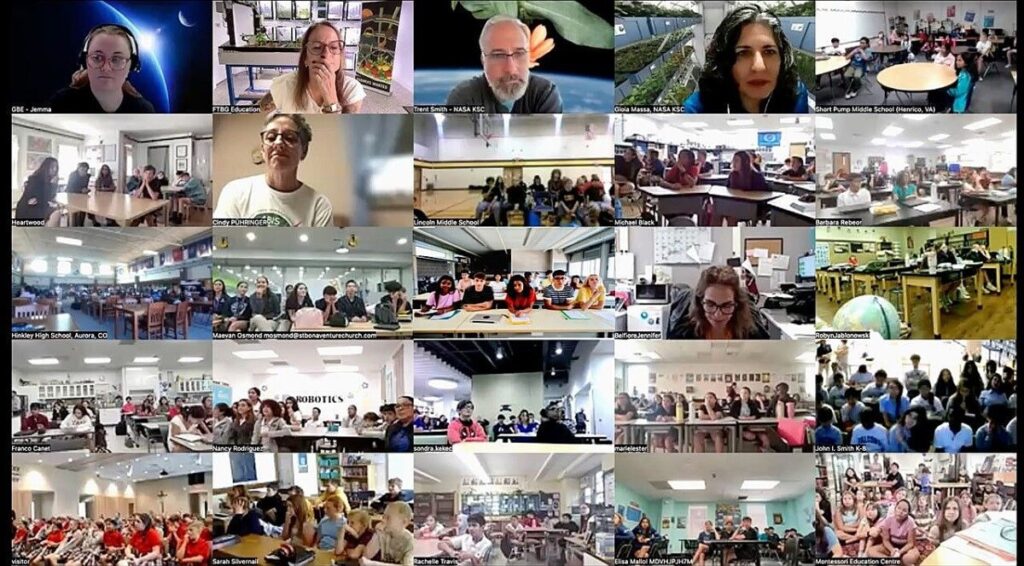
In a remarkable celebration of innovation and education, the Growing Beyond Earth (GBE) program marked its 10th anniversary by engaging nearly 1,250 students from 71 classrooms worldwide in a live interactive session with NASA scientists. Hosted by Fairchild Tropical Botanic Garden, this event connected students directly with Dr. Gioia Massa and Trent M. Smith from NASA’s Kennedy Space Center, allowing them to learn how their classroom experiments are instrumental in developing sustainable food sources for astronauts on long-duration missions to the Moon and Mars. This collaboration not only showcases the practical application of scientific research but also emphasizes the importance of engaging young minds in the field of space exploration.
Since its inception, GBE has involved over 120,000 students from more than 800 classrooms, where they have tested over 250 plant cultivars in specially designed growth chambers that simulate space conditions. The data collected by these students is shared with NASA scientists, contributing to vital research on crop production in space. Notably, five of the crops tested by students have already been grown aboard the International Space Station, highlighting the tangible impact of student involvement in NASA’s missions. Teachers involved in the program have noted the motivational effect it has on students, as they realize that their contributions could directly influence what astronauts eat during their journeys beyond Earth.
The GBE initiative is part of NASA’s broader Science Activation (SciAct) program, which aims to connect scientific knowledge with learners of all ages, fostering curiosity and engagement in STEM (Science, Technology, Engineering, and Mathematics) fields. As Dr. Massa pointed out, when students see themselves as integral to NASA’s mission, it transforms their perception of science from a distant concept to an accessible and exciting field. This kind of engagement not only enhances students’ understanding of scientific principles but also cultivates a generation of future scientists and explorers who are equipped to tackle the challenges of space exploration. By nurturing these young minds today, programs like GBE are planting the seeds for tomorrow’s discoveries, ensuring that humanity is prepared for life beyond our planet.
Explore This Section
Science
Science Activation
10 Years of Students Helping…
Overview
Learning Resources
Science Activation Teams
SME Map
Opportunities
More
Science Activation Stories
Citizen Science
3 min read
10 Years of Students Helping NASA Grow Space Food with Growing Beyond Earth
Students from 71 Classrooms engaged with NASA scientists to learn about how their Growing Beyond Earth research is contributing to feeding astronauts for long distance space travel.
Nearly 1,250 middle and high school students from 71 schools around the world joined Fairchild Tropical Botanic Garden for the Growing Beyond Earth (GBE) Student Launch Chat with the Scientists, marking an inspiring milestone in the program’s 10th anniversary year.
The live session, held in collaboration with NASA, connected classrooms directly with Dr. Gioia Massa and Trent M. Smith, senior leaders of NASA Kennedy Space Center’s Space Crop Production team. Students heard firsthand how their classroom experiments are helping NASA identify and grow the best crops for future astronauts on long-duration missions to the Moon and Mars.
“Our students are contributing to real NASA science,” said one participating teacher. “It’s incredibly motivating for them to know their data could influence what astronauts eat in space someday.”
Connecting Classrooms with NASA Science
Growing Beyond Earth
, led by Fairchild Tropical Botanic Garden in Miami, Florida, brings authentic NASA research into classrooms in a way that few science programs can. For more than a decade, the 83-acre botanic garden – renowned for its conservation, education, and research programs – has worked hand-in-hand with NASA to advance understanding of food production in space.
Students use specially designed plant growth chambers to test how different crops perform under conditions that mimic spacecraft environments. The data they collect are shared with NASA scientists, who use the findings to refine ongoing space crop production research.
Since the program’s inception, more than 120,000 students across 800+ classrooms have tested over 250 plant cultivars, with five student-tested crops already grown aboard the International Space Station.
Cultivating the Future STEM (Science, Technology, Engineering, & Mathematics) Workforce
The Growing Beyond Earth project exemplifies the mission of NASA’s Science Activation (SciAct) program, which connects NASA Science with people of all ages and backgrounds in ways that activate minds and promote a deeper understanding of our world and beyond, with the ultimate Vision: To increase learners’ active participation in the advancement of human knowledge. By engaging students as active participants in cutting-edge research, projects like GBE not only advance NASA’s goals but also cultivate curiosity, creativity, and confidence in the next generation of scientists and explorers. This year’s GBE Student Launch Chat celebrated that impact, showing how student research from classrooms around the globe contributes to the future of space exploration.
“When students see themselves as part of NASA’s mission, they realize science isn’t something distant, it’s something they can do,” said Dr. Massa. Teacher Espy Rodriguez from Hialeah Senior High School said, “It made their [her students] projects matter. I think it gave the kids a real sense of community. We are far, but we are one.” By growing plants, analyzing data, and sharing results with NASA, these students are helping humanity prepare for life beyond Earth, proving that the seeds of tomorrow’s discoveries are being planted in today’s classrooms.
GBE is supported by NASA under cooperative agreement award number 80NCCS2M0125 and is part of NASA’s Science Activation Portfolio. Learn more about how Science Activation connects NASA science experts, real content, and experiences with community leaders to do science in ways that activate minds and promote deeper understanding of our world and beyond:
https://science.nasa.gov/learn/about-science-activation/
.
www.fairchildgarden.org/gbe
Share
Details
Last Updated
Nov 21, 2025
Editor
NASA Science Editorial Team
Location
Kennedy Space Center
Related Terms
Science Activation
Biological & Physical Sciences
Grades 5 – 8 for Educators
Grades 9-12 for Educators
Opportunities For Educators to Get Involved
Opportunities For Students to Get Involved
Explore More
6 min read
NASA Fuels Discovery from Earth to Sky: One Crayon at a Time
Article
1 day ago
5 min read
Helio Highlights: October 2025
Since we all have a relationship with the Sun, it is important to learn about…
Article
2 months ago
2 min read
OSDR and PSI Unveil New Consolidated Website
Article
2 months ago
Keep Exploring
Discover More Topics From NASA
James Webb Space Telescope
Webb is the premier observatory of the next decade, serving thousands of astronomers worldwide. It studies every phase in the…
Perseverance Rover
This rover and its aerial sidekick were assigned to study the geology of Mars and seek signs of ancient microbial…
Parker Solar Probe
On a mission to “touch the Sun,” NASA’s Parker Solar Probe became the first spacecraft to fly through the corona…
Juno
NASA’s Juno spacecraft entered orbit around Jupiter in 2016, the first explorer to peer below the planet’s dense clouds to…


