NASA, NOAA Rank 2025 Ozone Hole as 5th Smallest Since 1992
In a significant environmental update, NASA and the National Oceanic and Atmospheric Administration (NOAA) have reported that the ozone hole over Antarctica in 2025 is the fifth smallest recorded since monitoring began in 1992. This year, the hole reached its maximum extent of approximately 8.83 million square miles (22.86 million square kilometers) on September 9, which is about 30% smaller than the largest ozone hole observed in 2006. The average size during the depletion season from September 7 to October 13 was around 7.23 million square miles (18.71 million square kilometers), nearly double the area of the contiguous United States. Notably, the ozone hole is showing signs of breaking up earlier than in previous years, indicating a positive trend in the recovery of the ozone layer, which is expected to continue throughout this century.
The gradual recovery of the ozone layer is attributed to international efforts to phase out ozone-depleting substances, particularly following the 1987 Montreal Protocol. This landmark agreement was pivotal in reducing the use of chemicals like chlorofluorocarbons (CFCs), which were widely used in products such as aerosol sprays and refrigerants. Since the peak of ozone-depleting substances around the year 2000, their levels in the Antarctic stratosphere have decreased by about one-third. Paul Newman, a senior scientist at NASA, emphasized that if the levels of chlorine in the stratosphere had remained as high as they were 25 years ago, the ozone hole would have been over one million square miles larger this year. However, the remnants of these harmful chemicals still linger in older products and landfills, meaning the full recovery of the ozone layer is projected for around the late 2060s.
Researchers utilize various instruments, including satellites like NASA’s Aura and NOAA’s NOAA-20 and NOAA-21, to monitor the ozone layer’s status globally. This year, the lowest recorded ozone concentration over the South Pole dropped to 147 Dobson Units on October 6, significantly higher than the record low of 92 Dobson Units set in 2006. The Dobson Unit is a measure indicating the total number of ozone molecules present in the atmosphere. The ongoing monitoring and research efforts highlight the importance of international cooperation in addressing environmental issues and the positive impact of reduced emissions on the ozone layer’s health. As we continue to track these developments, the findings reinforce the importance of maintaining vigilance in protecting our planet’s atmosphere.
https://www.youtube.com/watch?v=G0QvhkuX4sI
5 min read
NASA, NOAA Rank 2025 Ozone Hole as 5th Smallest Since 1992
Earth (ESD)
Earth
Explore
Explore Earth Home
Agriculture
Air Quality
Climate Change
Freshwater
Life on Earth
Severe Storms
Snow and Ice
The Global Ocean
Science at Work
Earth Science at Work
Technology and Innovation
Powering Business
Multimedia
Image Collections
Videos
Data
For Researchers
About Us
While continental in scale, the ozone hole over the Antarctic was small in 2025 compared to previous years and remains on track to recover later this century, NASA and the National Oceanic and Atmospheric Administration (NOAA) reported. The hole this year was the fifth smallest since 1992, the year a landmark international agreement to phase out ozone-depleting chemicals began to take effect.
At the height of this year’s depletion season from Sept. 7 through Oct. 13, the average extent of the ozone hole was about 7.23 million square miles (18.71 million square kilometers) — that’s twice the area of the contiguous United States. The 2025 ozone hole is already breaking up, nearly three weeks earlier than usual during the past decade.
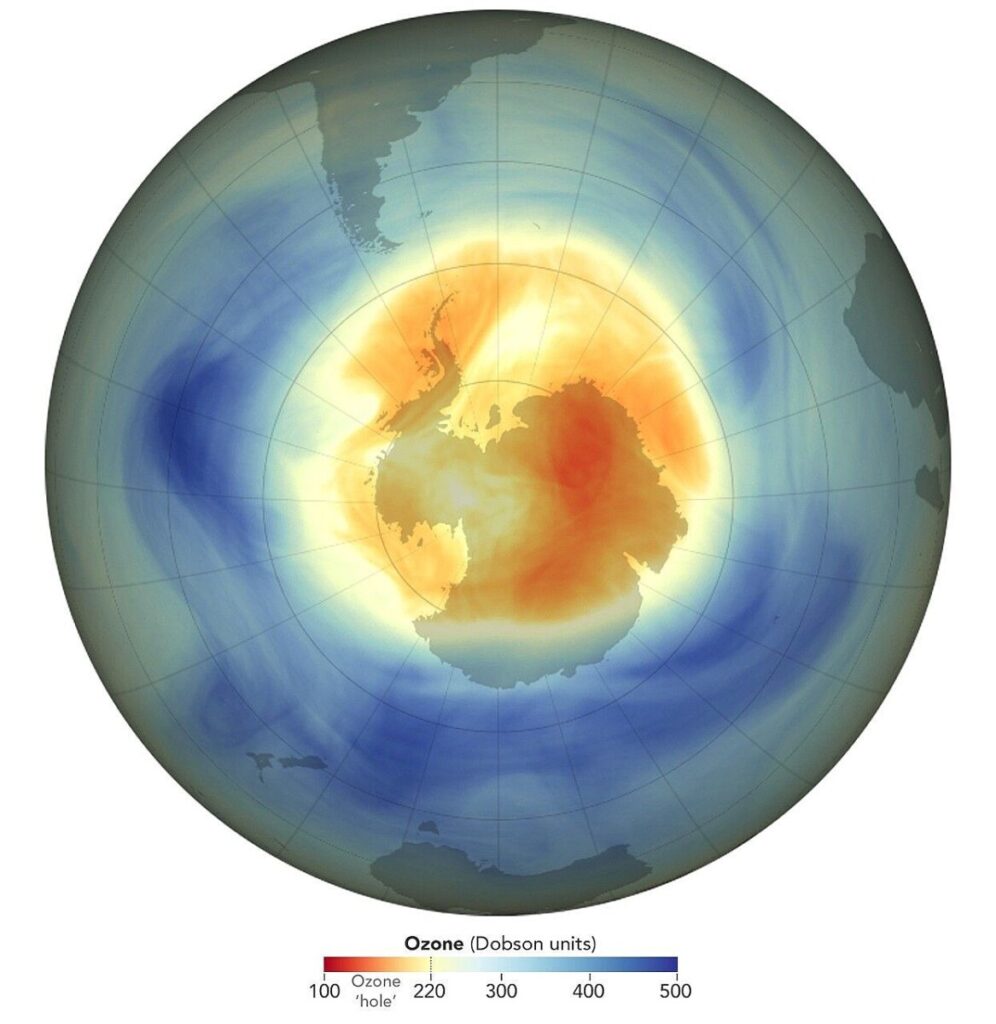
This map shows the size and shape of the ozone hole over the South Pole on the day of its 2025 maximum extent. Moderate ozone losses (orange) are visible amid areas of more potent ozone losses (red). Scientists describe the ozone “hole” as the area in which ozone concentrations drop below the historical threshold of 220 Dobson units.
NASA Earth Observatory image by Lauren Dauphin, using data courtesy of NASA Ozone Watch and GEOS-5 data from the Global Modeling and Assimilation Office at NASA GSFC
The hole reached its greatest one-day extent for the year on Sept. 9 at 8.83 million square miles (22.86 million square kilometers). It was about 30% smaller than the largest hole ever observed, which occurred in 2006, and had an average area of 10.27 million square miles (26.60 million square kilometers).
“As predicted, we’re seeing ozone holes trending smaller in area than they were in the early 2000s,” said Paul Newman, a senior scientist with the University of Maryland, Baltimore County, and leader of the ozone research team at NASA’s Goddard Space Flight Center in Greenbelt, Maryland. “They’re forming later in the season and breaking up earlier. But we still have a long way to go before it recovers to 1980s levels.”
NASA and NOAA scientists say this year’s monitoring showed that controls on ozone-depleting chemical compounds established by the
Montreal Protocol
and subsequent amendments are driving the gradual recovery of the ozone layer in the stratosphere, which remains on track to recover fully later this century.
The ozone-rich layer acts as a planetary sunscreen that helps shield life from harmful ultraviolet (UV) radiation from the Sun. It is located in the stratosphere, which is found between 7 and 31 miles above the Earth’s surface. Reduced ozone allows more UV rays to reach the surface, resulting in crop damage as well as increased cases of skin cancer and cataracts, among other adverse health impacts.
The ozone depletion process starts when human-made compounds containing chlorine and bromine rise high into the stratosphere miles above Earth’s surface. Freed from their molecular bonds by the more intense UV radiation, the chlorine and bromine-containing molecules then participate in reactions that destroy ozone molecules. Chlorofluorocarbons and other ozone-depleting compounds were once widely used in aerosol sprays, foams, air conditioners, and refrigerators. The chlorine and bromine from these compounds can linger in the atmosphere for decades to centuries.
“Since peaking around the year 2000, levels of ozone-depleting substances in the Antarctic stratosphere have declined by about a third, relative to pre-ozone-hole levels,” said Stephen Montzka, a senior scientist with NOAA’s
Global Monitoring Laboratory
.
As part of the 1987 Montreal Protocol, countries agreed to replace ozone-depleting substances with less harmful alternatives.
“This year’s hole would have been more than one million square miles larger if there was still as much chlorine in the stratosphere as there was 25 years ago,” Newman said.
Still, the now-banned chemicals persist in old products like building insulation and in landfills. As emissions from those legacy uses taper off over time, projections show the ozone hole over the Antarctic recovering around the late 2060s.
NASA and NOAA previously ranked ozone hole severity using a time frame dating back to 1979, when scientists began tracking Antarctic ozone levels with satellites. Using that longer record, this year’s hole area ranked 14th smallest over 46 years of observations.
Factors like temperature, weather, and the strength of the wind encircling Antarctica known as the
polar vortex
also influence ozone levels from year to year. A weaker-than-normal polar vortex this August helped keep temperatures above average and likely contributed to a smaller ozone hole, said Laura Ciasto, a meteorologist with NOAA’s
Climate Prediction Center
.
Researchers monitor the ozone layer around the world using instruments on NASA’s
Aura satellite
, the
NOAA-20 and NOAA-21 satellites
, and the
Suomi National Polar-orbiting Partnership satellite
, jointly operated by NASA and NOAA.
NOAA scientists also use instruments carried on
weather balloons
and upward-looking surface-based instruments to measure stratospheric ozone directly above the
South Pole Atmospheric Baseline Observatory
. Balloon data showed that the ozone concentration reached its lowest value of 147 Dobson Units this year on Oct. 6. The lowest value ever recorded over the South Pole was 92 Dobson Units in October 2006.
NOAA scientists launch a weather balloon carrying an ozonesonde near the South Pole in September 2025.
Simeon Bash/IceCube – courtesy of NOAA
The
Dobson Unit
is a measurement that indicates the total number of ozone molecules present throughout the atmosphere above a certain location. A measurement of 100 Dobson Units corresponds to a layer of pure ozone 1 millimeter thick — about as thick as a dime — at standard temperature and pressure conditions.
View the latest status of the ozone layer over the Antarctic with
NASA’s ozone watch
.
By Sally Younger
NASA’s Earth Science News Team
News Media Contacts:
Elizabeth Vlock
NASA Headquarters, Washington
202-358-1600
elizabeth.a.vlock@nasa.gov
Peter Jacobs
NASA’s Goddard Space Flight Center, Greenbelt, Md.
301-286-3308
peter.jacobs@nasa.gov
Theo Stein
NOAA Communications
303-819-7409
theo.stein@noaa.gov
About the Author
Sally Younger
Share
Details
Last Updated
Nov 24, 2025
Related Terms
Earth
Earth’s Atmosphere
Explore More
1 min read
At Land’s Edge – Tracking Coastal Ecosystem with Landsat
NASA–USGS Landsat has tracked coastal health, from Florida’s mangroves after hurricanes, to uncovering the surprising…
Article
2 months ago
1 min read
Inside the Visualization: Aerosols
NASA uses satellites, ground measurements, and powerful computer models to track tiny particles floating in…
Article
2 months ago
4 min read
NASA Aircraft Coordinate Science Flights to Measure Air Quality
Article
2 months ago
Keep Exploring
Discover More Topics From NASA
Earth
Your home. Our Mission. And the one planet that NASA studies more than any other.
Explore Earth Science
Earth Science at Work
NASA Earth Science helps Americans respond to challenges and societal needs — such as wildland fires, hurricanes, and water supplies…
Climate Change
NASA is a global leader in studying Earth’s changing climate.


