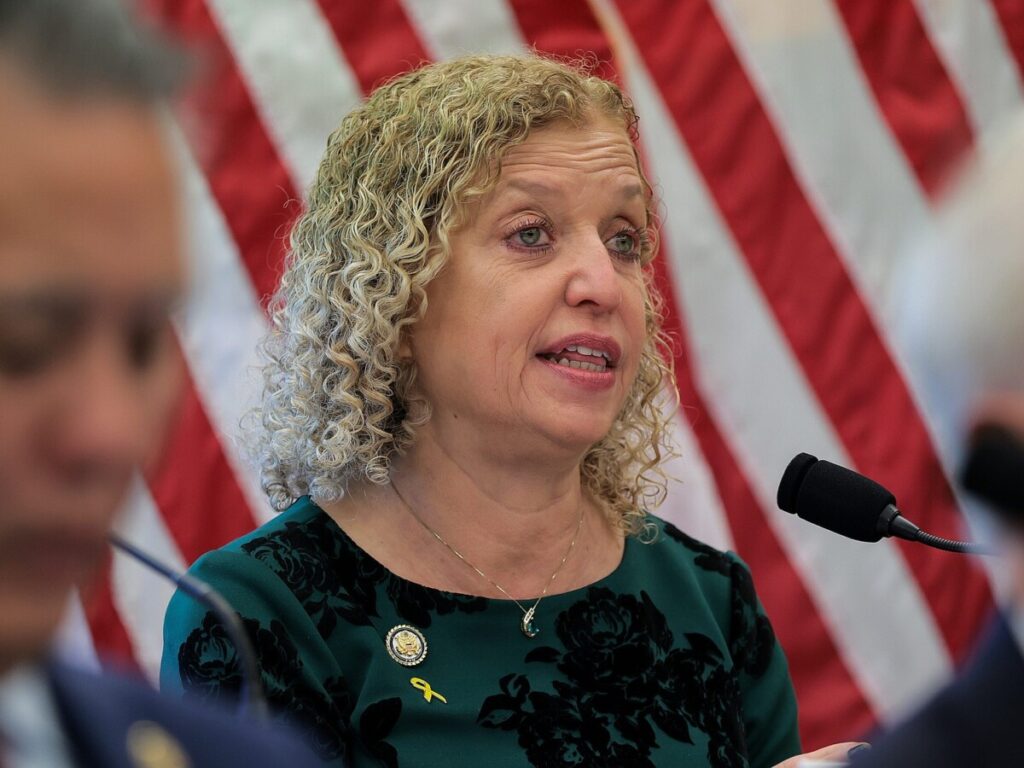
Rep. Debbie Wasserman Schultz says pressure to straighten her curly hair followed her throughout her career
Debbie Wasserman Schultz, the former chair of the Democratic National Committee, recently shared her journey of embracing her natural curly hair on the podcast “We Are Spiraling,” hosted by Priya Anand. Reflecting on her early political career, Wasserman Schultz recounted how she faced pressure from older women in politics to conform to traditional beauty standards by straightening her hair. Despite these pressures, she opted for a more manageable style rather than succumbing to the straight iron. However, this choice didn’t shield her from harsh criticism; in 2012, a Fox News host infamously dubbed her “Frizzilla,” and Adweek described her hair as “ramen noodle-like.” These experiences highlight a pervasive bias against women with curly hair in professional settings, as studies indicate that curly-haired women are often perceived as less professional compared to their straight-haired counterparts.
This bias is not just anecdotal; research underscores the discrimination faced by women with natural hairstyles, particularly among Black women. A 2021 study revealed that Black women sporting natural hairstyles are viewed as less competent and are less likely to be recommended for job interviews than those with straightened hair. The CROWN Act, passed in 2019, aims to combat race-based hair discrimination, yet many individuals with curly hair—regardless of race—still encounter prejudice in the workplace. Anand pointed out that this stigma leads many professionals to hide their curls, referencing former First Lady Michelle Obama’s admission that she straightened her hair to help the nation adjust to a Black family in the White House.
Wasserman Schultz’s personal narrative serves as a microcosm of a larger societal issue. She recalled a moment in the early 2000s when she allowed a hairdresser to straighten her hair, only to be met with astonished reactions from colleagues who suggested she should adopt that look permanently. This experience left her feeling undervalued, as she realized that her natural appearance was not only accepted but celebrated. Since then, she has fully embraced her curls, even inspiring young women at Jewish organizations who express gratitude for her representation. “I would never, ever, ever change my hair now,” Wasserman Schultz declared, emphasizing that while hair may seem trivial, it plays a significant role in self-identity and societal perception. As she continues to advocate for authenticity, her story resonates with many who face similar challenges, highlighting the ongoing need to challenge beauty standards in professional environments.
Debbie Wasserman Schultz is proud of her curly locks.
Kayla Bartkowski/Getty Images
As a young politician, Wasserman Schultz said she was urged to “do something” about her
curly hair
.
A Fox News host called her “Frizzilla” in 2012, while Adweek described her hair as ”
ramen noodle-like
.”
Studies show women with curly hair are often seen as less professional.
When Debbie Wasserman Schultz was in her mid-20s and preparing to run for the Florida State House, every older woman she sought advice from urged her to “do something” about her curly hair.
“They would say, you’re going to have to get a haircut and you’ve got to just have more manageable hair — a more professional look,” Wasserman Schultz, now 59, recalled during Monday’s episode of ”
We Are Spiraling
,” a new podcast about curly hair by former journalist Priya Anand, who has curly locks herself.
Although Wasserman Schultz decided to go with a new, more manageable hairstyle, the former chair of the Democratic National Committee said she refused to succumb to a straight iron. That sense of pride in her natural ringlets, however, did
lead to backlash. For example, in 2012, a Fox News host
called her “Frizzilla,”
while that same year, the publication Adweek described her hair as ”
ramen noodle-like
” and “usually out of control.”
Wasserman Schultz’s experience reflects a broader bias against women with hair like hers in professional settings, research shows.
A 2023 study
from Lindenwood University in Missouri found that straight-haired women were rated significantly higher than curly-haired women on job characteristics that are important to professional positions.
Black women are especially likely to face bias when they don’t straighten their hair.
A 2021 paper
from researchers at Duke University and Michigan State University concluded that Black women with natural hairstyles were perceived to be less professional, less competent, and less likely to be recommended for a job interview than Black women with straightened hairstyles and white women with either curly or straight hairstyles.
Lawmakers have sought to address the problem through legislation, such as the
2019 CROWN Act
, which bans race-based hair discrimination. But Anand said on her podcast that people with curly hair — regardless of their race or gender — continue to face prejudice. She said many curly-haired professionals go out of their way to hide their curls, pointing to how former first lady Michelle Obama
said in 2022 that she
straightened her hair so the US
could adjust to a Black family
in the White House.
“This idea comes up all the time, that curly hair is for some reason not professional,” Anand said.
During the interview, Wasserman Schultz
said that in the early 2000s, she let a hairdresser convince her to temporarily straighten her hair while she was serving in Congress. She said she quickly regretted the move.
“I went to the House floor because we had votes that day, and people went berserk,” she said. “They thought I looked completely different, but also they said, ‘Wow, you should wear your hair like that all the time. You look amazing.’ ”
The implication, Wasserman Schultz continued, was that they thought she didn’t look as attractive as when she wore her hair naturally. “It was kind of an insult. They didn’t realize it,” she said.
Making matters worse, Wasserman Schultz said that around this time, she was named to a list of the 50 most beautiful people in Congress by The Hill newspaper. It made her feel “cruddy,” she said, because it implied that she wouldn’t have been selected had she not straightened her locks.
Wasserman Schultz, who is Jewish, has since stuck with her curls and come to appreciate them even more. She said she has given talks at Jewish organizations such as Hillel and B’nai B’rith, and had girls in the audience pull her aside to thank her for wearing her hair curly in public.
“I would never, ever, ever change my hair now,” she said. “It’s not the most consequential issue, but how you look — and especially growing up and being teased about it — it certainly matters.”
Read the original article on
Business Insider


