White nationalism fuels tolerance for political violence nationwide
On June 15, 2025, Green Isle, Minnesota, became the focus of a law enforcement manhunt following the tragic assassination of state Representative Melissa Hortman and her husband, Mark. This incident is part of a troubling trend of escalating political violence in the United States, which has alarmed scholars, journalists, and politicians across the spectrum. The pattern of politically motivated violence has deep historical roots, echoing the violent upheavals seen in early 20th-century Europe, such as the rise of fascism in Italy and Germany, where political violence was used to suppress dissent and consolidate authoritarian power. Today, the U.S. is witnessing a resurgence of similar tensions, with a significant increase in threats against public officials—over 14,000 reported threats against members of Congress by the end of 2025, a staggering 1,400% increase since 2016.
The current wave of political violence diverges sharply from past instances, where radical groups often targeted property to make statements rather than aiming directly at individuals. For example, in the 1970s, groups like the Weather Underground conducted bombings as a form of anti-war protest, typically issuing warnings to minimize casualties. In stark contrast, today’s incidents are characterized by direct attacks on individuals, as seen in the 2017 shooting at a congressional baseball practice and the 2022 hammer attack on Nancy Pelosi’s husband. The assassination of Melissa Hortman underscores this shift, as authorities described it as politically motivated, reflecting a dangerous trend where political disagreements escalate to lethal violence.
Research indicates that white nationalism is a significant driver of this contemporary political violence. A study involving a national sample of 1,300 Americans revealed that support for political violence often correlates with white nationalist sentiments. Many respondents expressed that violent action could be justified if they perceived the government as infringing on their rights or engaging in unlawful violence against citizens. This growing sentiment poses a serious threat to U.S. democracy, as the normalization of violence against political adversaries fosters an environment where such actions are tolerated. With active white nationalist groups operating in nearly every state and a substantial portion of the population harboring these views, the implications for political stability are dire. Understanding and addressing the factors that contribute to this environment is crucial for preventing further escalation and protecting democratic values in the United States.
https://www.youtube.com/watch?v=30fEMfOEVWo
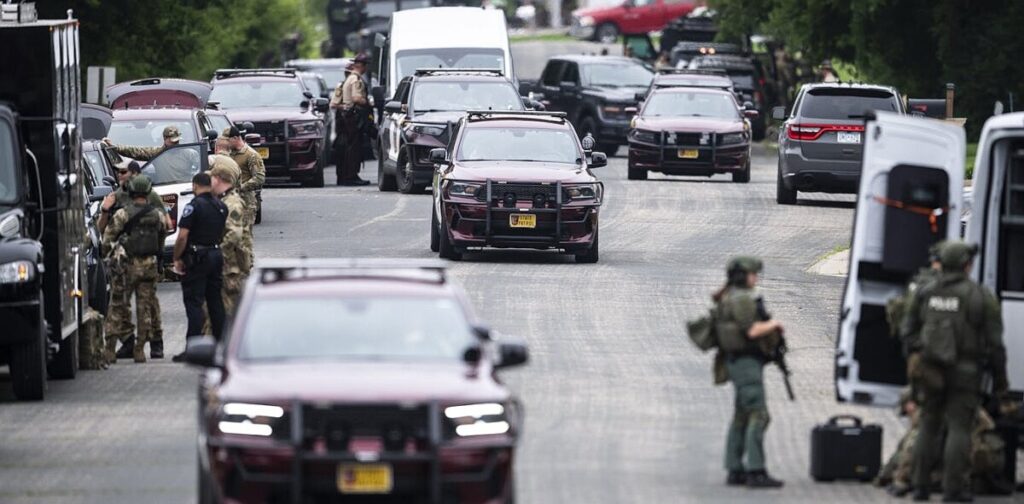
Law enforcement set up in Green Isle, Minn., on June 15, 2025, as they search for a suspect in the killing of state Rep. Melissa Hortman and her husband, Mark.
Stephen Maturen/Getty Images
Political violence among rival partisans has been a deadly and destabilizing force throughout history and across the globe. It has claimed countless lives, deepened social divisions and even led to the collapse of democratic systems.
In recent history, political violence and its deadly consequences were seen in
Italy after World War I
when thousands of fascist supporters marched on Rome, the capital, threatening to overthrow the government unless Benito Mussolini was appointed prime minister. That kind of violence and its effects were also seen in
1930s Germany
, where Adolf Hitler suppressed opposition and suspended civil liberties amid widespread unrest and factional violence.
Similar patterns occurred elsewhere in the decades that followed. Fascist movements used political violence and intimidation to seize or consolidate power, as seen in
Spain under Francisco Franco
, in
Portugal under António de Oliveira Salazar
and in
Romania under the Iron Guard
.
Today, many scholars, journalists, commentators and elected officials across the political spectrum have
voiced alarm
over escalating acts of violence in the United States, drawing parallels to Europe’s authoritarian past. Reports of
politically motivated violence are distressingly common
– ranging from mass shootings, car-ramming attacks and assaults at demonstrations to assassination attempts, kidnappings and threats targeting mayors, governors, political activists and members of Congress.
For example, threats of violence against members of Congress increased by more than 1,400%, from 902 in 2016 to an estimated 14,000 by the end of 2025,
according to U.S. Capitol Police reports
.
Political violence is certainly not new in American society, but current patterns differ in key ways. We found that, today, white nationalism is a key driver of support for political violence – a sign that white nationalism poses substantial danger to U.S. political stability.
In the 1970s, violence was political theater, aimed at drawing government and public attention to specific policies. Today, it’s personal and deadly, driven by a desire to annihilate.
Page 5 and envelope of a letter received by The Associated Press in Washington D.C., on March 2, 1971, signed by ‘Weather Underground,’ which claims responsibility for the March 1 bombing of the U.S. Capitol building.
AP Photo
Changing targets
In the 1970s
, radical left-wing groups often targeted government property to send political messages.
Attacks included the
anti–Vietnam War bombings carried out by the Weather Underground
, as well as actions by groups such as the
Symbionese Liberation Army
and
United Freedom Front
. They struck government and corporate targets to protest imperialism, racism and economic inequality. These attacks were generally intended as statements rather than mass-casualty events, with perpetrators often issuing warnings beforehand to
minimize harm
.
Today, however, much of the violence is aimed directly at individuals, often with the intent to harm or kill
political opponents
.
These include incidents such as the
2017 shooting
targeting Republican lawmakers at a congressional baseball practice, the
2022 hammer attack
on Democratic House Speaker Nancy Pelosi’s husband, Paul Pelosi, and
the 2025 killing of Democrat Melissa Hortman, the former speaker of the Minnesota House
, and her husband in what authorities described as a politically motivated assassination.
This resurgence of political violence has prompted intense academic and journalistic scrutiny. Numerous public opinion surveys have sought to gauge Americans’ approval of, or concern about, using violence against the government or political adversaries.
Initial estimates
suggested nearly 1 in 4 Americans support political violence. But later
studies identified flaws
in the questions used to measure support for violence. Simply asking about violence in general or the use of force leaves too much room for interpretation.
Using more sophisticated questioning techniques results in
lower estimates
of public support for political violence.
Understanding what drives individuals to endorse political violence is essential for developing effective strategies to prevent it. As public opinion researchers who have studied
Americans’ attitudes
toward ideological extremism, political polarization and counterterrorism policy, we sought to advance our understanding of the factors underlying public support for political violence in the United States.
We aimed to do this in two ways: by using more specific questioning techniques and by identifying the factors associated with increased support for violence.
Who justifies political violence?
Our study focused specifically on
white nationalism
– a
growing movement
in the U.S. – as a driver of support for violence.
We asked
a national sample of 1,300 Americans
how justified or unjustified it would be “to take violent action against the U.S. government” in response to a range of government actions. This approach captures both approval of the use of violence and its political motivation.
We included nonpartisan government actions such as “the government violated or took away citizens’ rights and freedoms” and “the government violated the U.S. Constitution” along with hypothetical actions reflecting right or left-wing political causes. For example, a right-wing action would be to ban all abortions while a left-wing action would be to legalize all abortions.
Analyses revealed substantial support for violence against the government in response to the nonpartisan government actions. Half of the respondents indicated that violence would be justified if the government violated citizens’ rights, and 55% supported the use of violence as a response if the U.S. government committed unlawful violence against citizens. Nearly 40% said that violence would be justified if the government censored the news.
When we examined the factors behind these attitudes, a belief in white nationalism stood out above all others. But what, precisely, is white nationalism? It is more than simply identifying as white. Indeed, white nationalism is a sentiment found among some
nonwhite Americans
as well.
White nationalists are concerned about the increasing diversity of the American population and want to ensure that white citizens maintain a predominant influence in the country. To them, white citizens’ social, cultural and political values are superior to those of nonwhite citizens and immigrants. The perceived need to protect and propagate these values serves as a call to action.
This ideology has motivated several recent acts of
mass violence
, from synagogue shootings to racially targeted attacks.
Our data revealed that a belief in white nationalism predicted support for political violence as well. In response to both nonpartisan government actions and those that would benefit left-wing causes, the stronger a person’s white nationalist sentiment, the more strongly that individual believed that violence would be justified.
Out of all the variables in our statistical models, including political views and demographic characteristics, white nationalism was the strongest predictor of support for violence in these circumstances.
It did not, however, significantly influence support for violence when the government actions would benefit right-wing causes.
Growing threat to US democracy
Most people who voice support for political violence will never commit violent acts
themselves
.
Yet such attitudes foster an atmosphere of tolerance, signaling that violence is acceptable and
enabling its continuation
. Our analyses show that
these supportive attitudes are prevalent among white nationalists.
Active white nationalist groups
operate in all but two U.S. states, Alaska and Vermont. Decentralized groups, such as
Active Clubs
, where white nationalists train and network, are also on the rise.
Many more individuals
hold white nationalist sentiments
without belonging to organized groups. Indeed, in our national sample, one quarter of respondents agreed with the statement “although people won’t admit it, White Americans and their culture are what made America great in the first place.”
The fact that white nationalism is gaining prominence in the U.S., combined with the association between holding white nationalist views and supporting political violence found in our study, indicates that white nationalism poses a serious threat to U.S. political stability.
The authors do not work for, consult, own shares in or receive funding from any company or organization that would benefit from this article, and have disclosed no relevant affiliations beyond their academic appointment.


