Florida residents’ anxiety is linked to social media use and varies with age, new study shows
A recent survey conducted in Florida reveals a concerning trend: younger adults, particularly those in Generation Z, are experiencing heightened levels of anxiety correlated with their social media usage. The survey, which involved 500 participants representing Florida’s demographic diversity, utilized the Generalized Anxiety Disorder 7-item (GAD-7) scale to assess anxiety symptoms. Results indicated that nearly 1 in 5 Floridians suffer from moderate to severe anxiety, with Generation Z participants (ages 18-27) reporting the highest average GAD-7 score of 8.17, just below the threshold for moderate anxiety. This finding aligns with national statistics showing that anxiety disorders are increasingly prevalent among younger populations, highlighting a pressing public health concern.
The study further explored the relationship between social media use and anxiety, revealing that those who spend more time online tend to report higher anxiety levels. For instance, individuals who do not engage with social media exhibit significantly lower average GAD-7 scores compared to those who spend upwards of 10 hours per week on these platforms. Notably, respondents who use social media primarily to connect with friends and family reported lower anxiety levels than those who engage to keep up with trends or who experience feelings of missing out (FOMO) from others’ posts. This correlation suggests that the nature of social media engagement may play a crucial role in determining its impact on mental health.
To mitigate anxiety associated with social media, researchers recommend moderating usage—potentially limiting time online to 30 minutes a day or taking extended breaks from social media platforms. While the study does not definitively establish social media as the sole cause of increased anxiety, it underscores the potential link between excessive online presence and mental health challenges among young Floridians. As awareness grows about the mental health implications of our digital lives, it becomes increasingly important for individuals, especially younger adults, to evaluate their social media habits and consider strategies for healthier engagement.
https://www.youtube.com/watch?v=3GChQ92tBqA
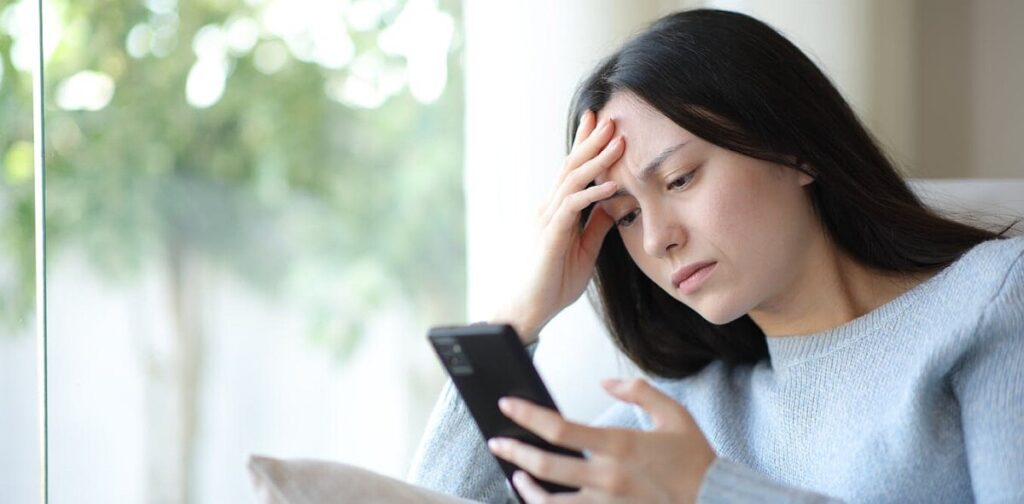
Younger Floridians who spend a lot of time on social media tend to be more anxious on average than other adults in the Sunshine State.
Pheelings Media/iStock via Getty Images Plus
Over 40 million American adults
– approximately 19% – live with an
anxiety disorder
, according to the National Institutes of Health.
Studies show this anxiety is
most prevalent in young people
. In recent years, social psychologists such as
Jonathan Haidt
have started to draw connections between tech use and anxiety. They argue that the ubiquity of smartphones and social media may affect not only the habits and emotions of young people but also key aspects of their brain development during adolescence.
Maintaining a constant online presence can result in
excessive social comparison
,
disrupted sleep
,
fragmented attention
and
increased exposure to cyberbullying
– all of which can increase the prevalence of anxiety.
We’re
public health and policy researchers
with an
interest in mental health
. We understand that this problem goes well beyond youthful angst. Evidence increasingly links this type of prolonged anxiety to a number of detrimental health issues, including
weakened immune function
,
increased cardiovascular risk
and
impaired cognitive performance
. Over time, these effects can
increase the risk of chronic illness and other negative health outcomes
.
So, in May 2025 we
conducted our own survey
to measure the prevalence of anxiety in the state where we live, Florida, and explore whether it is, in fact, related to age and social media use.
What our survey asked
We surveyed 500 adults, and we designed our research to ensure that our survey group matched the state’s population in terms of age, race, gender, political affiliation and geographic distribution.
We used
a questionnaire called the GAD-7
, which was developed by mental health professionals to assess symptoms of generalized anxiety disorder. The GAD-7 asks participants to identify how bothered they were about seven items during the past two weeks. They answered on a four-point scale, from “not at all” to “nearly everyday.” These seven items included questions on worrying, irritability, restlessness and feeling afraid or on edge.
A score under 10 indicates minimal (0-4) or mild (5-9) anxiety. Those who score between 10 and 14 exhibit moderate anxiety, while a score of 15 or higher is indicative of a severe anxiety disorder.
The difference between moderate and severe generalized anxiety corresponds to how often the participant experiences any of the seven items. For example, someone with severe generalized anxiety might experience all seven items nearly every day, while someone with moderate generalized anxiety might have experienced some of the items several days in the past two weeks.
We also asked participants about how much time they spend on social media platforms, such as Facebook, Instagram and TikTok, and how they feel while using these platforms.
What we found
Our survey found that roughly 1 in 5 Floridians are struggling with moderate to severe anxiety, which is consistent with
national statistics
.
While the average GAD-7 score was 4.74 – this would indicate that the “average” Floridian doesn’t have an anxiety disorder – 18.6% of participants reported symptoms of at least moderate anxiety, with nearly half of them rising to the level of severe.
This result tells us that nearly 3.5 million Floridians may suffer from clinically significant anxiety.
Members of
Generation Z
, ages 18 to 27 in our sample, reported the highest rates of anxiety by a significant margin. In fact, the average GAD-7 score for this group was 8.17 – just below the threshold for moderate anxiety – compared with an average of 6.50 for millennials, 5.32 for Gen Xers and 3.04 for baby boomers.
These averages track with previous nationwide studies, which have found that the portion of the U.S. adult population that suffers the most anxiety are members of Gen Z. According to a study conducted in 2020, 30.9% of adults ages 18 to 23
reported generalized anxiety disorder symptoms
, compared to only 27.9% of millennials, 17.2% of Gen Xers and 8.1% of baby boomers.
Social media and anxiety in Gen Z
In order to understand whether social media use might help explain the higher rates of anxiety we observed among younger Floridians, we examined the relationship between time spent on social media and anxiety.
In general, those who didn’t use social media at all reported lower levels of anxiety, with an average GAD-7 score of 3.56. In comparison, the average GAD-7 score for those who use social media less than one hour per week was 3.74, and it rose consistently as social media use increased, climbing to an average of 6.10 among those who spent seven to nine hours a week on social media, and 7.08 for those who were logged on for 10 hours or more.
While time spent was important, the reasons why Floridians use social media also made a big difference in whether they experienced anxiety. Anxiety was lowest among those who use social media primarily to stay connected with family and friends. But it rose significantly among those who use social media to stay up to date with current trends and pop culture or to learn about health, fitness and beauty trends.
We also asked respondents whether they “sometimes feel like they’re missing out when they see what others post on social media.” Among those who agreed that they sometimes get social media
FOMO
, average anxiety scores ranged between 7.26 and 9.00. But among those who disagreed, average scores were significantly lower – 4.16 or less.
Time spent on social media matters for young people
In this data, we see a clear correlation between social media use and heightened anxiety, and we also see a greater tendency for Gen Zers and millennials to report higher levels of anxiety. This makes sense, given that younger people generally spend more time on social media.
But one important question remained to be answered: Can reducing social media use lead to lower rates of anxiety for the youngest adults?
In order to answer this question, we reexamined the relationship between average weekly social media use and anxiety. But this time, we restricted the analysis to only those respondents who were members of the Gen Z and millennial groups.
Even when the study was restricted to just these two groups, we found a clear and decisive link between social media use and anxiety. Those who reported spending less than one hour on social media each week had average GAD-7 scores of 2.89. Those scores rose consistently as time on social media increased, reaching a high of 8.73 among those who use social media 10 hours or more per week.
Moderating intake to bring down anxiety
The results of our survey appear to confirm the suspicions of social psychologists and techno-critics – namely, that the high rates of anxiety observed among younger Americans appear to be connected to their time online. This is particularly true for those spending time in digital spaces that facilitate social comparison and information overload.
We cannot be sure from just this survey that social media alone is to blame for increased generalized anxiety. Other factors may be involved, such as digital information overload and a decline in person-to-person contact. But the amount of time spent on social media does appear to be affecting the mental health of young people in Florida.
One potential solution may be to moderate intake. Some emerging research has suggested
setting up automated daily reminders
to limit social media use to 30 minutes a day. Another suggestion includes occasionally
taking a monthlong break from social media
.
Those who feel they need more support taking time off social media may benefit from seeking professional help, such as talking with a licensed therapist.
Read more stories from The Conversation about
Florida
.
Stephen Neely receives funding from the Florida Center for Cybersecurity for this study
Kaila Witkowski receives funding from the Florida Center for Cybersecurity for this study.


