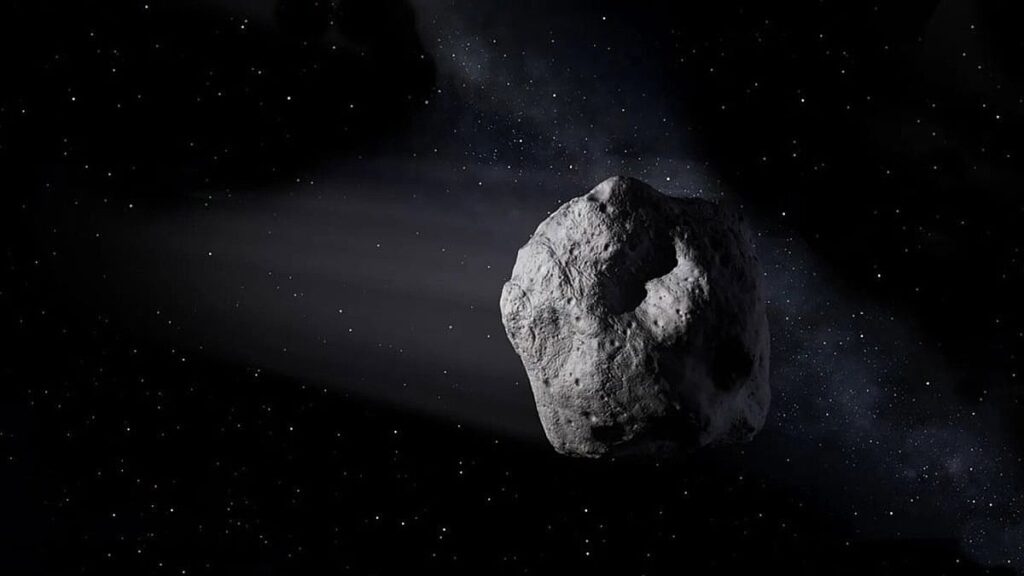
An asteroid near Earth could become a temporary moon, then a crash risk
In an intriguing development for astronomers and space enthusiasts alike, scientists have identified a small asteroid, designated 2022 RD2, that may temporarily orbit Earth as a “mini moon.” This asteroid belongs to a rare group known as Arjunas, characterized by their unique orbits that closely follow Earth’s path around the sun. These celestial bodies can drift near our planet at low velocities, making them susceptible to being captured by Earth’s gravitational pull for brief periods. NASA has placed 2022 RD2 on its risk list due to its potential for future impacts, with predictions suggesting that it could transition from a near-Earth object to a temporary moon and then potentially become a collision risk—all within a single human lifetime.
Recent research conducted by astronomers Carlos and Raúl de la Fuente Marcos from the Universidad Complutense de Madrid indicates that 2022 RD2 follows an especially unstable trajectory, with a Lyapunov time of less than 20 years. This means that small gravitational forces can significantly alter its orbit in a relatively short time frame. Their findings, published in the *Research Notes of the American Astronomical Society*, detail that 2022 RD2 could become a temporary mini moon between 2043 and 2044, orbiting Earth for several months. This phenomenon is significant, as it represents a rare opportunity to study an asteroid closely associated with our planet. While NASA’s models suggest a less than 0.1% chance of impact in the future, the asteroid’s relatively small size—comparable to a three-story building—means that even in the unlikely event of a collision, it would likely cause minimal damage.
The Arjuna asteroids, including 2022 RD2, are of particular interest to scientists for both their accessibility and potential for resource exploitation, such as mining. Given their proximity to Earth, they could serve as platforms for testing new space technologies. Additionally, some Arjunas may be remnants of lunar debris from recent impacts on the moon. Despite the excitement surrounding these discoveries, researchers acknowledge that studying these mini moons presents challenges due to their short visibility windows and the need for more data to understand their origins and composition. As the study of this population of near-Earth objects progresses, scientists hope to unravel the mysteries surrounding their formation and potential risks they may pose to our planet.
https://www.youtube.com/watch?v=pecVKZCdwpA
Scientists have spotted a small asteroid that may circle Earth as a
mini moon
before shifting onto a path that could make it a hazard later in the century.
The
asteroid
, known as 2022 RD2, belongs to a rare class of
space
rocks called Arjunas. These objects travel around the
sun
on orbits that closely match Earth’s and sometimes drift near the planet at unusually low speeds. That sluggish pace can allow Earth’s gravity to trap them for a short time, creating what researchers call mini moons.
NASA
has calculated the asteroid’s orbit and placed it on its
risk list
for potential impacts, though the agency’s Center for Near-Earth Object Studies has reached somewhat different conclusions about the asteroid’s future trajectory.
If these predictions hold, 2022 RD2 could become one of the few known asteroids to shift from near-Earth object to temporary moon and later to a potential crash risk — all within a single lifetime.
SEE ALSO:
NASA has a broken giant antenna that could upend its 2026 plans
A team of astronomers in Madrid says 2022 RD2 follows an especially unstable path. It has a Lyapunov time — a measure of how quickly an orbit becomes unpredictable — of less than 20 years, much shorter than that of most near-Earth asteroids. That rapid change means small gravitational nudges can push the rock onto dramatically different routes over just a few decades.
Their
findings
appeared this week in
Research Notes of the American Astronomical Society
. The paper’s authors, brothers Carlos and Raúl de la Fuente Marcos of the Universidad Complutense de Madrid, have previously reported on the “quasi-moon”
2025 PN7
and the mini-moon
2024 PT5
, which briefly orbited Earth last year.
An image of the asteroid 2024 PT5, which became a temporary mini moon last year.
Credit: Two-Meter Twin Telescope / Light Bridges / Instituto de Astrofísica de Canarias
A key distinction, they note, is that mini moons get briefly captured by Earth’s gravity. But 2025 PN7 is more of a stalker, merely following Earth on its travels around the sun without becoming a true satellite.
The
Arjunas
interest researchers because of their scientific and practical potential, Carlos told Mashable.
“On the one hand, they are easier to access than other asteroids, so they can be used to test space technology or even to attempt commercial ventures on them such as mining,” he said. “On the other hand, some of them are suspected lunar debris resulting from present-day impacts on the moon.”
Simulations suggest 2022 RD2 could slip into a temporary orbit around Earth between 2043 and 2044, becoming a mini moon for several months. The team applied standard criteria for temporary captures: a close approach, a reduction in relative speed, and a period during which Earth’s gravity exerts enough control to form a true orbit.
After 2022 RD2 leaves Earth’s neighborhood, its path appears to grow more erratic. Some possible trajectories include collision paths beginning around 2080, according to the paper.
But NASA’s models put
potential impact
dates even later and estimate the odds at less than 0.1 percent, said Davide Farnocchia, a navigation engineer with the center. The asteroid is also relatively small, perhaps the size of a three-story building.
“So it wouldn’t cause any significant damage even in the unlikely case it were on an impact trajectory,” Farnocchia told Mashable.
Many recent mini moons and quasi-moons appear to belong to the Arjuna population — a loose cluster of Earth-like objects that trail our planet along its path around the sun. Their origins and composition remain largely unknown because only a few have been studied in detail. Some show similarities to the
actual moon
, Carlos said, but scientists need more data.
Although some small objects near Earth turn out to be old spacecraft or rocket boosters, the researchers say 2022 RD2 is almost certainly natural. And while their projections don’t confirm a future collision, they can’t yet rule it out.
“The study of this population is just beginning,” Carlos said. “Paradoxically, being so close to us, they are comparatively difficult to study, as many of them have short visibility windows and far between.”