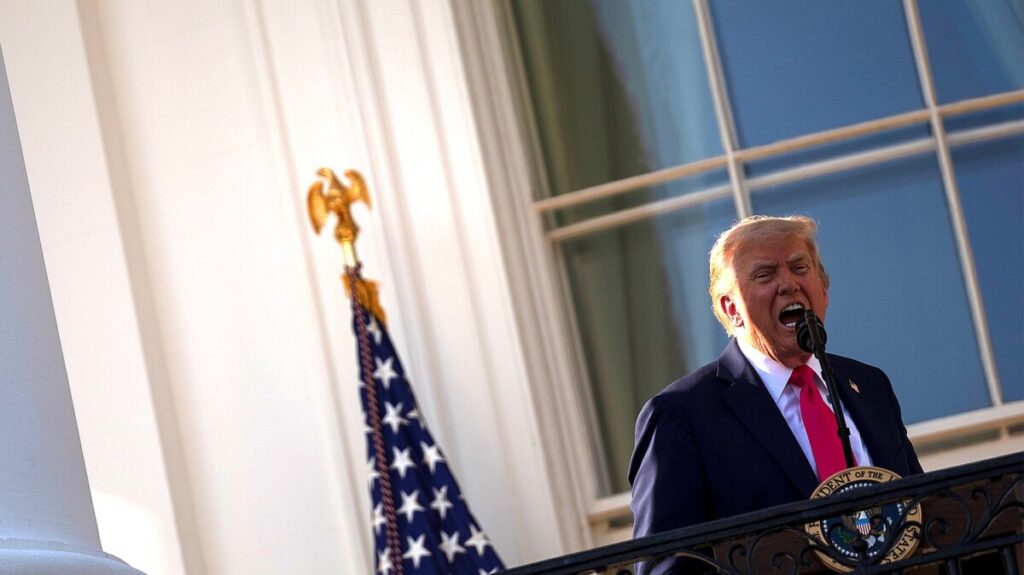
The President Is Losing Control of Himself
In a troubling escalation of rhetoric, former President Donald Trump has publicly called for the arrest and execution of elected officials who he accuses of being “traitors” to the Constitution. This alarming demand follows a series of emotional outbursts that appear to be linked to his distress over the release of documents related to his former associate, Jeffrey Epstein. Trump’s comments came after a group of Democratic legislators, all with military backgrounds, reminded the armed forces of their constitutional oath to refuse illegal orders, a statement that seems to have provoked his ire. The urgency of their message reflects a growing concern over Trump’s use of military power, including the deployment of troops to U.S. cities and issuing potentially unlawful commands.
Trump’s recent behavior has raised significant alarms about his mental state and the implications of his words. In a series of posts on Truth Social, he referred to the lawmakers as “traitors” and suggested that their actions warranted severe punishment, including death. This rhetoric not only threatens the safety of those lawmakers but also signals a dangerous precedent for political discourse in the United States. The response from his administration, particularly Press Secretary Karoline Leavitt, attempted to downplay the seriousness of Trump’s comments while framing the legislators’ adherence to the Constitution as a potential incitement to chaos within the military. This narrative reflects a profound misunderstanding of the military’s allegiance to the Constitution over any individual leader.
The situation demands vigilance from all sectors of American society, including voters, Congress, and the military. As Trump continues to incite his base with calls for violence against political opponents, the risk of real-world consequences grows. The historical parallels to Richard Nixon’s erratic behavior during Watergate are striking, as both leaders displayed signs of paranoia and instability when faced with political threats. However, unlike Nixon’s era, the current political climate is amplified by social media and a deeply divided electorate, creating a volatile environment that could lead to dangerous outcomes. As the nation grapples with these developments, it is imperative that all citizens remain aware of the threats to democratic norms and actively engage in safeguarding the principles of the Constitution.
https://www.youtube.com/watch?v=A36Y5-8v-Vw
Presidents often lose control
over their agenda, or the policy process, or pieces of legislation. Sometimes, they even lose control of their party. But Donald Trump seems to have lost control over the one thing every person, and especially those with immense power, should always maintain control over: himself. Yesterday the president called for the arrest and execution of elected American officials for the crime—as he sees it—of fidelity to the Constitution.
It would be easy merely to note, yet again, that the president is a depraved man and a menace to the American system of government. As remarkable as it is to say it, however, the outbursts of this past week are different, and were likely triggered by Trump’s panic over the release of files about his former friend, the dead sex offender Jeffery Epstein. No one should treat this new phase in the president’s aggression against democracy as just another episode in the Trump reality show.
A group of Democratic legislators—all of them either military veterans or former national-security officials—may have helped to push the president over the edge. On Tuesday, they issued a
video
reminding members of the U.S. Armed Forces that their oath of service requires them to refuse illegal orders, and that their loyalty is owed not to any one president, but to the Constitution itself. Normally, legislators don’t feel the need to make such an obvious declaration, but the president is using the military—including
deploying troops
to U.S. cities and ordering the
killing
of people on the high seas—in ways that almost certainly involve illegal orders. Members of Congress have a right, even an obligation, to speak up.
[
Read: What we lose by distorting the mission of the National Guard
]
The president was already showing strain before his attack on the legislators. Last Friday, he lashed out at a female journalist who asked about the Epstein files, calling her “
piggy
.” (Trump seems to revel in getting away with
speaking to women
as president in ways that would land him on the sidewalk back in Queens.) On Tuesday, as he sat next to the Saudi crown prince, a man credibly accused by U.S. intelligence of murdering an American journalist, he lashed out at yet another female reporter: He called Mary Bruce of ABC “insubordinate”—a rather telling choice of words—and threatened to use the FCC to attack her network. Tuesday, of course, was the day the
Epstein Files Transparency Act
passed the House by a vote of 427–1. The next day, it passed the Senate by unanimous consent, and a humiliated Trump signed the bill into law.
Yesterday, Trump seemed to lose the last bit of his grip on his emotions as he fired off a fusillade of Truth Social
posts
. (“Trump must not have slept well Wednesday night,” Bill Kristol and Andrew Egger of
The Bulwark
observed
today.) “This is really bad,” the president wrote, “and Dangerous to our Country. Their words cannot be allowed to stand. SEDITIOUS BEHAVIOR FROM TRAITORS!!! LOCK THEM UP???”
“Lock them up” is a favorite Trump chant, but he did not end with this classic demand. He went on: “Each one of these traitors to our Country should be ARRESTED AND PUT ON TRIAL. Their words cannot be allowed to stand – We won’t have a Country anymore!!! An example MUST BE SET.” The charge, according to the chief executive? “SEDITIOUS BEHAVIOR, punishable by DEATH!” He also reposted a comment that said: “HANG THEM GEORGE WASHINGTON WOULD !!”
Trump’s posts risk putting the lives of American lawmakers in danger, and he almost certainly knows it. Many people who have publicly criticized the president have found themselves getting death threats from his most fervid followers. (Like many Trump-critical writers, I started getting them years ago.) As Representative
Marjorie Taylor Greene
, a former MAGA doyenne from Georgia whom Trump has now marked as a heretic, wrote on X last week, “A hot bed of threats against me are being fueled and egged on by the most powerful man in the world.” Senator
Elissa Slotkin
revealed that she is now traveling with a security detail because of what she called “a huge spike” in threats that came to her office after Trump’s eruption yesterday.
In what must be a first for any White House official, Press Secretary Karoline Leavitt had to step forward and
answer
whether the president of the United States wants to kill members of Congress. In a ringing defense of American values and constitutional order, she responded to the question by saying:
“No.”
Leavitt then tried to turn the entire ghastly business on its head. “Many in this room want to talk about the president’s response, but not what brought the president to responding in this way,” she said—as though members of Congress publicly speaking their minds somehow justified the death threats. She went on: “The sanctity of our military rests on the chain of command, and if that chain of command is broken, it can lead to people getting killed. It can lead to chaos, and that’s what these members of Congress who swore an oath to abide by the Constitution are essentially encouraging.”
This is now the position of the Trump administration: Members of the Article I branch of government who insist that the armed forces must be faithful to the law are inducing potentially fatal disorder among the troops. Not only is Leavitt wrong—the “sanctity” of the military rests on the Constitution, not the chain of command—but she is showing a remarkable lack of faith in the officers and enlisted personnel of the United States military, implying that they will become a violent rabble if they refuse illegal orders.
Trump’s reaction to the statement by these members of Congress shows why such statements are now necessary in the first place. He is acting like a man who is cornered, terrified, and irrational. In 1974, Secretary of Defense
James Schlesinger
was worried about the mental state of Richard Nixon, who was facing impeachment and almost certain conviction. Nixon was becoming erratic and drinking too much, so Schlesinger told the chairman of the Joint Chiefs of Staff that any “unusual” orders from Nixon should be routed over to him. (Talk about disrupting the chain of command.) Trump is famously a teetotaler, but he has publicly surpassed Nixon’s anguish and paranoia.
And Secretary of Defense Pete Hegseth is no Jim Schlesinger.
Americans, and especially their elected representatives, must pay attention to Trump now in a way that many of them have never thought to do before. The president of the United States is publicly howling for the arrest and execution of members of Congress, knowing that he commands a base that will take him seriously and has people in it that might act on his demands. (And no, Leavitt’s curt denials are not a reassurance.) Despite Nixon’s famous
1977 assertion
, things do not become legal just because the president wants to do them. This is a new and dire development in the ongoing American constitutional crisis. The voters, Congress, and, yes, the U.S. military must all now be more vigilant than at any time in our modern history.


