Hubble Captures Puzzling Galaxy
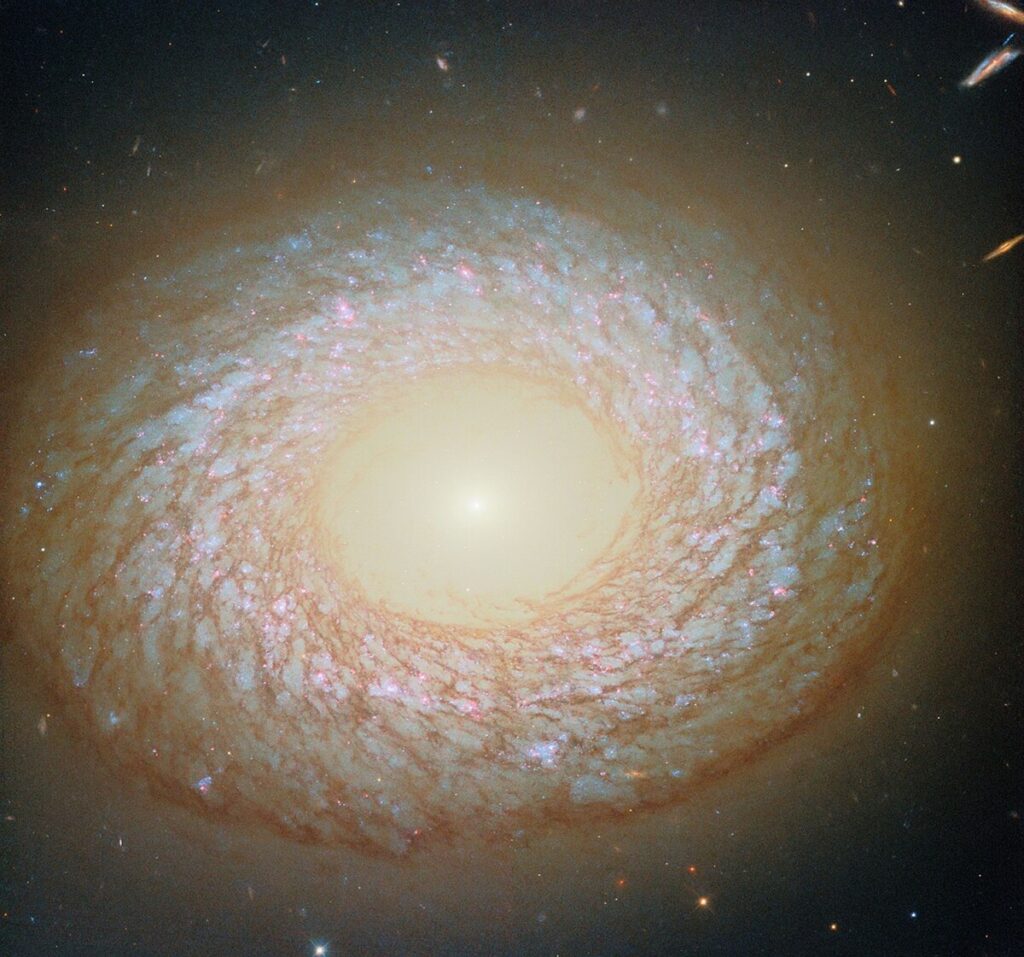
NASA and ESA’s Hubble Space Telescope has recently captured a striking image of the enigmatic galaxy NGC 2775, located 67 million light-years away in the constellation Cancer. This galaxy presents a unique challenge for astronomers attempting to classify it, as it exhibits characteristics of both spiral and elliptical galaxies. The central region of NGC 2775 is smooth and featureless, resembling an elliptical galaxy, while its outer structure boasts a dusty ring dotted with star clusters, akin to a spiral galaxy. This duality raises intriguing questions about its true nature: is it a spiral, an elliptical, or perhaps a new category altogether?
The classification of NGC 2775 is further complicated by the fact that we observe it from a single angle, making it difficult to ascertain its true form. Some astronomers lean towards categorizing it as a spiral galaxy due to its feathery ring of stars and dust, while others suggest it may be a lenticular galaxy—a type that showcases traits of both spirals and ellipticals. The origins of lenticular galaxies remain somewhat of a mystery, with theories suggesting they could either be spirals that have merged with others or have exhausted their star-forming gas, leading to the loss of their prominent spiral arms. Additionally, NGC 2775 shows signs of past mergers, evidenced by a tail of hydrogen gas stretching nearly 100,000 light-years around the galaxy, indicating that it may have absorbed smaller galaxies in its vicinity.
Most astronomers currently classify NGC 2775 as a flocculent spiral galaxy, characterized by its poorly defined, discontinuous arms that resemble feathery tufts of stars. This classification is supported by Hubble’s latest observations, which reveal bright pinkish clumps in the image. These clumps represent clouds of hydrogen gas surrounding massive young stars, providing crucial insights into the ongoing star formation within the galaxy. This new data enhances our understanding of NGC 2775 and highlights the importance of continued observation and research in unraveling the complexities of such unique celestial bodies. Hubble had previously captured an image of NGC 2775 in 2020, but this latest version offers a more detailed view, showcasing the dynamic nature of star formation and the intricate processes that shape galaxies across the universe.
This NASA/ESA Hubble Space Telescope image features a galaxy, NGC 2775, that’s hard to categorize.
ESA/Hubble & NASA, F. Belfiore, J. Lee and the PHANGS-HST Team
This NASA/ESA
Hubble Space Telescope
image features a galaxy that’s hard to categorize. The galaxy in question is NGC 2775, which lies 67 million light-years away in the constellation Cancer (the Crab). NGC 2775 sports a smooth, featureless center that is devoid of gas, resembling an elliptical galaxy. It also has a dusty ring with patchy star clusters, like a spiral galaxy. Which is it: spiral or elliptical — or neither?
Because we can only view NGC 2775 from one angle, it’s difficult to say for sure. Some researchers classify NGC 2775 as a spiral galaxy because of its feathery ring of stars and dust, while others classify it as a lenticular galaxy. Lenticular galaxies have features common to both spiral and elliptical galaxies.
Astronomers aren’t certain of exactly how lenticular galaxies come to be, and they might form in a variety of ways. Lenticular galaxies might be spiral galaxies that merged with other galaxies, or that have mostly run out of star-forming gas and lost their prominent spiral arms. They also might have started out more like elliptical galaxies, then collected gas into a disk around them.
Some evidence suggests that NGC 2775 merged with other galaxies in the past. Invisible in this Hubble image, NGC 2775 has a tail of hydrogen gas that stretches almost 100,000 light-years around the galaxy. This faint tail could be the remnant of one or more galaxies that wandered too close to NGC 2775 before being stretched apart and absorbed. If NGC 2775 merged with other galaxies in the past, it could explain the galaxy’s strange appearance today.
Most astronomers classify NGC 2775 as a flocculent spiral galaxy. Flocculent spirals have poorly defined, discontinuous arms that are often described as “feathery” or as “tufts” of stars that loosely form spiral arms.
Hubble previously released an image of NGC 2775 in
2020
. This new version adds observations of a specific wavelength of red light emitted by clouds of hydrogen gas surrounding massive young stars, visible as bright, pinkish clumps in the image. This additional wavelength of light helps astronomers better define where new stars are forming in the galaxy.


