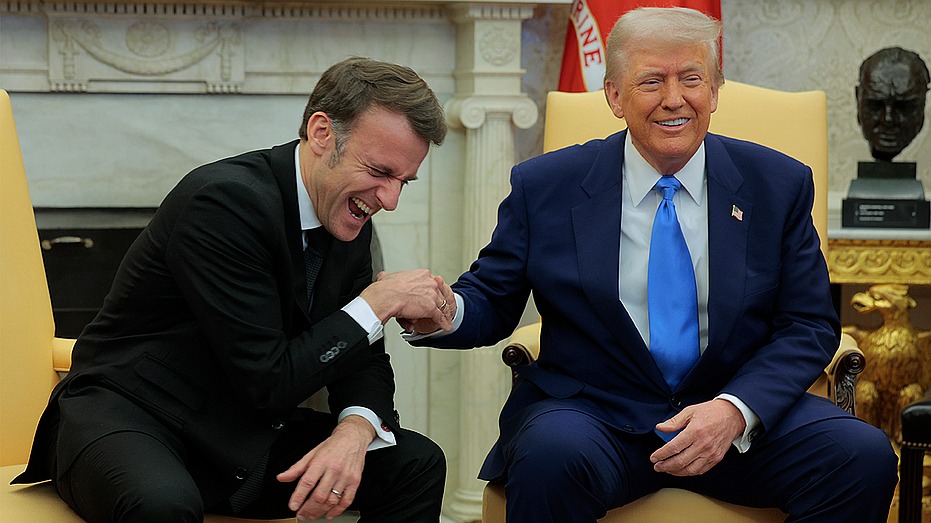
Trump’s ‘America First’ collides with Macron’s ‘Europe First’ in face-off over Western dominance
The relationship between French President Emmanuel Macron and former U.S. President Donald Trump has been a complex interplay of cooperation and rivalry, marked by a series of strategic maneuvers that reflect shifting global dynamics. From the onset of Trump’s presidency, Macron believed he could manage the unpredictable leader, claiming he could “handle” Trump through flattery and reason. This approach initially bore fruit, as evidenced by the lavish Bastille Day celebrations in Paris, where Trump was hailed as a “great friend.” However, as Trump’s “America First” policy took center stage, the rapport between the two leaders shifted, highlighting Macron’s ambition to redefine European autonomy on the global stage.
Macron’s efforts to assert European power have included significant diplomatic gestures, such as his recent trip to South Africa amidst a U.S. boycott of the 2025 G-20 summit, signaling Europe’s readiness to engage where the U.S. refrains. Additionally, Macron’s decision to facilitate a deal for Ukraine to purchase 100 French Rafale jets instead of American fighters underscores a strategic pivot towards European defense autonomy, stirring discontent among American officials who view it as a betrayal given the extensive U.S. support for Ukraine. These actions, along with Macron’s recognition of a Palestinian state at the U.N. against U.S. objections, illustrate his intent to position France—and by extension, Europe—as an independent power capable of navigating global challenges without being tethered to U.S. policy.
Despite the tensions, both leaders share a consensus on the necessity for Europe to bolster its defense capabilities. Macron has long advocated for European independence from U.S. military reliance, a notion that has gained traction among European nations, particularly in light of Trump’s unpredictable foreign policy. However, Macron’s ambitions are tempered by the realities of European politics, including Germany’s rising defense budget and his own domestic challenges, which hinder his ability to lead decisively. In this evolving landscape, Macron’s unique position allows him to engage with Trump in a manner that is both confrontational and congenial, embodying the delicate balance European leaders must strike as they navigate their relationship with the U.S. and assert their own geopolitical interests.
https://www.youtube.com/watch?v=ogC5wEyH2eA
From the start,
Emmanuel Macron
believed he could manage Donald Trump.
In private conversations with European counterparts early in Trump’s first term, Macron reportedly boasted that he could “handle” the American president — flatter him, reason with him and keep him inside the Western fold.
For a time, it worked: Trump was treated to a red-carpet Bastille Day parade in Paris and called the young French leader a “great friend.”
But the relationship soon turned into a running spectacle. The two leaders’ chemistry has always mixed cooperation with rivalry.
TRUMP’S SWIPE AT ‘WEAK’ LEADERS HIGHLIGHTS THE SHIFTING GLOBAL INFLUENCE OF WESTERN NATIONS
Macron’s sparring with Trump is more than personality — it’s projection. Each clash, phone call or quip feeds a larger mission: to show that Europe can act like a power again.
As Trump reasserts “America First,” Macron is trying to define what “Europe First” might look like — an alliance that can stand up to Washington, Moscow or Beijing without flinching.
While the U.S. plans to boycott the 2025 G-20 leaders’ summit because
South Africa
is hosting, Macron is visiting Johannesburg — a sign of his willingness to go where Washington won’t.
Earlier in the week, Ukrainian President Volodymyr Zelenskyy and Macron signed a deal for Kyiv to buy 100 French Rafale jets instead of U.S.-made fighters,
a move that underscored France’s push for European defense autonomy and sidelined American manufacturers at a politically sensitive moment.
“Zelenskyy slaps the face of a nation that saved him,” said former Rep. Mike Garcia, a U.S. Navy fighter pilot. “After receiving nearly $180 billion in American aid, including free aircraft, Zelenskyy turns to others when it’s time for Ukraine to actually pay for weapons systems.”
Before that, Macron recognized a Palestinian state at the United Nations General Assembly over U.S. objections, prompting Trump to accuse him of “honoring Hamas.”
“As if to encourage continued conflict, some of this body is seeking to unilaterally recognize a Palestinian state,” Trump said during his U.N. General Assembly address.
And in June, Macron visited Greenland in a show of European unity — a symbolic warning to Trump to step back from his long-voiced ambitions to control the island.
Trump repeatedly has floated the prospect of purchasing Greenland from Denmark, drawn by its wealth of oil and minerals locked deep below ice and Arctic defense positioning.
“Macron has always seen himself in the European context as the leader of European defense efforts,” said Liana Fix, senior fellow for Europe at the Council on Foreign Relations. Each move, she said, asserts Europe’s autonomy and “at times seems designed to remind Trump that America no longer dictates every script.”
Still, the two leaders agree on one key point:
Europe must shoulder more of its own defense
.
“Years ago, Macron proposed the idea that Europe should become more independent from the United States,” Fix said. “Now, with the election of Donald Trump, the reaction of many Europeans was — perhaps Macron was right.”
Their rapport swings between camaraderie and confrontation.
“I want to be able to get along with the world — not the French, though,” Trump told Fox News’ Laura Ingraham Nov. 10.
“The Chinese, they spy on us, they steal our intellectual property,” Ingraham replied.
“Do you think the French are better?”
“Yeah,” she said.
“I’m not so sure,” Trump shot back, citing French tariffs.
White House press secretary Karoline Leavitt was asked about the Trump–Macron relationship Thursday.
“The relationship remains very strong,” she said at a White House press briefing. “President Trump speaks quite frequently with Emmanuel Macron. I think they have a good working relationship. But the president is not shy to point out when he has disagreements with world leaders as well. And he’s done that with respect to Mr. Macron.”
At September’s U.N. General Assembly,
Macron phoned Trump from the sidewalk
to complain that the president’s motorcade was causing a traffic jam.
“Guess what, I’m waiting in the street because everything is frozen for you,” Macron said in a moment caught on video.
France’s embassy in Washington
joined the fun on X, posting: “It’s a good thing our presidents have each other on speed dial… If you’ve ever had to walk through NYC during UNGA, this is 110% relatable content.”
FRANCE SAYS UN RECOGNITION OF PALESTINIAN STATE IS A BLOW TO HAMAS NOT A GIFT
With Germany distracted by domestic politics and Britain outside the European Union, Macron has seized the space to lead. He casts France not just as a nation but as Europe’s voice of resolve, urging the continent to “think for itself” and invest in its own defense.
“Macron sees himself as the leader of Europe’s defense efforts,” Fix said. “He’s been consistent about wanting Europeans to buy less off the shelf from the United States and invest more in their own defense industry.”
But that vision runs into Europe’s limits. Fix noted that Germany is on track to surpass France in defense spending, projected to reach 162 billion euros by 2029 — levels France “simply doesn’t have the financial flexibility to match.” Even within the EU, she said, leadership is more collective than Macron sometimes portrays.
“It’s a shared effort. Macron sees himself as one among many — but the most important among many.”
At home, his authority is under strain. Fix said Macron’s “leadership ambition in Europe and with the United States is undermined by domestic instability,” pointing to his struggles to form a government and his party’s poor outlook in upcoming elections. That political weakness “inevitably weakens his hand abroad.”
Still, Macron remains one of the few European leaders willing to trade punches — and pleasantries — with Trump in full view of the world.
“It’s a difficult line for all European leaders,” Fix said. “They have to charm Trump to fulfill Europe’s security needs, even though the Trump administration is hugely unpopular at home. They have to swallow some bitter pills.”
For Macron, that line between charm and challenge has become the essence of leadership — and the stage on which he’s chosen to stand.