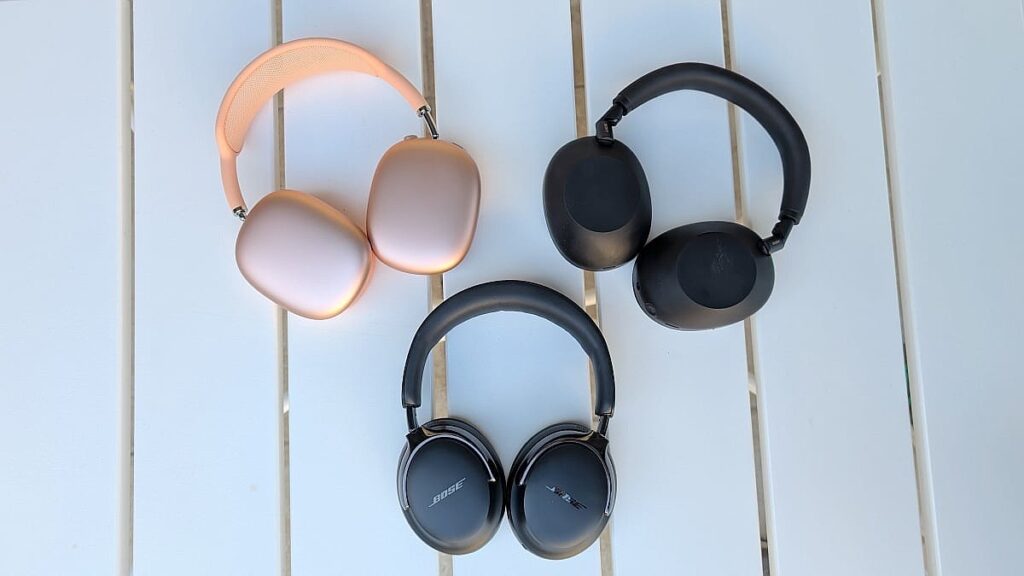
I compared the second-gen Bose QC Ultra Headphones to my Sony XM6 and AirPods Max headphones
The launch of the Bose QuietComfort Ultra Headphones (Gen 2) has sparked interest among audiophiles and casual listeners alike, especially when pitted against established competitors like the Apple AirPods Max and Sony WH-1000XM6. After extensive testing over three weeks, it’s clear that while the QC Ultra headphones come with notable enhancements, the competition remains fierce. The key areas of comparison include battery life, noise cancellation, sound performance, and usability, each of which significantly influences the overall listening experience.
When it comes to battery life, the Sony WH-1000XM6 leads the pack with an impressive 40 hours of playback time, even with active noise cancellation (ANC) engaged. In contrast, the QC Ultra headphones offer up to 30 hours, which is a step up from their predecessor but still falls short compared to Sony’s offering. Quick charging is another area where Sony excels, providing three hours of use from just a three-minute charge, while Bose’s quick charging capabilities are less impressive, yielding only 2.5 hours from a 15-minute charge. On the noise cancellation front, Bose has refined its ANC technology, making it highly effective at blocking out ambient sounds, which is especially beneficial for those working from home or in noisy environments. The Sony XM6 also performs admirably, particularly with its 20-level transparency mode that allows users to hear their surroundings clearly when needed.
Sound quality is another critical factor where both brands shine, but they approach it differently. Sony’s headphones are renowned for their powerful sound output, delivering robust bass and crisp mids, enhanced further by their proprietary audio technologies. The QC Ultra headphones, meanwhile, offer impressive clarity and a customizable EQ through their companion app, along with a unique Immersive Mode that enhances the listening experience across various content types. While both models support high-resolution audio streaming, Bose’s advancements in spatial audio make it a compelling choice for users seeking a more immersive sound experience. Ultimately, the decision between these headphones may come down to personal preferences regarding features and sound profiles. For those prioritizing advanced noise cancellation and spatial audio, the QC Ultra is a strong contender, but for overall value and functionality, the Sony WH-1000XM6 may be the better option. As for the Apple AirPods Max, they fall short in several areas, including battery life and advanced features, making them less appealing compared to the newer offerings from Bose and Sony.
https://www.youtube.com/watch?v=XS_nk34hY3c
Now that the all-new
Bose QuietComfort Ultra Headphones (Gen 2
) have officially launched, you may wonder how they compare to industry favorites like the
Apple AirPods Max
and
Sony WH-1000xM6
.
Do they sound as good as the competition? Has noise cancellation been increased? Where does battery life stand? I’m here to answer these questions, and much more.
For the past three weeks, I’ve been testing the second-gen QC Ultra to see where they rank among the trio. Time to block out all the distractions and jump right in!
Bose QC Ultra Headphones (Gen 2) vs. Sony XM6 headphones
Credit: Alex Bracetti / Mashable
It is Bose’s best versus the market’s best. On the surface, these two headphones are marginal upgrades from their predecessors. Let’s see if the QC Ultra can dethrone the XM6 as the
best headphones
overall.
Battery life:
Sony has the upper hand with the XM6 carrying up to 40 hours of playtime. ANC decreases it to 30 hours, and spatial audio sheds another 5 hours. Quick charging also goes to Sony: a 3-minute charge nets you 3 hours of use with a USB-PD compatible AC adapter. This version of the QC Ultra receives a bump in battery life (up from 24 hours to 30 hours), though spatial audio drains about 6 to 8 hours. Bose’s quick charging technology pales in comparison; a 15-minute charge for 2.5 hours isn’t exactly “quick.”
Noise cancellation:
The XM6 subdues ambient noise with ease. Bird chirping, construction sites, and emergency vehicle sirens go unnoticed. Sony’s mics do an impeccable job of filtering out these noises, as well as loud voices. But it is the 20-level transparency mode that steals the show. I was able to eavesdrop on conversations taking place across the street. All other standard noises entered loudly and clearly.
Nevertheless, the QC Ultra have unbeatable ANC. Modifications to the ActiveSense algorithm make ambient noise sound more natural. Bose’s adaptive noise cancellation is on point and removes background fracas at a ridiculously high level, no matter the environment. My toddler often surprised me when working from home; I couldn’t hear him calling for attention or sneaking up behind me. Nearly all outdoor noises were neutralized. Certain high-frequency sounds (e.g., sirens, whistles) were audible, but none broke my concentration.
Sound performance:
Sony has the best-sounding headphones money can buy, thanks to powerful drivers and proprietary technologies that strengthen sound output. Expect robust bass right out of the box, along with crisp mids and striking highs. Turning on the
DSEE
feature raises fidelity on music tracks. LDAC codec support means high resolution over Bluetooth when streaming content on Android devices. The 360 Reality Audio format delivers convincing 3D effects to enjoy select content. In addition, Sony’s multiple well-engineered presets in the EQ setting complement their assigned categories.
The Bose app allows you to customize the EQ settings for the QC Ultra.
Credit: Alex Bracetti / Mashable
Audio quality is satisfying on the QC Ultra. Clarity and high-end delivery have been improved. Qualcomm’s aptX Adaptive codec creates wireless hi-res sound on Android devices. There is a customizable EQ with four presets in the companion app. USB-C lossless playback produces clearer audio (this feature is absent on the XM6). Then comes Bose’s universal spatial audio format: Immersive Mode. It’s a game-changer that works with
all
stereo content. You’re not restricted to Dolby Atmos like most other headphones. Immersive Audio brings a truer sound presence to anything you play, be it a Napster-ripped MP3 file, Spotify track, or action movie.
Usability:
You won’t have issues connecting to Android, iOS/macOS, or Windows. Bluetooth 5.4 with dual-device pairing allows each set of cans to connect to two different platforms at the same time. Sony grants more ways to operate the XM6 via motion, physical, touch, and voice controls. All work flawlessly. The QC Ultra’s advanced controls (e.g., capacitive volume rail, voice activation) work exceptionally well, but their multifunctional buttons often struggle to register input. The biggest differentiator is special features, which the XM6 crush. We’re talking everything from a 10-band EQ to auto-adjust volume settings and upscaling audio technologies. The QC Ultra have a much smaller feature set. Standouts include multiple ANC profiles and a sidetone setting to hear your voice louder on calls.
Should you buy Bose QC Ultra Headphones (Gen 2) or Sony XM6 Headphones?
It’s a tough call since they share the same MSRP: $449. Overall, the XM6 get you more functionality for your dollar. If extras like touch and smart voice controls aren’t essential, then the QC Ultra are well worth the look based on their clearer voice calling, prime spatial audio, and slightly higher ANC.
Bose QC Ultra Headphones (Gen 2) vs. Apple AirPods Max
Credit: Alex Bracetti / Mashable
Both are practically director’s cuts of the originals. Upgrades are minimal, but noteworthy. The biggest question you should be asking is which headphones are more futureproof?
Battery life:
Apple left playtimes unchanged: 20 hours. That is with ANC on and off. USB-C charging has been employed this time around. Meanwhile, Bose upped the QC Ultra’s battery life from 24 to 30 hours. Where Apple has Bose beat is quick charging. The AirPods Max can generate 1.5 hours of playtime on a 5-minute charge, whereas the QC Ultra require 15 minutes to achieve 2.5 hours of listening time.
Noise cancellation:
Bose refined its digital signal processing to increase noise reduction. I couldn’t tell much difference between this version and the previous. All I know is that the new QC Ultra delivers class-leading ANC capable of eliminating close to 90 percent of unwanted sounds. Quiet Mode demonstrates top-tier ambient listening for increased situational awareness.
The AirPods Max’s noise cancellation remains the same. It silences a high number of low- and mid-frequency sounds, but it struggles with high-frequency sounds. Apple’s Transparency Mode is still an excellent choice for hearing ambient sounds and conversations. If only Apple added its newest listening modes from the
AirPods Pro 2
and
AirPods Pro 3
: Conversation Boost, Hearing Aid, and Live Translation.
You can choose from multiple sound modes in the Bose app.
Credit: Alex Bracetti / Mashable
Sound performance:
Both models have enticing sound profiles. They also come with adaptive sound technologies that tailor audio to your hearing, plus spatial audio and USB-C lossless playback. I favor the QC Ultra for their richer sonic presence.
Bose’s CustomTune feature adjusts sound to your ear shape and balances output, while minimizing distortion. It handles high frequencies better than Apple’s adaptive EQ. Lossless audio is equally great. Apple’s Personalized Spatial Audio mode creates immersive sound and places effects precisely on the soundstage for a theater-like listening experience. However, Bose’s Immersive Mode produces stellar spatial mixes and works with all stereo content.
Usability:
The QC Ultra are more platform-friendly and easily connect to Apple and Android devices; the latter takes advantage of one-tap Google Fast Pair. Furthermore, they run on the latest Bluetooth version (5.4) and support dual-device pairing. Bose’s multifunctional buttons don’t always register input. Luckily, its capacitive volume rail and voice assistance are reliable.
The AirPods Max instantly connect to all Apple devices. You can manually pair them to an Android device, but the process isn’t as seamless as it is with other headphones. Nothing beats Apple’s “Hey Siri” voice activation for hands-free voice commands. Lastly, there’s the cool-looking digital crown (aka the dial) that provides accurate playback and volume control.
Should you buy Bose QC Ultra Headphones (Gen 2) or Apple AirPods Max?
Buy the Bose QC Ultra because they are cheaper than the AirPods Max and superior in multiple categories (e.g., ANC, battery life, connectivity, sound). Not to mention the QC Ultra have been updated with modern specs that will keep the headphones fresh for the next 2 to 3 years. The AirPods Max are outdated in several areas.
So, are the Bose QC Ultra Headphones (Gen 2) really worth buying?
Credit: Alex Bracetti / Mashable
Only if you want the absolute best noise cancellation and spatial audio.
Ideally, you could save up to $350 by looking into the
best budget headphones under $100
, some of which offer impressive ANC, playtimes, and sound quality. Just don’t expect grade-A performance.
In conclusion, the QC Ultra Headphones are the go-to for noise cancellation and spatial audio, while Sony’s XM6 headphones are a greater value that meets all marks. Skip the AirPods Max completely.