The Old Guard Is Not Gone Yet
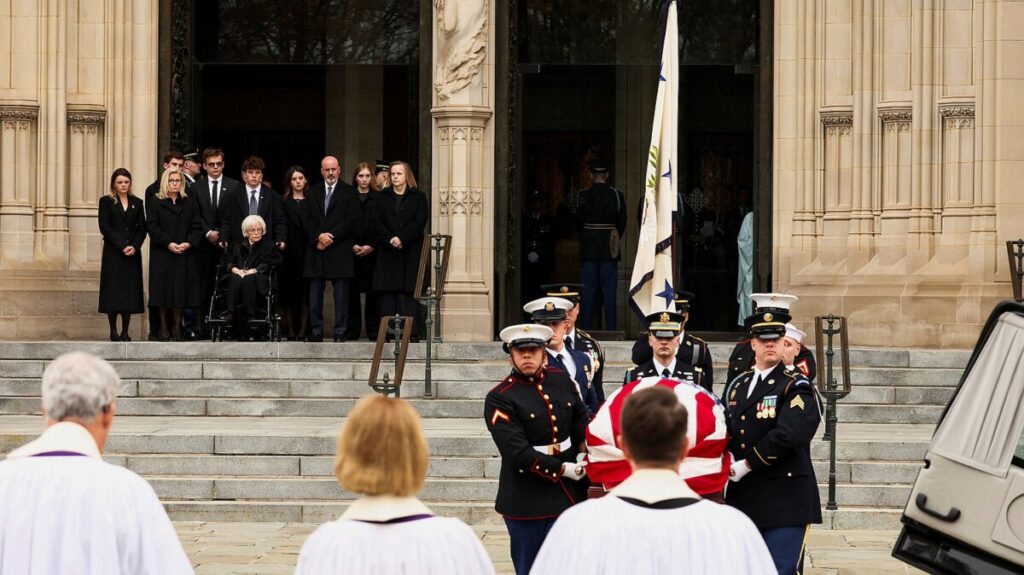
In a striking reflection of the shifting dynamics in American politics, Rachel Maddow was spotted at Dick Cheney’s funeral alongside notable figures like Anthony Fauci and James Carville, underscoring the unusual alliances that have emerged in the Trump era. Cheney, the 46th Vice President of the United States, was remembered at a service held at the National Cathedral, attended by a bipartisan assembly of political heavyweights, including former Presidents George W. Bush and Joe Biden, as well as congressional leaders from both sides of the aisle. The gathering was particularly notable for the conspicuous absence of former President Donald Trump and current Vice President J. D. Vance, both of whom were not invited, highlighting the deep rifts within the Republican Party stemming from Trump’s contentious relationship with Cheney and his family.
During the eulogies, Cheney’s daughter, Liz, delivered poignant remarks that captured the essence of her father’s character and values. She shared personal anecdotes, including cherished road trips where Cheney was both a strict critic and a supportive figure, emphasizing his commitment to family and public service. Liz’s tribute also subtly critiqued the current political climate, suggesting that for her father, loyalty to the Constitution outweighed partisan allegiance. The funeral served not only as a farewell to a complex political figure but also as a moment of reflection on the state of American governance, where the respect for civil service, once a unifying principle, now feels increasingly fragile. As speakers reminisced about Cheney’s legacy, they conveyed a sense of nostalgia for a time when bipartisan cooperation was more common, even as they acknowledged the current tumultuous landscape of American politics.
Ultimately, Cheney’s funeral was more than just a memorial; it was a microcosm of a divided political landscape where traditional norms and allegiances have been upended. The event highlighted the enduring significance of public service amidst a backdrop of ongoing political strife, suggesting that while the current chapter of American politics may be fraught with division, the values of duty and respect for governance still resonate with many. As attendees paid their respects, the ceremony served as a reminder that, despite the chaos, there remains a thread of continuity in the nation’s political fabric, one that cherishes the legacy of leaders like Cheney who navigated the complexities of power with a sense of duty and commitment to their country.
https://www.youtube.com/watch?v=jCji18GakZU
Here’s yet another indication that Washington has been turned upside down in recent years: I saw Rachel Maddow at Dick Cheney’s funeral and didn’t give it a second thought. She was sitting with Anthony Fauci, in the same row as James Carville.
Such is life—and death—in the Trump years. You never know who will show up to pay respects at gatherings of this sort, or what odd alliances and strange bedfellows will reveal themselves. Who gets invited and who doesn’t? Whose attendance will Donald Trump take as an act of disloyalty, or treason?
Wait, didn’t that one die during the Obama years?
This was one of those pre-Trump Washington-reunion scenes: Cheney, the not-unpolarizing 46th vice president of the United States, was memorialized yesterday before processions of power mourners at the National Cathedral. Guests included former Presidents George W. Bush and Joe Biden, former speakers of the House (John Boehner, Nancy Pelosi), Senate leaders (John Thune, Mitch McConnell), and a bipartisan gallery of lawmakers, some of them Trump’s most persistent antagonists in Congress (including the House January 6 select committee alumni Adam Kinzinger, Jamie Raskin, and Adam Schiff). Every living vice president lined the front pews of the sanctuary, except the current one, J. D. Vance, who, like his boss, was not invited.
[
Barton Gellman: What I learned about Dick Cheney
]
In the not-so-distant past, it would have been automatic for a sitting president and vice president to attend the funeral of any predecessor who died during their term. But of course, different rules apply when Trump is in the White House.
The absence of Trump and Vance was conspicuous but hardly surprising. Cheney and his family, especially his older daughter, Liz, viewed Trump as a mortal threat to the nation. Both she and her father loathed the man and were vocal in their contempt, and the feeling has been mutual. Trump, who issued no statement following Cheney’s death two weeks ago, spent part of yesterday morning menacing Democrats on Truth Social, calling Senators Mark Kelly and Elissa Slotkin, among others, “TRAITORS” and accusing them of “SEDITIOUS BEHAVIOR, punishable by DEATH!” (Happy Thursday!)
None of the eulogists at the funeral mentioned Trump, though one line from Liz’s remarks could easily be applied to her father’s unsparing critique of him. “He knew that bonds of party must always yield to the single bond we share as Americans,” Liz said of a man who had been a loyal and partisan Republican for much of his life. “For him, a choice between defense of the Constitution and defense of your political party was no choice at all.”
Liz described long car rides that she took with her father across the country in recent years. He reluctantly let her drive, as long as he could curate the soundtrack, which included John Denver, Johnny Cash, and the Carpenters (!). She described Dick in the passenger seat, wearing his Stetson and in possession of the latest
Economist
, that day’s newspapers, and a book. He could be exacting on certain topics, she recalled. If someone said that he had “flunked out” of Yale, he would correct them. “No, no, I was asked to leave,” he said, according to Liz. “Twice.”
Dick Cheney was famously quiet and reserved, in keeping with his code of western stoicism. “If any voters came hoping for a kind word and a hug,” Bush said of his old running mate, “they’d have to settle for the kind word.” If Cheney could ever be called expansive, it was in the company of his family, especially his seven grandchildren. “Dick Cheney wasn’t just my grandpa. He was my best friend,” one of them, Grace Perry, said, describing how Cheney would drive her to her rodeo competitions. “I’m pretty sure he’s the only person who ever had the title vice president turned rodeo grandpa,” she said.
[
Mark Leibovich: Dick Cheney didn’t care what you thought
]
Liz referred to the “gift of time” that Cheney had been granted with his family in his later years, something that seemed unlikely given the chronic heart troubles that he endured, including a transplant in 2012. His cardiologist, Jonathan Reiner, said that he was honored to be Cheney’s physician and friend, but not wild about being a eulogist. “No one wants a doctor who’s great at funerals,” Reiner said. He told a story about a young cardiology fellow who was attending to Cheney in 2000, and somehow did not know who his patient was. The fellow asked the soon-to-be vice president what he did for a living.
“Government work,” Cheney replied.
The congregation laughed, but there was a recurring, and important theme, here: Public service, to Cheney, was a simple and egalitarian duty. Pete Williams, the longtime NBC reporter who served as Pentagon spokesperson when Cheney was secretary of defense, recalled that he once wrote a press release that contained the word
bureaucrat
. Cheney crossed it out in favor of
federal official
.
“As the son of a man who worked for the Agriculture Department, he respected people who chose to serve their country,” Williams said of his former boss. Williams delivered this as an obvious, almost throwaway line, but it rang defiant in this time, when career civil servants have been so vilified, if not axed by DOGE.
No one tried to claim that Cheney’s respect-payers constituted a government in exile that would be ready to snap back into place if the country’s current chapter ever ends. The production felt much more vestigial than hopeful. But these big-ticket Washington funerals—bipartisan, ceremonious, patriotic—seem like momentous formalities nonetheless. Although another old-guarder had departed, his send-off at least carried a signal, however faint, for anyone who cared to take something from the observance: that, for now, something powerful still survives.


